

New Year's Eve fireworks contribute to poor air quality; crews respond to many alley and dumpster fires
PHOENIX - Thick, soupy, hazy.
That’s what the Phoenix sky looked like for the first day of 2024, amid a high pollution alert in the area.
"It’s kinda gross, and it makes it hard to breathe," said one Phoenix area resident, identified only as ‘Sara.’
"When I woke up this morning, it was smokey, and you could definitely see," said one person.
From the East Valley to the West Valley, explosions could be heard on Sunday night as fireworks rained down from the sky.
"We were actually sitting out back, me and my wife, and we were saying how it sounded like we were getting attacked," said another person.
Weather experts are citing excessive fireworks from New Year's Eve as a major contributor to the poor air quality on Jan. 1.
"New year's is actually the worst air quality day of the year," said Alex Young, Lead Meteorologist at the National Weather Service's Phoenix office. "All that smoke gets trapped closer and closer down to the surface, so that’s why the density of that smoke increases, going into the early morning hours."
Since 2014, there have been four New Year's Eve days that brought very unhealthy air quality. In comparison, only one dust storm in that timeframe has surpassed those levels.
Young said people can expect to see the smoke move slowly out of the area by the late evening hours of Jan. 1. In the meantime, Young is urging sensitive groups to avoid the bad air, if they can.
"Especially if they are doing any sort of physical activity, like running or walking," said Young. "Just limiting the time outside today."

Some blame NYE fireworks for poor air quality
The Phoenix sky looked thick, soupy and hazy for the first day of 2024, and experts say our festivities on New Year's Eve are to blame for the rather poor air quality on New Year's Day. FOX 10's Lauren Clark reports.
For fire crews, it was a busy night
For fire crews, New Year's Eve 2023 was a busy night. We were told there were 117 calls for matters such as alley or dumpster fire. That compares to about 30 or 40 such calls on an average night.
"We had fire trucks criss-crossing each other all night, putting out dumpster fires and other various small fires across the city," said Cpt. Rob McDade with the Phoenix Fire Department.
Cpt. McDade said calls were ringing off the hook from 5:00 p.m. on Dec. 31 to 5:00 a.m. on Jan. 1.
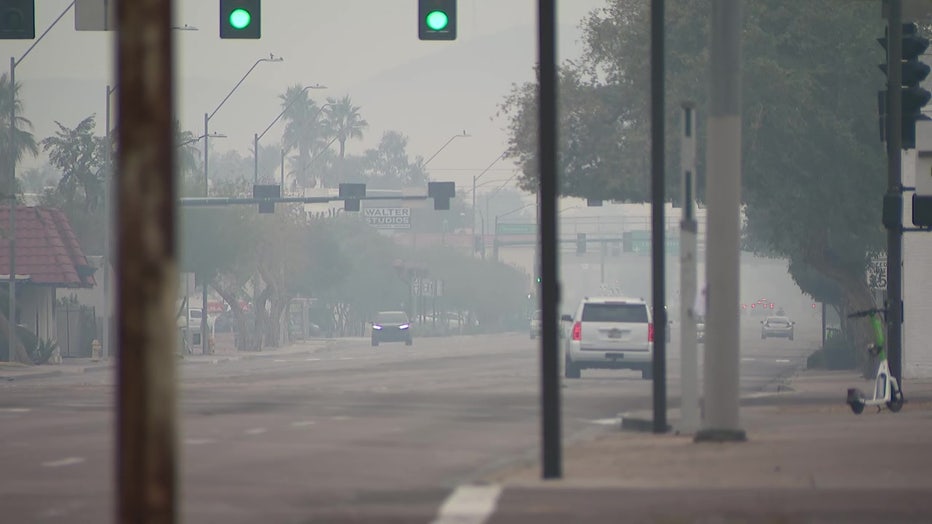
Smog on New Year's Day along a street in Phoenix