

Valley fever test: Patient calls new technology 'life-changing'

Mayo Clinic, ASU create new valley fever rapid test
ASU and Mayo Clinic developed new technology for fast Valley Fever detection. All you need to do is provide a blood sample. It's expected to be available for use later in 2025. FOX 10's Lauren Clark has more on what to know.
PHOENIX - Valley fever infects thousands of Arizonans each year as the fungus thrives in this kind of desert landscape.
Some have no idea they have it, but for others, it could be deadly.
Mayo Clinic and ASU developed cutting-edge technology to help fight back and change how the infection is detected.

(Related) Valley Fever: Deal with higher risk amid monsoon
The annual Monsoon season in the Phoenix area is set to start on June 15, and along with rain, the monsoon can also deliver a major health problem. We sat down with Dr. John Galgani with Banner University Medical Center to talk about Valley Fever.
Local perspective:
"Never even heard of it, never thought twice about it," said Chris Sams, whose infection started with a strange illness.
After losing 30 pounds, his family rushed him to the hospital for answers.
"They didn’t know what was wrong. So not understanding the treatment or how to diagnose it was a big issue in the beginning," Sams said.
It wasn’t until later that doctors finally knew what was wrong with him. He had valley fever.
It's a sickness caused by a fungal organism that lives in the Arizona soil.
When he was diagnosed, it was already serious. It eventually spread to Sams’ spine and brain, causing lasting damage.
Dig deeper:
"It can take an average of 23 days to make this diagnosis," said Thomas Grys, Director of Clinical Microbiology at Mayo Clinic of Arizona.
Why so long? He says there are many reasons.
Valley fever symptoms can look like other respiratory illnesses like COVID or a bacterial infection. Testing for Valley Fever also takes several days, which leads to a lot of misdiagnoses.
"If an urgent care or ER doc is evaluating you, they want to make a decision today. They don’t want to follow up on results that might come back later. So if they can’t get a result today, they won’t order the test," Grys said.
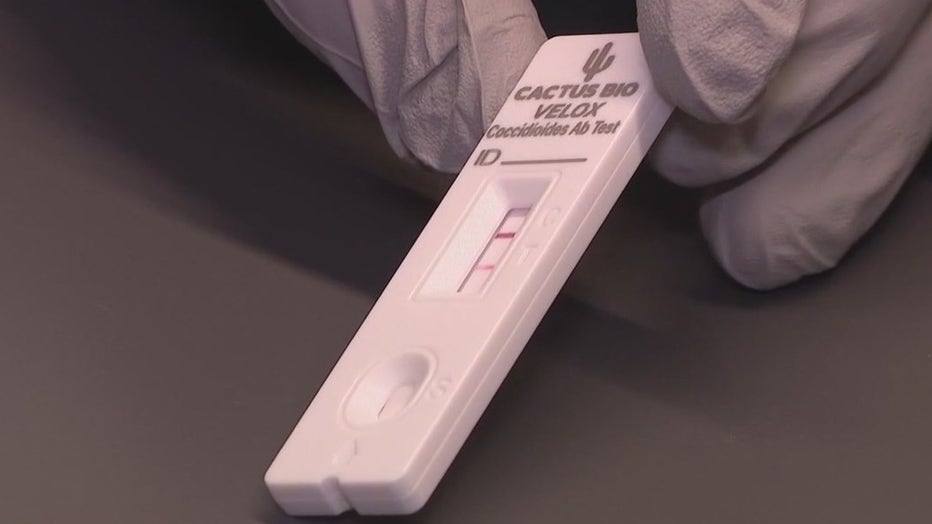
That’s why Grys worked with the team to develop a rapid test for valley fever. It’s similar to the rapid COVID tests used during the pandemic, but with blood instead of a nasal sample.
A patient has a tube of blood drawn at a doctor's office or ER, similar to a standard lab test. Ten minutes later, there’s an answer.
"The real thing is finding that answer sooner than 23 days, hopefully in that first visit," Grys said.
Big picture view:
"We are having this conversation today because of the Mayo Clinic. Because I wouldn’t be here without them," Sams said, holding back tears.
He credits Mayo Clinic for saving his life. Eight years later, he still comes every two weeks for treatment.
He believes this rapid test will change lives.
"It’s going to be life-changing, and that’s what we need it to be, life-changing," he said.
What's next:
Grys says this test also appears to work on animals, too. It’s on track to be available for use later this year.
What you can do:
Click here to learn more about the test and its research.