

Judge blocks Trump-era push for college admissions race data collection
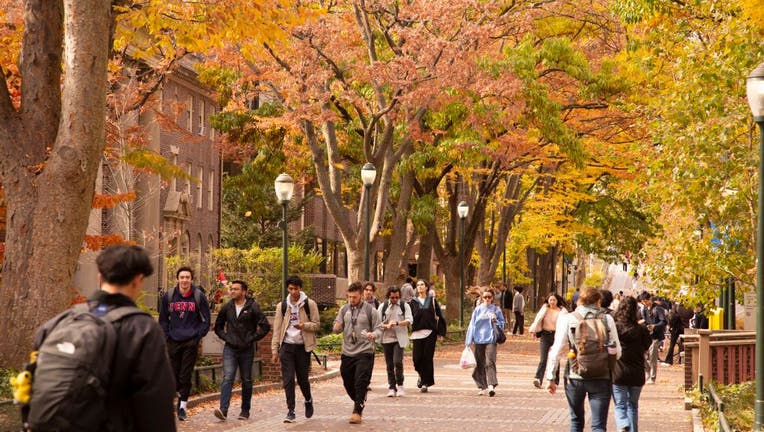
Locust Walk with students in fall, University of Pennsylvania, University City area, Philadelphia, PA, USA. (Photo by: Jumping Rocks/Universal Images Group via Getty Images)
BOSTON - A federal judge has blocked a Trump administration effort to gather data intended to show colleges are not considering race in admissions.
The ruling from U.S. District Court Judge F. Dennis Saylor IV in Boston on Friday granting the preliminary injunction follows a lawsuit filed last month by a coalition of 17 Democratic state attorneys general. It will only apply to public universities in plaintiffs.ad

SCOTUS: Race cannot factor into college admissions
The Supreme Court said Thursday that race can no longer be used as a factor in college admissions. Professor Maurice "Mo" Cayer at the University of New Haven joined LiveNOW from FOX's Josh Breslow to discuss what the ruling will do.
What they're saying:
The federal judge said the federal government likely has the authority to collect the data, but the demand was rolled out to universities in a "rushed and chaotic" manner.
RELATED: List: Bible stories proposed in Texas as required reading in public schools
"The 120-day deadline imposed by the President led directly to the failure of NCES (National Center for Education Statistics) to engage meaningfully with the institutions during the notice-and-comment process to address the multitude of problems presented by the new requirements," Saylor wrote.
The backstory:
President Donald Trump ordered the data collection in August after he raised concerns that colleges and universities were using personal statements and other proxies to consider race, which he views as illegal discrimination.
In 2023, the Supreme Court ruled against the use of affirmative action in admissions but said colleges could still consider how race has shaped students’ lives if applicants share that information in their admissions essays.
RELATED: Student loan borrowers in SAVE plan told to prepare for repayment: What to know
The states argue the data collection risks invading student privacy and leading to baseless investigations of colleges and universities. They also argued that universities have not been given enough time to collect the data.
"The data has been sought in such a hasty and irresponsible way that it will create problems for universities," a lawyer for the plaintiffs, Michelle Pascucci, told the court, adding that the effort seem was aimed at uncovering unlawful practices.
The other side:
The Education Department has defended the effort, arguing taxpayers deserve transparency on how money is spent at institutions that receive federal funding.
The administration's policy echoes settlement agreements the government negotiated with Brown University and Columbia University, restoring their federal research money. The universities agreed to give the government data on the race, grade-point average and standardized test scores of applicants, admitted students and enrolled students. The schools also agreed to be audited by the government and to release admissions statistics to the public.
Big picture view:
The National Center for Education Statistics is to collect the new data, including the race and sex of colleges’ applicants, admitted students and enrolled students. Education Secretary Linda McMahon has said the data, which was originally due by March 18, must be disaggregated by race and sex and retroactively reported for the past seven years.
If colleges fail to submit timely, complete and accurate data, the administration has said McMahon can take action under Title IV of the Higher Education Act of 1965, which outlines requirements for colleges receiving federal financial aid for students.
The Source: The Associated Press contributed to this report. The information in this story comes from a federal court ruling issued by U.S. District Court Judge F. Dennis Saylor IV in Boston, along with details from the lawsuit filed by 17 Democratic state attorneys general. This story was reported from Los Angeles.