

MIT scientists spot rare 'stellar cannibalism' as star slowly eats brown dwarf
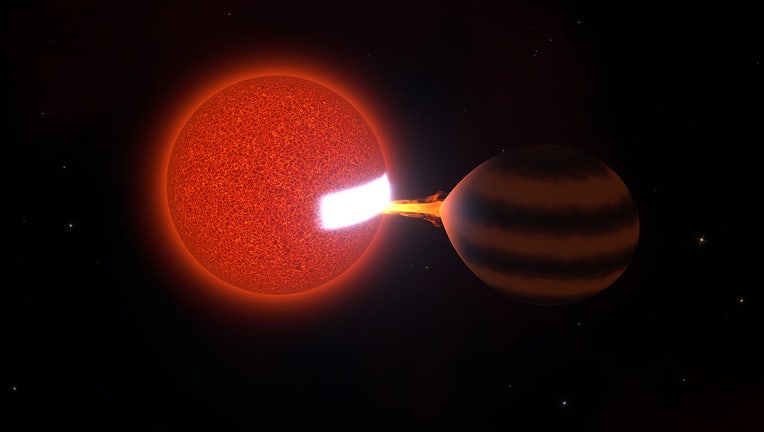
Artist's impression of ZTF J0440+2325, a brown dwarf (right) and a red dwarf (left) that orbit each other every 86.65 minutes. The brown dwarf overflows onto its companion, and the stream of material strikes the surface of the red dwarf, heating a la
Scientists have discovered a star that is slowly "snacking" away at a nearby brown dwarf (too small to be a star but bigger than a planet) in an act astronomers have called "stellar cannibalism."
Star snacking on nearby brown dwarf
Dig deeper:
Stars quickly engulfing other celestial bodies isn’t new nor is it uncommon.
However, this new discovery is the first to showcase a star slowly and steadily consuming material from another low-mass object, according to researchers at MIT.
At the rate which the star is feeding, it’ll take likely hundreds of thousands, or maybe even billions of years for it to completely consume its nearby neighbor.
What they're saying:
"When we think of stars interacting with planets or brown dwarfs, the picture is always that the star eventually swallows the other thing," says Kevin Burdge, assistant professor of physics at MIT. "This is what will happen to the Earth when the sun becomes a red giant. But here, we’ve found an alternative: Instead of swallowing the thing up, the star can gradually eat it, for billions of years."
The star and brown dwarf are within the Milky Way galaxy and roughly 300 light years away from Earth.
Like eating a lot of burritos every second
By the numbers:
Scientists calculated that the brown dwarf was feeling material to the star at a rate of 1/100,000 of an Earth’s mass each year.
To compare, that’s about 40 million dump trucks’ worth of material, or roughly 1.3 trillion one-pound burritos every second.
What's next:
Researchers hope to find other examples of slow-feeding systems nearby.
The Source: Information for this article was taken from an MIT news release published on Oct. 5, 2026. This storyw as reported from San Jose.