

Valley Fever: ASU, Mayo Clinic team up to develop new test

Valley Fever: ASU, Mayo team up for fast test
Emergency rooms and urgent care facilities in Phoenix are one step closer to having a 10-minute test for Valley Fever. FOX 10's Steve Nielsen has more on the collaboration between ASU and Mayo Clinic.
PHOENIX - Emergency rooms and urgent care facilities in the Phoenix area are one step closer to having a new Valley Fever test on hand, thanks to the Arizona State University and the Mayo Clinic.
What is Valley Fever?
Big picture view:
According to the Cleveland Clinic's website, Valley Fever is a fungal infection in a person's lungs, and it can be contracted by breathing in a fungus called Coccidioides.
"The fungus lives in the soil in the southwest U.S., parts of Washington state and in Central and South America," read a portion of the website.
Cleveland Clinic officials say the infection is most common in Arizona and California, and that about 20,000 people get it each year.
"The spores can be inhaled, and once they're inhaled, then the fungus transforms in your lung and causes, usually, pneumonia," said Doug Lake with Arizona State University. "They can be sick for months to years."
How does the new test work?
Dig deeper:
Using a drop of blood, the strip tests to see if the blood contains any antibodies for Valley Fever.
If it does, a line will form, like a COVID test. The process takes 10 minutes instead of weeks, which is important.
"They need to know the answer right away. If they can't find the answer right away, they're likely to prescribe the wrong drugs, which would be antibiotics. For Valley fever, that would be the wrong drug," Lake said.
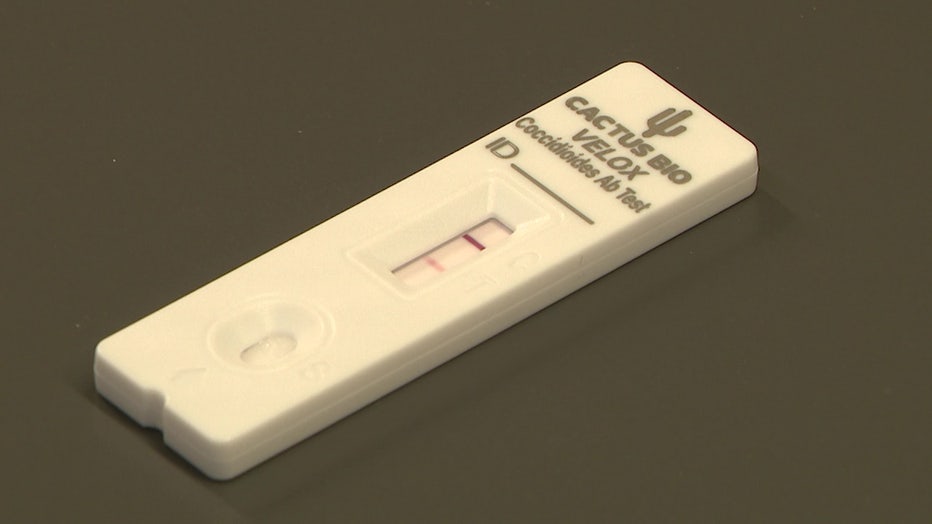
It's been 14 years since the work first began on the test.
"A lot of work from a lot of people," said Thomas Grys of the Mayo Clinic.
The team says this is an example of why research funding is important. It often can take years for research to become applicable, but they say those years were worth it.
"All of those things can help really move the needle of progress in diseases like this," Grys said.
What's left to do before the test is made available?
What's next:
The test needs to be approved, and they also need to be shipped to urgent care centers and hospitals afterwards.
Once that happens, the next goal is to get approval for a Valley Fever test reader. The reader could give clearer answers to how much of the fungus is inside someone, giving perspective to doctors on how treatments are going.
"If your levels are half of what they were before, and you're feeling better, well, it's working," Grys said.
The absolute soonest this could be seen in a hospital setting is in December.