

ASU Biodesign Institute's research could lead to earlier breast cancer detection

ASU researchers lead effort to detect, treat breast cancer
Arizona State University is leading the way in cancer research, with one group hoping to find ways to detect certain forms of breast cancer much sooner. FOX 10's Danielle Miller has this story.
TEMPE, Ariz. - Arizona State University is leading the way in cancer research, with one group hoping to find ways to detect certain forms of breast cancer much sooner.
What they're saying:
"One in eight women in their lifetime in America will experience breast cancer in one form or another. And it can be a devastating disease. We have a lot of different programs here to address that problem," said Dr. Joshua LaBaer, executive director of ASU's Biodesign Institute.
Detecting and treating breast cancer is the focus of research right now for LaBaer, his colleagues, and students at the Biodesign Institute. They are focusing on two areas in particular: early detection with blood-based biomarkers and research into triple-negative breast cancer.
"It's a disease that's missing some of the classical markers found in the most common breast cancers. That disease especially affects young women. It especially affects women of color. And it can be devastating to treat," LaBaer said about triple-negative breast cancer.
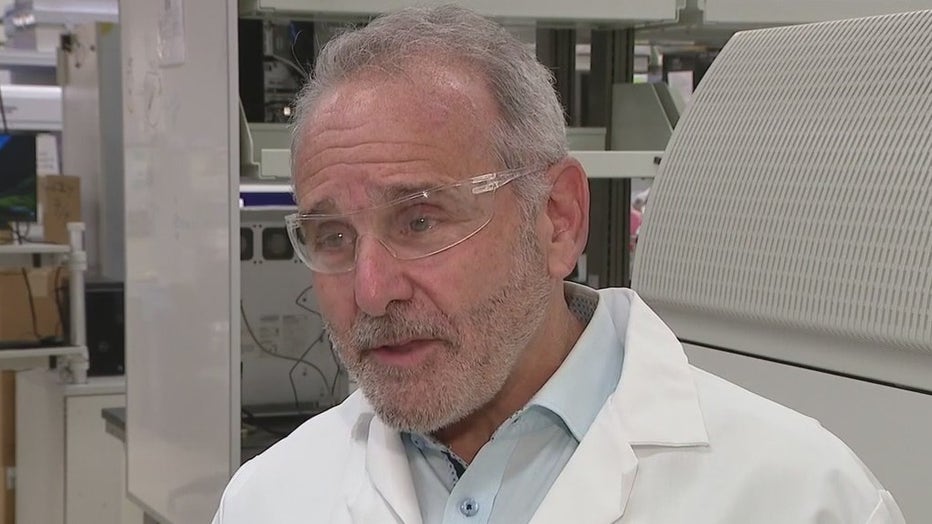
Dr. Joshua LaBaer, executive director of ASU's Biodesign Institute
Triple-negative breast cancer is difficult to treat because of its natural biology and a lack of molecules that can be used to treat it. LaBaer's lab is researching the causes of the disease to find new ways to develop drugs to treat it.
Machines in the lab are able to find molecular pathways that lead to the disease. They are going through hundreds of samples of different proteins to detect abnormalities.
"Our lab has already got a number of biomarkers for breast cancer that have held up in a prospective clinical trial, so now we're looking for ways to get companies to place these biomarkers into a blood test that they can use," LaBaer said.
CLICK HERE TO LEARN MORE ABOUT THE SYMPTOMS AND CAUSES OF BREAST CANCER
Local perspective:
The goal for the team is to help doctors intervene in time for cancer to be treated, which in turn saves more lives. This is a personal mission for LaBaer, whose mother passed away after a battle with breast cancer.
"I'm very sympathetic to all of this," he said. "If we look back at the mammogram that had been done before the one that found the cancer, and if we knew where the cancer was, we could probably find signs of it, that it was probably already there. We don't know if a blood test available at the time would have helped us catch it, but that's certainly the reason that motivates me to do this now."
The Biodesign Institute also conducts research on infectious diseases, the environment, cybersecurity, and more.