

Balance of power latest: Democrats win control of Congress in 2026 midterm elections
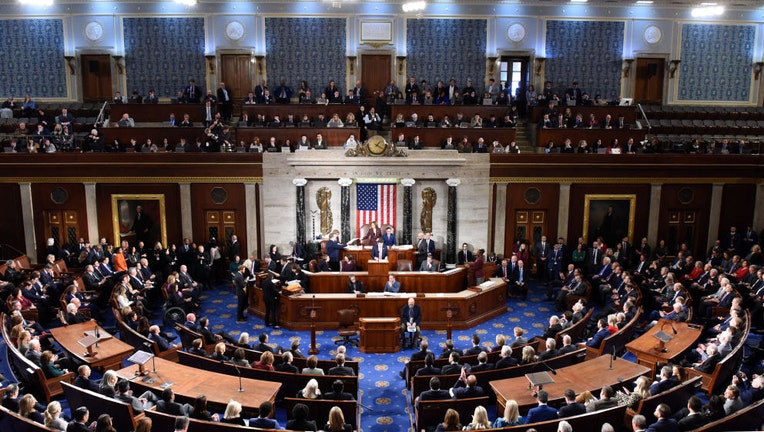
FILE-Members of Congress participate in a joint session of Congress to ratify the 2024 Presidential election at the U.S. Capitol on January 6, 2025 in Washington, DC. (Photo by Chen Mengtong/China News Service/VCG via Getty Images)
Democrats have won control of Congress in the 2026 midterm elections.
The political party flipped roughly seven Senate seats in red states and battleground states: Kansas, Iowa, Texas, Ohio, Maine, North Carolina and South Carolina. And Democrats held on to seats in the battleground states of Georgia and Michigan.
RELATED: Hakeem Jeffries set to make history as first Black house speaker
In the House, Democrats flipped over two dozen districts, some that voted for
President Donald Trump by double digits in 2024, according to The Associated Press.
2026 midterm election race results we know
What we know:
The 2026 midterm elections delivered major victories for Democrats nationwide with the results marking a series of historic firsts as candidates from underrepresented communities won some of the country’s highest offices.
Georgia
Democrat Keisha Lance Bottoms was elected governor of Georgia on Tuesday, making history as the first Black woman to be elected governor in the United States, defeating Republican businessman Rick Jackson.
Texas
Gina Hinojosa was elected the first Democratic governor of Texas in more than 30 years, ousting Republican incumbent Greg Abbott.
RELATED: Democrats win House and Senate - what this means for Trump's final two years
Michigan
Democrat Abdul El-Sayed has defeated Republican Mike Rogers in the race for Michigan’s open Senate seat, giving the Democratic Party’s progressive wing a breakthrough victory as Democrats take control of both the House and Senate.
RELATED: Midterms mark historic firsts across several states and the nation
El-Sayed, the son of Egyptian immigrants, will become the nation’s first Muslim senator.
A former public health official who has never held elected office, he rose from a double-digit defeat in Michigan’s Democratic gubernatorial primary eight years ago to win a seat in the U.S. Senate.
Late Democratic entry Troy Jackson won Maine’s U.S. Senate seat early Wednesday, defeating longtime Republican Sen. Susan Collins, taking advantage of President Donald Trump’s deep unpopularity to dislodge an incumbent who had survived tough challenges in the past.
Ohio
Democrat Sherrod Brown defeated Republican Sen. Jon Husted in Ohio’s special Senate election and is returning to Washington. The Associated Press reported that he will serve the final two years of Vice President JD Vance’s Senate term and work alongside Republican Sen. Bernie Moreno.
Iowa
Democratic U.S. Senate candidate Josh Turek just handed Democrats a major prize in their
drive to win back control of the Senate. The state lawmaker defeated Republican Ashley Hinson in Tuesday’s election, flipping the Senate seat left open by outgoing Sen. Joni Ernst, who did not seek re-election.
Nevada
The Associated Press reported that Democrat Aaron Ford won election Wednesday as governor of Nevada, defeating Republican incumbent Joe Lombardo. Ford, the attorney general, defeated the incumbent Lombardo in what was considered one of the country’s most competitive governor’s races.
Iowa
Iowa voters selected Democrat Rob Sand to be the state’s next governor, flipping the seat Republicans have held for nearly two decades and ushering in a new era of divided state government. Sand defeated Zach Lahn, a first-time candidate.
Kansas
Kansas voters have elected their first Democratic senator since the Great Depression. The Associated Press has declared Adam Hamilton the winner of the state's Senate race. The Methodist megachurch pastor ousted incumbent Sen. Roger Marshal in a state that President Donald Trump won by 16 points two years ago.
New Hampshire
U.S. Rep. Chris Pappas defeated former U.S. Sen. John E. Sununu in New Hampshire on Tuesday, keeping a critical open U.S. Senate seat in the hands of Democrats as they regained control of the chamber.
Midterm election race results we don’t know
What we don't know:
Several races for Senate and governor have not yet been called by The Associated Press on Wednesday.
In the House, 59 races where party control of the seat is at stake also have yet to be called. Here’s the latest on races that are undecided.
Mississippi
In Mississippi's Senate race, Democrat Scott Colom has a lead of a few dozen votes over Republican Sen. Cindy Hyde-Smith. Mississippi does not have an automatic recount process, but a challenger can seek a court order for one.
Alaska
The Associated Press has also not called Alaska’s Senate contest between incumbent Republican Dan Sullivan and Democrat Mary Peltola, who has a 626-vote lead over Sullivan with an estimated 74% of votes counted. Under Alaska law, if neither candidate gets more than 50% of the vote then it goes to ranked-choice tabulation.
Also in Alaska, Democrat Jonathan Kreiss-Tomkins has a 20-percentage point lead over Republican Bernadette Wilson in Alaska’s governor’s race. Kreiss-Tomkins had 49.2% of the vote with an estimated 74% of the ballots counted.
Like the Senate contest, the governor's election advances to another round if no candidate gets more than 50% of the votes.
Kansas
In Kansas, Democrat Cindy Holscher has less than a percentage point lead over Republican Ty Masterson in the Kansas governor’s race. Holscher’s 5,557 vote lead with an estimated 98% of votes counted comes after Democrat Adam Hamilton became the first member of his party to win a Senate seat in nearly a century.
What control of Congress means for Democrats
Big picture view:
With control of the House and the Senate, the Democrats gain control of the entire legislative branch of the federal government, giving them more leverage in budget negotiations and the ability to block Cabinet and judicial nominations, including those to the U.S. Supreme Court.
Supreme Court confirmations
Dig deeper:
Democratic control of the Senate will likely change the tone of confirmation hearings for any potential Supreme Court nominees if a vacancy does arise. President Donald Trump’s previous nominees all went before a Senate controlled by the GOP, meaning Democrats could raise concerns about a nominee, but they could not block the nomination without support from Republican senators.
What those confirmation hearings may look like will remain to be seen. All recent Supreme Court justices have been confirmed by a Senate controlled by the same party as the president who nominated them. The last time a Senate controlled by the opposing party signed off on a nominee was in 1991, when a Democratic-controlled Senate confirmed Justice Clarence Thomas, who was nominated by former President George H.W. Bush and is now the longest-serving justice on the current bench.
One path Democrats could take may trace itself back to 2016 when former President Barack Obama, a Democrat, nominated then-federal judge Merrick Garland to serve on the Supreme Court, but the Republican-controlled Senate refused to consider the nomination, arguing that they should wait until that fall’s presidential election.
Potential investigations
What's next:
After taking control of the House during Trump’s first term, Democrats launched a series of investigations that culminated in the president’s impeachment and subsequent trial. They went on to impeach Trump a second time, for the Jan. 6, 2021, attack on the U.S. Capitol, shortly after retaining control of the House in the 2020 election.
While the Senate does not have the power to impeach, it does have subpoena power and the ability to launch its own investigations. Some Democratic candidates called for investigations into Trump or members of his administration if their party took control of Congress. How far the party is willing to go down that route will remain to be seen.
The Source: Information for this story was provided by previous FOX Local reporting and The Associated Press. This story was reported from Washington, D.C.