

Maricopa County Public Health: Different COVID-19 tests answer different questions
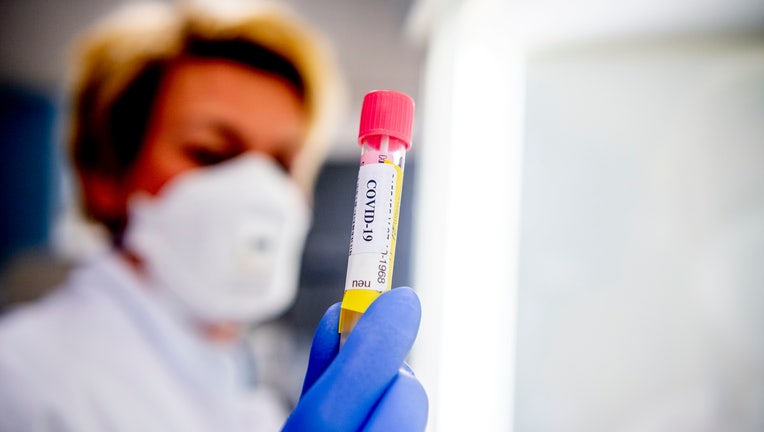
A lab technician holding a test tube that contains blood sample from a patient that has tested positive with the COVID-19 coronavirus. (Photo by Robin Utrecht/SOPA Images/LightRocket via Getty Images)
PHOENIX - Officials with Maricopa County Public Health talked about the different tests that are currently being offered on COVID-19.
In an e-mail released Thursday afternoon, officials say the two main types of COVID-19 tests answer two different questions.
"The two main questions people want to know are, am I sick with COVID-19 right now, and have I had it already," said Dr. Rebecca Sunenshine, Medical Director for Disease Control at Maricopa County Department of Public Health, in the statement. “The first question is easier to answer, but you need the right type of test to answer that specific question."
Officials say the two main types of tests currently available, a PCR (Polymerase Chain Reaction) Test is used to determine if someone is currently infected with COVID-19, while a Serology Test is used to determine if someone has been infected with COVID-19 recently, or in the past.
PCR Test
County Health officials say PCR Tests have been available since the start of the pandemic, is used by most healthcare providers to diagnose COVID-19, and is reported to the County Public Health Department for their daily numbers of confirmed cases.
Officials say the test determines if someone is infected with COVID-19 by detecting the genetic material of the disease.
Serology Test
Health officials define a Serology Test as an antibody testing that looks for antibodies created by the body, in order to determine if someone was recently infected, or infected in the past.
"Because it takes some time for the body to develop these antibodies, it is not as reliable for diagnosing active infection or for making clinical recommendations for care," read the statement.
County Health officials also say there is not enough information about the test yet to know if a positive Serology Test means someone definitely had COVID-19 in the past, because the test may also detect antibodies to related, but different strains of the coronavirus that causes the common cold.
"It’s like seeing someone at a party who at first glance you think is your friend, but then it turns out to be their cousin who just looks really similar," said Dr. Sunenshine, in the statement.
LIVE: Interactive Coronavirus case data and map
FULL COVERAGE: fox10phoenix.com/coronavirus
FOX 10 is working to keep you up to date with local and national developments on COVID-19. Every weekday on FOX News Now, our live coverage begins at 7 a.m. MST reporting the latest news, prevention tips and treatment information.
You can watch live in your FOX 10 News app or on the FOX 10 Facebook page.
Get the latest coronavirus news by downloading the FOX 10 News App. Our promise is that our alerts are there to inform you - not scare you.
You can also get the latest coronavirus news from around the country at coronavirusnow.com.
Additional resources
Coronavirus (COVID-19) - How it spreads, symptoms, prevention, treatment, FAQ
https://www.cdc.gov/coronavirus
https://espanol.cdc.gov/enes/coronavirus/2019-ncov/index.html (In Spanish/En Español)
Arizona COVID-19 Response - Public resources, FAQ, webinars
https://www.azdhs.gov/coronavirus
https://www.azdhs.gov/preparedness/epidemiology-disease-control/infectious-disease-epidemiology/es/covid-19/index.php#novel-coronavirus-home (In Spanish/En Español)
In order to protect yourself from a possible infection, the CDC recommends:
Avoid close contact with people who are sick.
Avoid touching your eyes, nose, and mouth.
Stay home when you are sick.
Cover your cough or sneeze with a tissue, then throw the tissue in the trash.
Clean and disinfect frequently touched objects and surfaces using a regular household cleaning spray or wipe.
Wash your hands often with soap and water for at least 20 seconds, especially after going to the bathroom; before eating; and after blowing your nose, coughing, or sneezing.
Related Stories
Coronavirus: What to do if you’re told to self-quarantine
Does wearing a face mask protect you from coronavirus and other infectious diseases?
Social distancing: What to do and what not to do to slow the spread of COVID-19