

New study reveals what, exactly, in human body odor attracts mosquitoes
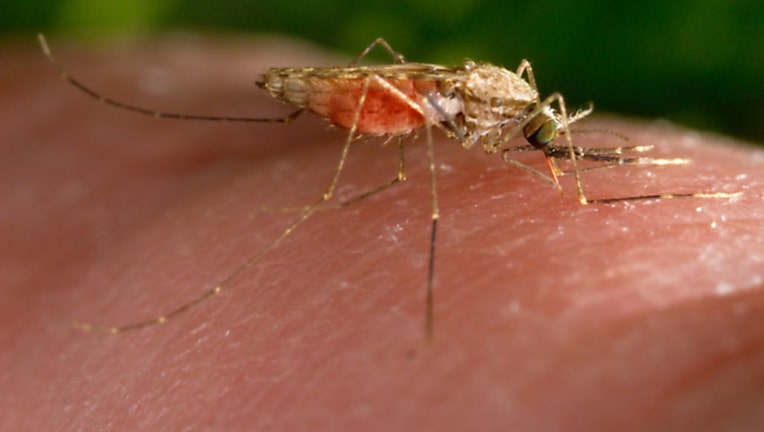
FILE - Anopheles gambiae mosquito feeding on a human host, close-up view, 2004. (Photo by Smith Collection/Gado/Getty Images)
For many, summer means picnics, pools, grilling, and swatting away those pesky mosquitoes as the sun sets. The insects always seem drawn to certain people over others, and it’s known that human scent plays a role.
In a new study, published on May 19 in Current Biology, researchers sought to better understand what, exactly, in human odor is more attractive to mosquitoes – and what seems to deter them.
The study focused on Anopheles gambiae, the African malaria mosquito, using an ice-rink-sized outdoor testing arena in Zambia. Malaria is a life-threatening disease primarily found in tropical countries. Typically, people contract it by being bitten by an infected female Anopheles mosquito.
It’s both preventable and curable – but without prompt diagnosis and effective treatment – a case can progress to a severe form of the disease, which can turn fatal, according to the World Health Organization.
Malaria has largely been eliminated from many developed countries with temperate climates, including the United States. But it remains a major health problem in many developing countries – particularly in African countries south of the Sahara, according to the U.S. Centers for Disease Control and Prevention, citing a lack of resources and political instability that can prevent the building of solid malaria control programs.
In 2021, roughly 247 million people contracted malaria across 85 countries and approximately 619,000 died, according to the World Health Organization.
Mosquitoes ‘consistently’ choose same human scent
The study team, led by Dr. Conor McMeniman with the Johns Hopkins Malaria Research Institute in Baltimore, tested mosquito behavior under "naturalistic conditions."
They used a structure called a semi-field flight cage, or a screened structure with a volume of around 1,000 cubic meters, and compared six human scents. The team pumped the scent of humans sleeping in nearby tents into the cage to analyze mosquito landing behavior on targets heated to human skin temperature, McMeniman explained in a post about the study.
"The most interesting part of this study was that mosquitoes consistently, night after night, would choose the same human scent and not prefer some humans," McMeniman explained.

The semi-field flight cage, or a screened structure with a volume of around 1,000 cubic meters, is pictured. Photo credit: Provided / Johns Hopkins Malaria Research Institute / Macha Research Trust
The team found they were most attracted to those whose skin contained a large makeup of airborne carboxylic acids, which are oily secretions that hydrate and protect our skin, according to Science. The outlet reported that two of these carboxylic acids are also found in Limburger cheese, a stinky cheese known to lure mosquitoes.
Meanwhile, the mosquitoes seemed to be less attracted to human scents that were depleted of airborne carboxylic acids and contained lots of a compound known as eucalyptol, which the team suspected was likely derived from the individual’s plant-based diet.
The team said such information could help develop imitations of human scent that could be used as baits or lures in mass trapping efforts to control malaria.
McMeniman said the team is planning to conduct a large-scale screen of 100 to 120 humans in the next few years in Zambia.
"This work is being coupled in my laboratory with a higher-detail understanding of what we call the human volatilome, which is all of the chemical emissions emitted by the human body," McMeniman said. "We hope that by characterizing variability in the scent signature between humans, we can gain a high-resolution understanding of how we smell as humans and why we're so attractive to various bloodsucking insects."
The team also hopes to develop a similar system for mosquitoes found within the U.S. that pose risks to public health, including Culex mosquitoes, which transmit West Nile virus, and Aedes aegypti and Aedes albopictus, which are competent vectors for dengue and Zika.
Could certain soaps make you more or less attractive?

New York's mosquito problem: Schumer urges action from EPA, CDC
2021 video: Senate Majority Leader Chuck Schumer announced a push to zap one of the worst mosquito seasons in New York in a video dated September 19, 2021.
A separate study, conducted by researchers at Virginia Tech and published on May 10 in the journal iScience, suggested that certain soaps and scents may also make one more or less attractive to the insects.
However, the effects vary between people – and the researchers reaffirmed the idea that each person’s unique human scent also plays a role.
The research team used female Aedes aegypti mosquitoes for the study, which only feed on blood after mating – compared to males, which feed exclusively on nectar. This species of mosquito is a known vector of several viruses, including yellow fever, dengue, chikungunya, and Zika.
In this study, four human volunteers' chemical odors were studied both when unwashed, and after they had washed themselves with each of four brands of soap: Dial, Dove, Native, and Simple Truth.
The team also analyzed the odor profiles of the soaps themselves.
Soap-washing was found to impact the mosquitoes’ preferences, but this differed between soap types and the human volunteers. Washing with Dove and Simple Truth increased the attractiveness of some – but not all – volunteers, while washing with Native soap tended to repel mosquitoes.
"It's remarkable that the same individual that is extremely attractive to mosquitoes when they are unwashed can be turned even more attractive to mosquitoes with one soap, and then become repellent or repulsive to mosquitoes with another soap," senior study author and neuroethologist Clément Vinauger said in a statement.
This story was reported from Cincinnati.