

Atlantic hurricane season 2026: Here's Colorado State University's tropical forecast
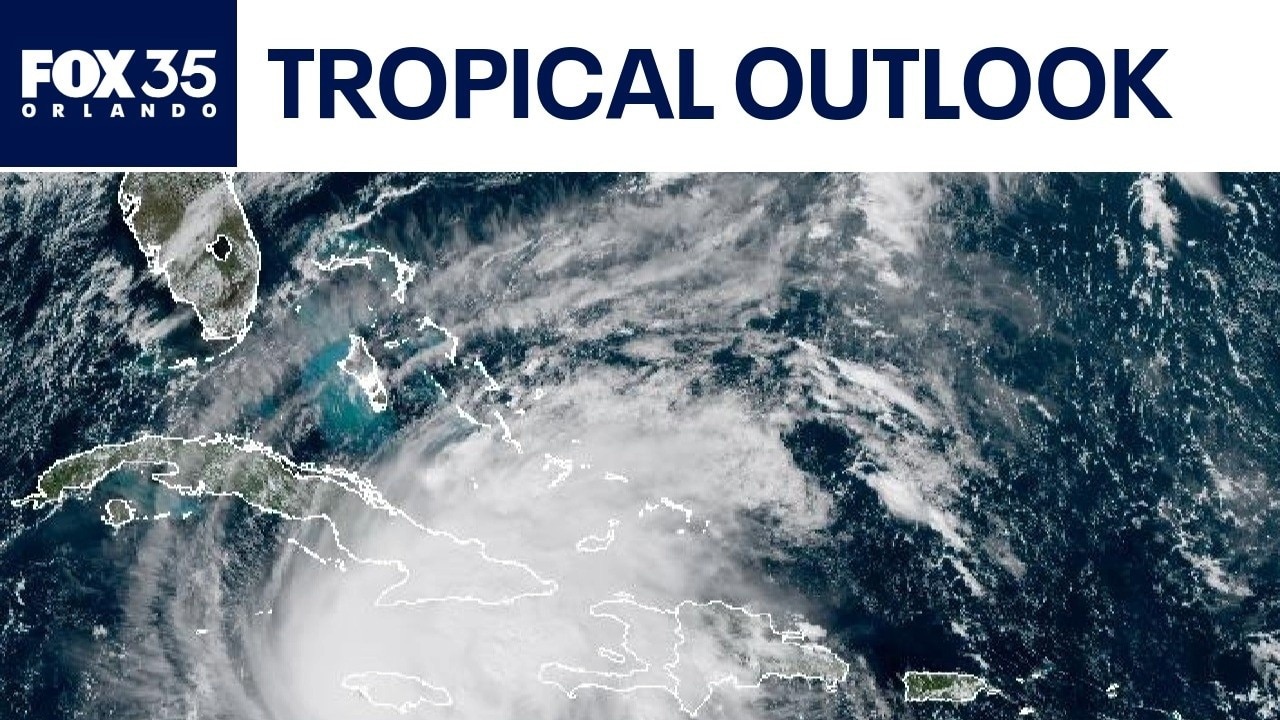
CSU hurricane season forecast explained | FULL
Colorado State University released its first forecast for the 2026 Atlantic hurricane season. FOX 35 meteorologists Noah Bergren and Laurel Blanchard explain the forecast, what it means, what we know, don't know, and changed to the tropical forecast zone.
The start of the 2026 Atlantic hurricane season is less than two months away, and Colorado State University has released its first forecast for the upcoming season.
CSU is predicting a "somewhat below-average" hurricane season, citing a "robust" El Niño pattern as the dominating factor.
How many tropical storms or hurricanes could we see this year?
By the numbers:
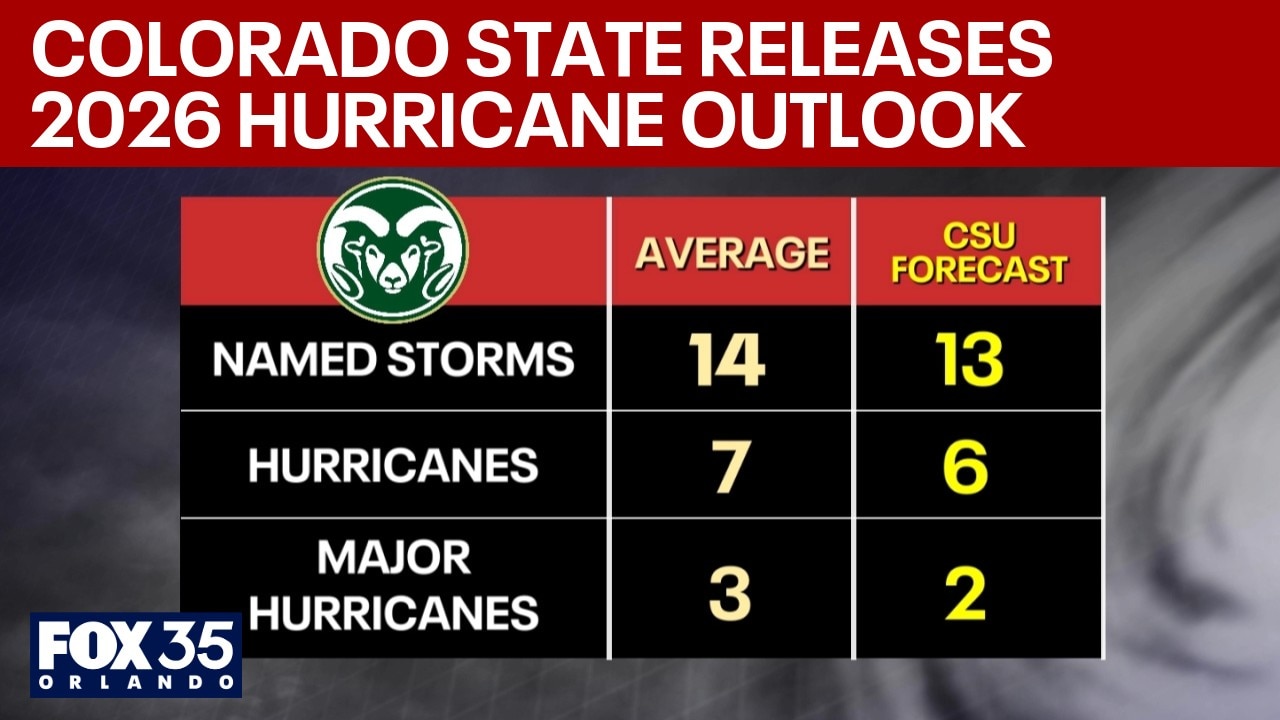
According to Colorado State University's initial predicted forecast:
- 13 named storms
- 6 hurricanes
- 2 major hurricanes (Category 3 or higher)
CSU will provide forecast updates on June 10, July 8, and August 5.
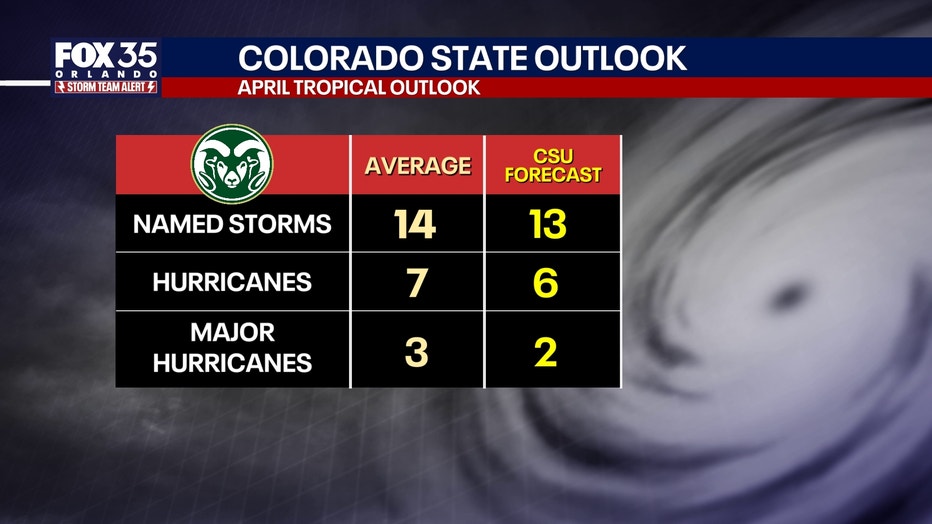
How many tropical storms or hurricanes do we see in an average season?
- 14 named storms
- 7 hurricanes
- 3 major hurricanes (Category 3 or higher)
How many storms were there during the 2025 season?
The 2025 Atlantic hurricane season ended with 13 named storms, 5 hurricanes, and 4 major hurricanes. None threatened or directly impacted Florida.
What were the 2025 hurricane season forecasts?
By the numbers:
CSU originally predicted 17 named storms, 9 hurricanes, and 4 major hurricanes.
NOAA originally predicted 13-19 named storms, 6-10 hurricanes, and 3-5 major hurricanes.
Florida hurricane season: CSU releases 2025 forecast
FOX 35's Brooks Garner explains Colorado State University's outlook for the 2026 Atlantic hurricane season. CSU is predicting a "below average" season.
What is El Niño?
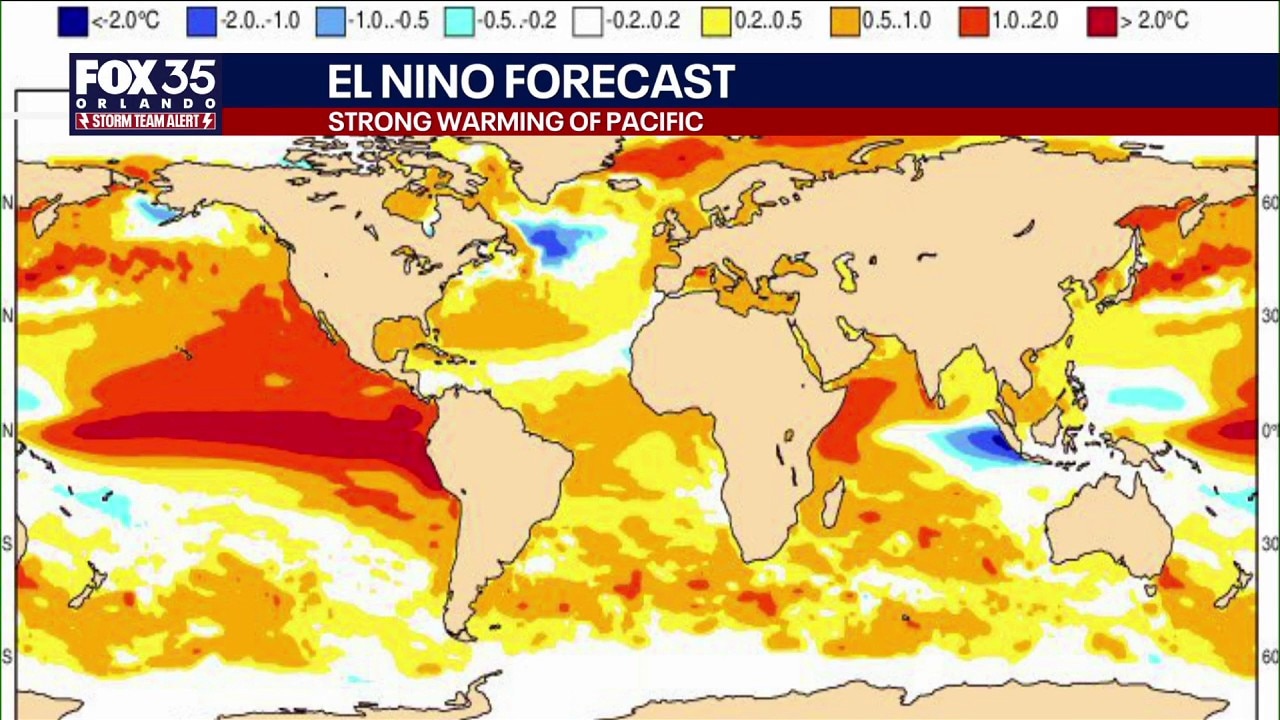
El Niño and La Niña are natural weather patterns in the Pacific Ocean that impact weather in the Atlantic – and in return, can impact the intensity of the Atlantic hurricane season.
When in El Niño, the Pacific Ocean is warmer than usual, which can impact the trade winds, leading to more wind shear in the Atlantic, which can rip apart potential tropical systems.
La Niña is the opposite. Cooler waters, which could lead to lighter winds and warmer waters in the Atlantic, two conditions needed to help support development of tropical storms or hurricanes.
What is a Super El Nino?
El Niño, but a warmer version. That happens rarely – every 20 or 30 years with anomalies of 2 degrees Celsius, which is roughly twice the threshold of a standard El Niño. This one may read 3 degrees above normal.
What happens under a Super El Niño?
- Stronger warming in the central and eastern Pacific
- A bigger shift in global atmospheric circulation
- A more powerful and displaced jet stream, influencing rainfall patterns.
- Major flooding in Peru and Ecuador
- Severe drought and fire risk in Australia and Indonesia
- Disrupted Monsoon in India
- Global temperature could increase
2026 hurricane season outlook: Conditions, names, more
Colorado State University released the 2206 hurricane season outlook, projecting the activity which is below average.
When does the Atlantic hurricane season start? How long does it last?
The Atlantic hurricane season starts each year on June 1 and runs through November 30.
2026 tropical storm names
Here are the cyclone names for the 2026 Atlantic hurricane season. There are 21 names listed each season, as well as a reserve list with additional names if needed.
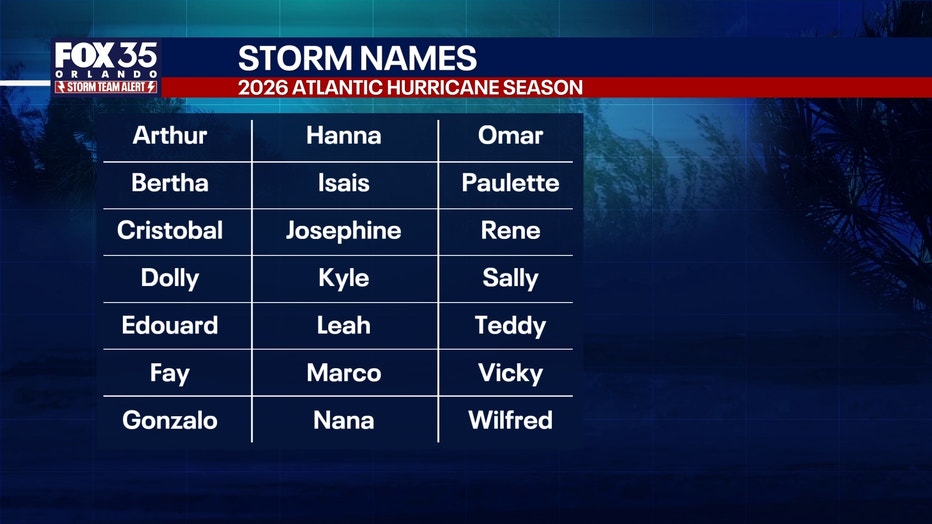
The World Meteorological Organization decides the names, which rotate every 6 years. Storm names can be retired if they're particularly destructive or deadly.
2026 storm names
- Arthur
- Bertha
- Cristobal
- Dolly
- Edouard
- Fay
- Gonzalo
- Hannah
- Isaias
- Josephine
- Kyle
- Leah
- Marco
- Nana
- Omar
- Paulette
- Rene
- Sally
- Teddy
- Vicki
- Wilfred
Prediction: How likely will a tropical storm or hurricane make landfall in the United States this year?
- 32% for the entire U.S. coastline (average from 1880–2020 is 43%).
- 15% for the U.S. East Coast, including the Florida Peninsula (average from 1880–2020 is 21%).
- 20% for the Gulf Coast from the Florida panhandle westward to Brownsville, Texas (average from 1880–2020 is 27%).
- 35% for the Caribbean (average from 1880–2020 is 47%).
How did Colorado State University come up with its prediction?
CSU said its team uses a statistical model, forecast models, and information and historical data from several agencies, to come up with its forecast.
"The team bases its forecasts on a statistical model, as well as three models that use a combination of information and predictions of large-scale conditions from the European Centre for Medium-Range Weather Forecasts (ECMWF), the UK Met Office, and the Centro Euro-Mediterraneo sui Cambiamenti Climatici. These models use 25 to 40 years of historical hurricane seasons and evaluate variables such as Atlantic sea surface temperature, sea level pressure, vertical wind shear, the ENSO phenomenon, and other factors," CSU said in its report.
Hurricane Melissa: One of the strongest Atlantic hurricanes on record
Hurricane Melissa became one of the strongest storms recorded in the Atlantic basin, reaching peak winds of 190 mph, making it a powerful, destructive, and deadly Category 5 hurricane.
That also tied the record with Hurricane Allen (1990) for sustained winds, the National Hurricane Center said in a review of Hurricane Melissa.
Hurricane Melissa decimated parts of Jamaica, Cuba, Haiti, the Dominican Republic, Bahamas, and Bermuda – and was responsible for nearly 100 deaths.
The World Meteorological Organization retired the name Melissa and replaced it with Molly. Storm names are retired when they’re especially destructive or deadly.
Can A.I. help with hurricane forecasts?
This year, for the first time, it is also using an AI-based model, called Ai2 Climate Emulator, which uses predicted sea surface temperatures from the ECMWF model.
At the end of the 2025 Atlantic hurricane season, FOX Weather's Brian Norcross examined how the various models performed, including Google's AI weather model.
The Source: Colorado State University released its 2026 prediction for the Atlantic hurricane season on April 9, 2026. Additional information on the 2025 Atlantic hurricane season from the National Hurricane Center, NOAA, National Weather Service, and the FOX 35 Storm Team.