

Man in Mississippi discovers rare mammoth tusk dating back to Ice Age
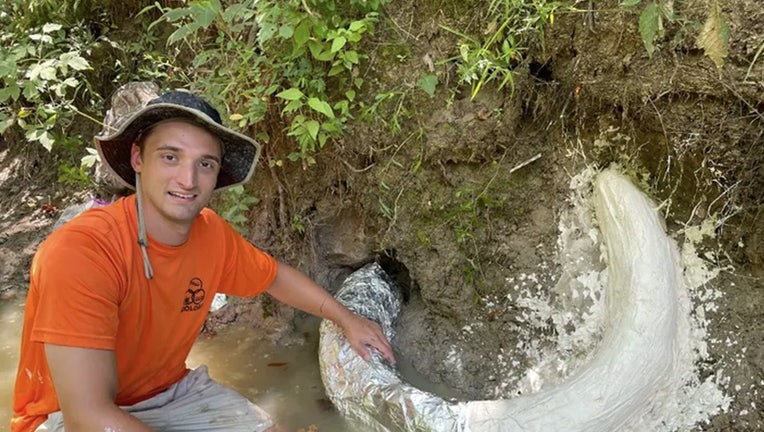
Eddie Templeton (pictured) found a portion of an Ice Age-era elephant tusk exposed in a steep embankment while exploring in Madison County, Mississippi. ( Mississippi Department of Environmental Quality )
An avid artifact and fossil collector recently came across a stunning discovery before alerting the Mississippi Department of Environmental Quality (MDEQ).
Eddie Templeton found a portion of an Ice Age-era, Columbian mammoth tusk exposed in a steep embankment while exploring in Madison County.
DEQ’s Mississippi State Geological Survey scientists worked with the Mississippi Museum of Natural Science to properly excavate and stabilize the tusk.
Templeton and the team spent an entire day cleaning the tusk to expose the 7-foot-long ivory fossil.
"It was suspected based on the strong curvature of the massive tusk that Eddie and the team were dealing with a Columbian mammoth and not that of the more common mastodon. This would be the first of its kind for the area," said a MDEQ press release.
Mississippi Museum of Natural Science paleontologists confirmed the tusk did belong to a mammoth.
"Mississippi was home to three Proboscideans during the last ice age: Mastodon, Gomphothere and the Columbian mammoth. All three possessed ivory tusks. Mastodons are by far the most common Proboscidean finds in Mississippi as they were browsers, like modern deer and inhabited a variety of different environments," said the release.
For more Lifestyle articles, visit www.foxnews.com/lifestyle.
Columbian mammoths were larger than wooly mammoths that roamed the colder, more northern regions of North America, growing up to 15 feet and weighing over 10 tons, according to the MDEQ.
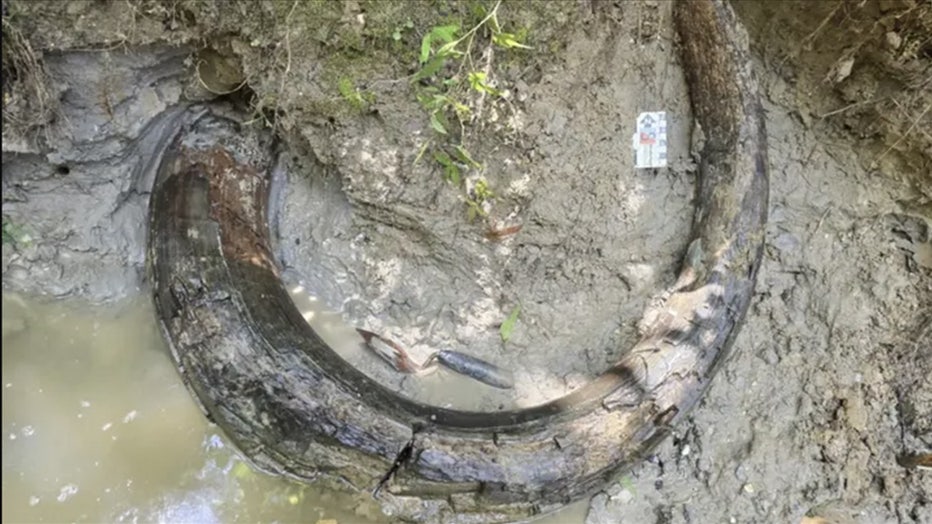
Columbian mammoths were larger than wooly mammoths that roamed the northern regions of North America, growing up to 15 feet and weighing over 10 tons, according to the MDEQ. ( Mississippi Department of Environmental Quality )
"These colossal mammals played an important role in maintaining the rich fertile prairie ecosystem, much as their modern elephant relatives do in other parts of the world today. This ice-age prairie ecosystem of what is now Madison County was also home to herds of now extinct horses and giant bison along with giant ground sloths, giant tortoises and tapirs," said the release.
Scientists created a plaster jacket by covering the fossil with aluminum foil and burlap to learn more about the animal.
"Our field scientists interpreted the mammoth tusk specimen to be leaning up against the edge of an ancient sandbar of a stream while a portion of it rest on the floor of stream channel."
CLICK HERE TO SIGN UP FOR OUR LIFESTYLE NEWSLETTER
"This would have been just before it was completely covered with alluvium entombing the fossil, possibly the result of a storm resulting in a major flooding event," said the release.
It was concluded the animal likely had died nearby, and its remains were then carried along the stream’s channel.
"Eddie’s discovery offers a rare window into the Columbian mammoths that once roamed Madison County along the Jackson Prairie of central Mississippi," said the release.
CLICK HERE TO GET THE FOX NEWS APP
Fox News Digital reached out to the MDEQ and Eddie Templeton for additional comment.