

Arizona 2026 voter checklist: Important deadlines, ID rules, and voting options
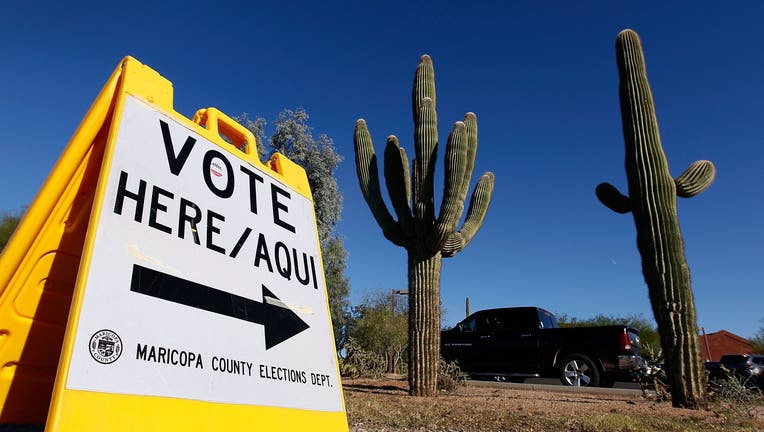
PHOENIX, AZ - A Maricopa County Elections Department sign directs voters to a polling station on November 8, 2016 in Cave Creek, Arizona. (Photo by Ralph Freso/Getty Images)
PHOENIX - The general election takes place on Nov. 3 this year, and there are several dates to keep in mind if you plan on voting in Arizona.
Registration
The last day to register to vote in this election is Oct. 5 at 11:59 p.m.
You can click here for information on how to register to vote, and you can check your voter registration status on Arizona.vote.
Requesting a mail-in ballot
Oct. 23 is the deadline to request a mail-in ballot. If you don't request a mail-in ballot, you will need to vote in person.
When registering to vote, you can choose to be on the Active Early Voting List (AEVL). That means you'd get a ballot by mail for every election you're eligible to vote in.
Click here to request a mail-in ballot.
Early voting
On Oct. 7, you can begin to vote early as early ballots are mailed out.
"Voters receive an early ballot package containing the ballot, instructions, and an affidavit envelope. After marking their choices, voters must sign the affidavit envelope, which is crucial for identity verification. Upon receipt, county officials compare the signature on the envelope to the voter's registration record. Once verified, the ballot is sent to the elections office for tabulation. This meticulous process ensures that only valid ballots are counted, maintaining the election's integrity," Arizona Clean Elections says.
Absentee voting
Federal protections guaranteed under the Uniformed and Overseas Citizens Absentee Voting Act (UOCAVA) give eligible military personnel and U.S. citizens abroad the right to vote by absentee ballot.
The federal law applies to three main groups:
- Service members in the armed forces, Merchant Marine, Public Health Service commissioned corps, or National Oceanic and Atmospheric Administration
- Family members living with an active-duty service member
- American citizens residing internationally
Eligible voters can register and request an absentee ballot in a single step using the Federal Postcard Application. The same form can be submitted to update contact details.
Voters must complete, print and sign the application before submitting it to their county recorder by mail, fax or email.
For those who do not receive a standard absentee ballot in time to meet election deadlines, the law provides an emergency backup option known as the Federal Write-In Absentee Ballot. Like the application, voters must complete, print, sign and submit this backup ballot to their county recorder using mail, fax or email.
Mailing in a ballot
If you're mailing in a ballot, it needs to be sent in no later than Oct. 27, and after that it can be dropped off at a designated ballot drop box or a polling place by 7 p.m. on Election Day.
"You should always plan to mail back your ballot at least 7 days prior to election day, to ensure it is received by the county in time. The United States Post Office recommends 7 days for returning ballots by mail, which is first class mail. Postage is pre-paid so all you have to do is drop your signed and sealed ballot envelope in the mail," Arizona Clean Elections says.
Make sure to sign your ballot before mailing it in, or else it will not be counted!
Tracking your mail-in ballot
Click here to track your mail-in ballot from the time it was sent to you, to when it's received by the county recorder's office.
Early in-person voting, poll stations & precincts
Oct. 30 is the last day you can vote early in person.
You can visit your county recorder's website for details on where early voting centers and ballot drop boxes will be open:
Emergency early voting
If you need to take part in emergency early voting, that begins at 5 p.m. on Oct. 30 and ends at 5 p.m. on Nov. 2.
Click here to find your county's elections department for more information about emergency early voting.
What to bring when you vote
"Every voter is required to show proof of identity when voting in person. After arriving to the polls to vote on Election Day, Arizona law requires voters to state your name and place of residence to a poll worker and present one form of identification from List #1, or two different forms of identification from List #2 or #3," Maricopa County Elections said. "Valid identification is also required prior to receiving a ballot at any in-person early voting location or emergency voting location or from a special election board."
List 1: One Photo ID
Present one valid government-issued photo ID that includes your name and current address:
- Arizona driver's license
- Arizona non-operating ID
- Tribal enrollment card or other official tribal ID
- Federal, state, or local government-issued ID
Note: IDs are considered valid unless clearly expired. If your photo ID address does not match your voter registration record, you must present a second ID (see List 3) or vote using a regular provisional ballot.
List 2: Two Non-Photo IDs
Present two documents that show your name and current address:
- Utility bill (dated within 90 days of the election)Electric, gas, water, solid waste, sewer, telephone, cellular phone, or cable TV
- Electric, gas, water, solid waste, sewer, telephone, cellular phone, or cable TV
- Bank or credit union statement (dated within 90 days of the election)
- Arizona vehicle registration
- Vehicle insurance card
- Property tax statement from your address
- Tribal enrollment card
- Voter registration card or Recorder's Certification
- Official election mail
- Federal, state, or local government ID
List 3: Combination (Mix and Match)
If your photo ID address is outdated or missing an address, present one of the following photo IDs along with one non-photo item from List 2 with your correct address:
- Any valid photo ID from List 1 with an outdated address
- U.S. passport
- U.S. military ID
What if your address doesn't match?
If your ID address doesn't match the precinct voter registration record, you may cast a regular provisional ballot. You do not need to return to the polling location later to confirm your identity.
When do polls open and close?
Polling locations will be open from 6 a.m. to 7 p.m. on Election Day, Tuesday, Nov. 3.
According to Arizona law, voters who are still in line when polls close at 7:00 p.m. will be allowed to vote.
What races are on the ballot?
The top races Arizonans are voting for are Governor, Secretary of State, Attorney General, Superintendent of Public Instruction, several statewide props and Congressional races. (Click here to learn more about the races)
2026 Arizona General Election voter guide: What to know about when to vote, how to register, and the races
Arizona voters will decide on various federal, state and local races as part of the 2026 midterm election. Here's what to know for this year.
How votes are counted in Arizona on election night & ballot security
Initial election night results, published at 8 p.m., will include early ballots processed by Election Day, according to Maricopa County Elections. These ballots undergo signature verification, separation from their affidavit envelopes by bipartisan teams, and processing at the Maricopa County Tabulation Center.
In-person voters on Election Day receive a printed ballot after checking in with proper identification at a vote center. Once completed, voters insert their ballots directly into on-site tabulators. Election Day voters generally account for 10% to 15% of the overall vote.
When polls close and all voters exit, bipartisan teams secure the tabulator memory drives in tamper-proof packaging for transport to the central election facility. Election workers confirm the integrity of the packaging before uploading the data into the aggregate server. Official results update publicly as additional memory drives arrive and process throughout the evening.
Arizona uses comprehensive security protocols to safeguard ballots throughout every phase of voting. A detailed chain of custody tracks all early and Election Day ballots. To ensure process integrity and transparency, tabulation spaces remain under continuous video monitoring and secure storage, while bipartisan boards oversee early ballot processing, Arizona Clean Elections says.
Check here to track the status of your ballot.
How to report voting issues
The Arizona Attorney General’s Office handles certain election law violations during statewide elections. Here is how and where to report different types of issues.
Criminal Allegations
Submit reports to the Criminal Division by clicking here for alleged criminal misconduct, such as:
- Election fraud
- Voting twice
- Illegal or false voter registrations
Non-Criminal (Civil) Violations
The office investigates non-criminal civil issues involving statewide voting qualifications, candidate nominating procedures, and election administration. (Click here for a form to mail to Elections Integrity Unit Solicitor General's Office 2005 N Central Avenue, 6th Floor, Phoenix, AZ 85004)
Examples include:
- Elections not following Arizona election laws (Title 16, Chapter 4)
- Government officials failing to complete required tasks, like certifying election results
- Government officials performing unauthorized actions, like unapproved manual vote counts
The office does not investigate or handle:
- Personal registration or ballot issues: Contact your County Recorder.
- Local elections: Contact your city, town, or county attorney.
- Unverified reports: Claims relying on news reports, social media posts, or hearsay are not accepted.
General feedback: Send personal opinions or general comments to Constituent Services at AGInfo@azag.gov.
Help America Vote Act
Under the federal Help America Vote Act, individuals voting in U.S. elections possess specific statutory rights and safeguards.
These protections guarantee voters the right to:
- Receive clear instructions on marking their ballots
- Confirm that their cast ballots were properly recorded
- Correct or alter their choices before final submission
- Cast their ballots using accessible voting equipment
If a violation of these standards takes place, is currently happening, or appears imminent, voters may file a formal complaint under the law.