

‘Rosetta Stone for Mars’ gives glimpse of the Red Planet’s very early days
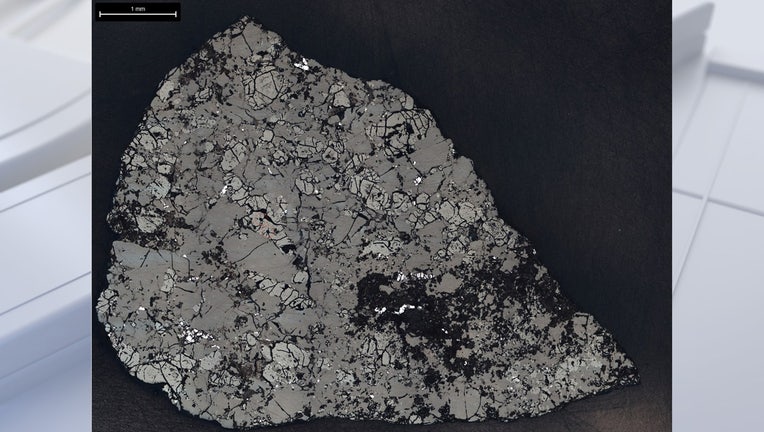
This slice of Teghaza 001, a Martian meteorite, was used to study its mineralogy and chemistry. (Credit: NASA/JPL-Caltech)
A meteorite found nearly four years ago in the Sahara Desert is giving scientists new insights into how Mars formed and what the planet was like when it was young.
Big picture view:
The nearly two-pound chunk of rock was once part of a piece of the Martian crust that formed approximately 4.1 billion years ago, according to NASA’s Jet Propulsion Laboratory. For a planet that scientists believe is more than 4.5 billion years old, that means the crust was created when the planet was about 10% of its current age.
What they're saying:
"This is really our first piece of Martian crust from a part of Mars we’ve never had a sample of before," said Lee Saper, who helped author a paper on the meteorite based on research he conducted while at JPL as a postdoctoral scholar. "It records interactions of water and rock and maybe even an imprint of the Martian atmosphere as it was losing water."
The backstory:
The rose-colored meteorite, named Teghaza 001, is one of the oldest meteorites ever found, NASA explained. Only two other meteorites come close, with close being a very relative term. The meteorite, dubbed ALH84001, is about as old as this latest one; meanwhile the more memorably named "Black Beauty" came from rock that is only half as old, having formed 2.1 billion years ago from small, volcanic rock segments.
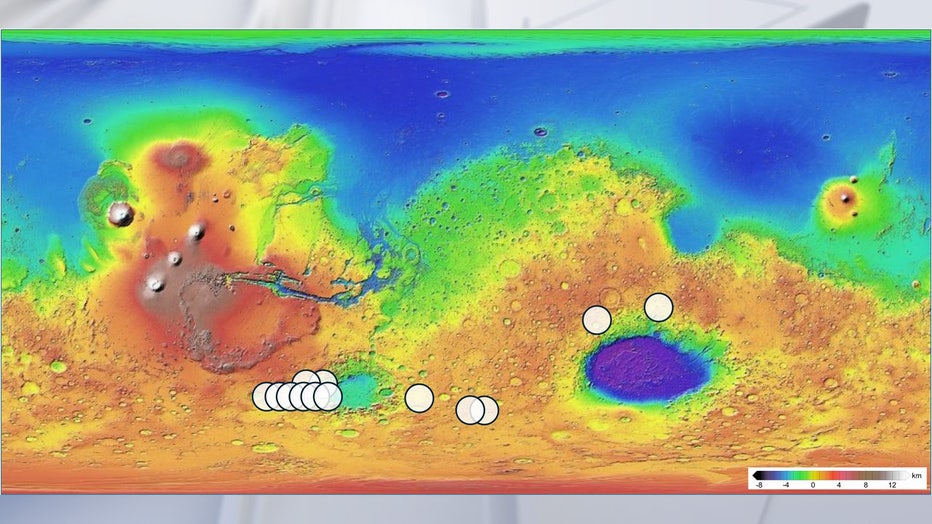
Scientists identified 13 locations on Mars that match the mineralogy and chemistry of Teghaza 001, one of the most ancient Martian meteorites ever found on Earth. (Credit: NASA/JPL-Caltech/USGS)
Why you should care:
Teghaza 001 stands out, though, because igneous minerals in it mean scientists can see how the Martian crust cooled from magma before subsurface water began altering it. While NASA acknowledges that knowing exactly where on Mars the rock was is next to impossible, researchers for another paper were able to come up with potential locations based on mineralogy and chemistry.
Dig deeper:
The meteorite has been the subject of two recent papers, including one that was published this week in Science that offered an initial overview of Teghaza 001, talked about Mars’ ancient crust, and how the planet formed. JPL’s Yang Liu was the lead author on that paper, joined by Saper and other researchers. The second paper, on which Saper’s name is first and Liu’s is second, along with other researchers, came out in June and focused on Teghaza 001’s water content.
"It was only after we started looking closely that we realized this meteorite is really unique," said the paper’s lead author, Yang Liu of NASA’s Jet Propulsion Laboratory. "One of the paper’s reviewers called it a Rosetta Stone for Mars."
The Source: Information for this article was taken from NASA’s Jet Propulsion Laboratory. This story was reported from Orlando.