

Which countries have birthright citizenship?
Trump to attend birthright citizenship arguments at Supreme Court
UCLA Professor of Law Adam Winkler joins LiveNOW's Shawna Khalafi to preview Wednesday's arguments on birthright citizenship at the Supreme Court and the significance of President Donald Trump attending.
As the Supreme Court hears oral arguments on whether to end birthright citizenship, President Donald Trump has repeatedly said the U.S. is the only country that grants automatic citizenship to nearly everyone born on U.S. soil. But that’s not true.
Nearly three dozen other countries have birthright citizenship laws similar to the U.S., according to a Pew Research Center analysis. About 50 other countries have more limited variations of birthright citizenship.
What is birthright citizenship?
The backstory:
In the U.S., the right to birthright citizenship was enshrined in the 14th Amendment of the Constitution after the Civil War, in part to ensure that former slaves would be citizens.
"All persons born or naturalized in the United States and subject to the jurisdiction thereof, are citizens of the United States," the 14th Amendment states.
In the late 1800s, birthright citizenship was legally expanded to the children of immigrants.
SCOTUS to hear birthright citizenship arguments
The Supreme Court on Wednesday will hear arguments over President Trump's efforts to end birthright citizenship. LiveNOW's Christina Evans previews the hearing with immigration attorney Susham Modi.
Wong Kim Ark, who was born in the U.S. to Chinese parents, sued after traveling overseas and being denied reentry into the U.S. The Supreme Court eventually ruled that the amendment gives citizenship to everyone born in the U.S., no matter their parents’ legal status.
Today there are only a handful of birthright exceptions, such as for children born in the U.S. to foreign diplomats.
Why does Trump want to end birthright citizenship?
Dig deeper:
On the first day of his second term, Trump signed an executive order to end birthright citizenship, but a series of judges have ruled against the administration and the order has been repeatedly put on hold by lower courts.
RELATED: Trump attends Supreme Court as justices hear birthright citizenship case
On Wednesday, Trump became the first sitting president in history to sit in the courtroom while the Supreme Court heard arguments for and against his executive order to end it.
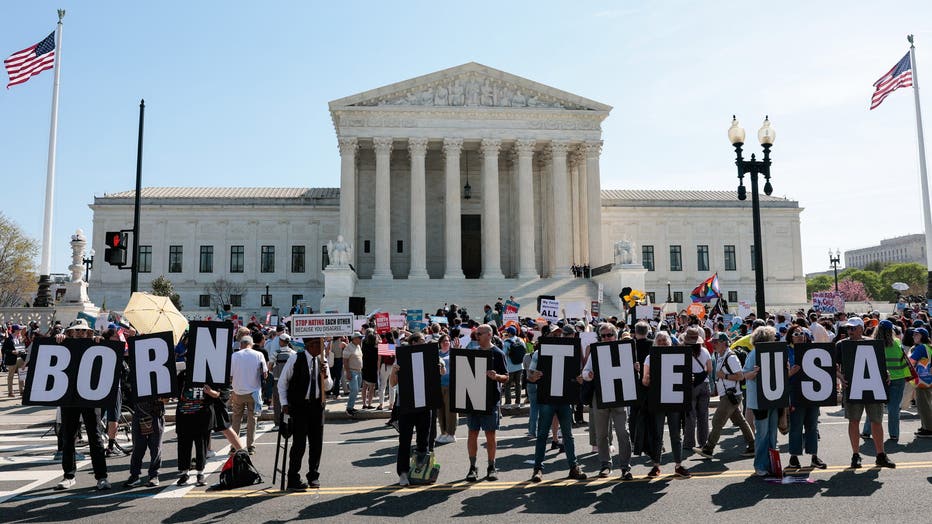
Demonstrators rally in support of birthright citizenship outside the US Supreme Court as President Donald Trump attends oral arguments in Washington, DC on April 1, 2026. President Donald Trump is watching in person as the US Supreme Court hears a la
Trump has said ending birthright citizenship is essential to his broader crackdown on both legal and illegal immigration to the U.S. Those who support Trump’s move to limit birthright citizenship point to a handful of words in the constitutional amendment: "subject to the jurisdiction thereof."
That phrase, they argue, means the U.S. can deny citizenship to children born to women who are in the country illegally.
Which countries besides the US have birthright citizenship?
According to the Pew Research Center, 32 other countries in the world, nearly all of them in the Americas, guarantee citizenship to children born on their territory. About 50 other countries have more limited variations of birthright citizenship.
None of the 27 member states of the European Union, for example, grant automatic, unconditional citizenship to children born on their territories to foreign citizens. The situation is similar across much of Asia, the Middle East and Africa.
Most countries follow the principle of jus sanguinis, or "right of blood," with a child’s citizenship based on the citizenship of their parents, no matter where they are born.
Here’s a map showing which other countries besides the U.S. have some form of birthright citizenship:
The Source: This article includes information from The Associated Press and previous FOX Local reporting.