

Countdown is on: 1 year away until the Great North American Solar Eclipse

Total eclipse countdown: The Great North American Solar Eclipse is officially less than 1 year away
In 2023 and 2024, Americans will have the rare opportunity to witness two spectacular celestial events: an annular solar eclipse and a total solar eclipse.
The countdown clock stands at less than one year until large parts of North America are cast in the complete shadow of the moon on April 8, 2024, when the Great North American Solar Eclipse traverses the sky.
The event only happens when the moon’s orbit is close to Earth, and the celestial body blocks out the view of the sun, creating a shadow on Earth’s surface.
Solar eclipses happen about twice a year, but finding yourself under the totality of one is rare.
The American Astronomical Society says that any given spot on the planet only sees temporary darkness from the moon’s shadow once every 400 years.
The event in 2024 will take place during the afternoon as the eclipse will travel over Mexico, into Texas and 14 other states before exiting through Canada.
WILL WEATHER COOPERATE FOR TOTAL SOLAR ECLIPSE IN APRIL 2024?
When the moon obscures the sun, the air temperature drops, stars and planets - usually only viewable at night - will be visible, and NASA even says animals are tricked into thinking night is falling.
The totality lasts less than 10 minutes, but that is not stopping communities from planning celebratory events.
Cities along the path are planning to host large watch parties, with millions expected to ring in the Great North American Solar Eclipse.
Del Rio, Texas, is hosting a five-day long festival with music, art and other activities and in Cleveland, Ohio, a massive tailgate party is planned to take place at the Rock & Roll Hall of Fame to ring in the occasion.
Against all odds, a limited part of the U.S. that consists of southeastern Missouri, western Kentucky and southern Illinois will be in store for their second total solar eclipse in less than a decade.
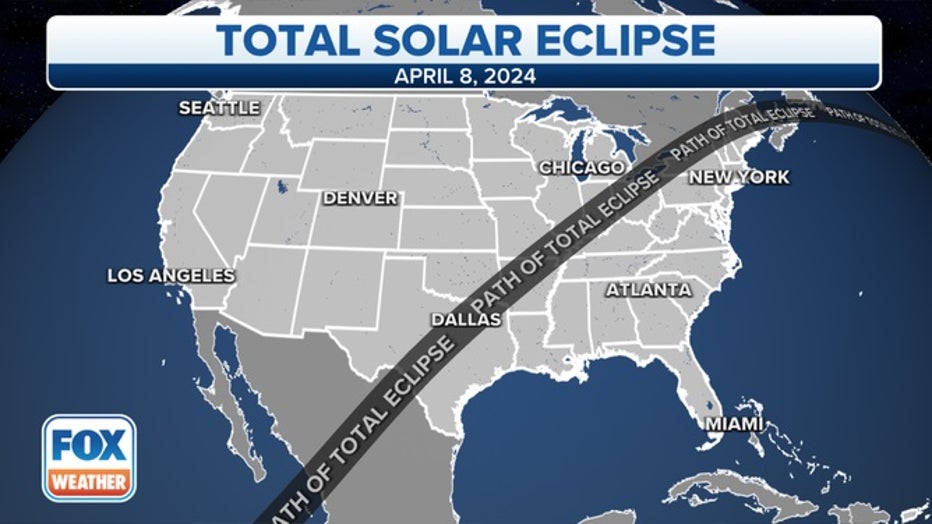
Path of totality during the Great North American Solar Eclipse on April 8, 2024. (FOX Weather)
A similar eclipse in 2017 toured the country from coast to coast, capturing the attention of millions, who stared into the sun with protective eye coverings.
"If you can get yourself into the path of the moon’s shadow for a total eclipse, it’s definitely worth the effort," says Rick Fienberg, Project Manager of the American Astronomical Society’s Solar Eclipse Task Force. "A 99% partial solar eclipse doesn’t get you 99% of the experience of a total solar eclipse — that last 1% is literally the difference between night and day."
If you miss the event in 2024, the next total solar eclipse visible from the U.S. won’t happen until August 12, 2045. The path of totality will pass through the West, heartland and South.
Believe it or not, astronomers believe that one-day total solar eclipses will be a thing of the past.
The American Astronomical Society says the moon is slowly moving away from Earth at the rate of about 1.5 inches per year.
The society estimates the lunar body will lose the unique feature of completely blocking out the sun in about a billion years.
SEE THE OBJECTS HUMANS LEFT BEHIND ON THE MOON

Watch & listen: Eclipse over the beach
This footage was posted to Facebook by South Carolina State Parks, who said a ranger captured it from Myrtle Beach State Park in November 2022. "What a great video, with the sound of the ocean in the background!" the park said.
An annular solar eclipse will be visible in October
If you don’t mind not being in the path of totality, then October 14, 2023, might be a date to highlight on your calendar for what is dubbed as an annular solar eclipse.
During the fall, the eclipse is expected to be visible across most of the Americas as the event begins on the West Coast and works eastward through Texas.
Astronomers say because the moon will be far from Earth, it won’t completely block out the sun leading to a "ring of fire" look.
In the path of maximum sun obscuration, 90 percent of the bright start will be covered by the lunar body.
All of the lower 48 states will see at least a sliver of obscuration, but communities such as Eugene, Oregon; Albuquerque, New Mexico; and San Antonio, Texas, will be treated to the greatest views, if skies are clear.
The "ring of fire" sight will last upwards of five minutes, with the partial eclipse lasting a few hours.
Similar to a total eclipse, it is not advised to look at the sun without specialized eye protection.
Due to the glass market being flooded with counterfeit products, the AAS Solar Eclipse Task Force has established a list of companies and manufacturers that meet the ISO 12312-2 international safety requirement: https://eclipse.aas.org/resources/solar-filters