

2024 YR4: What to know about the asteroid that could hit Earth in the future
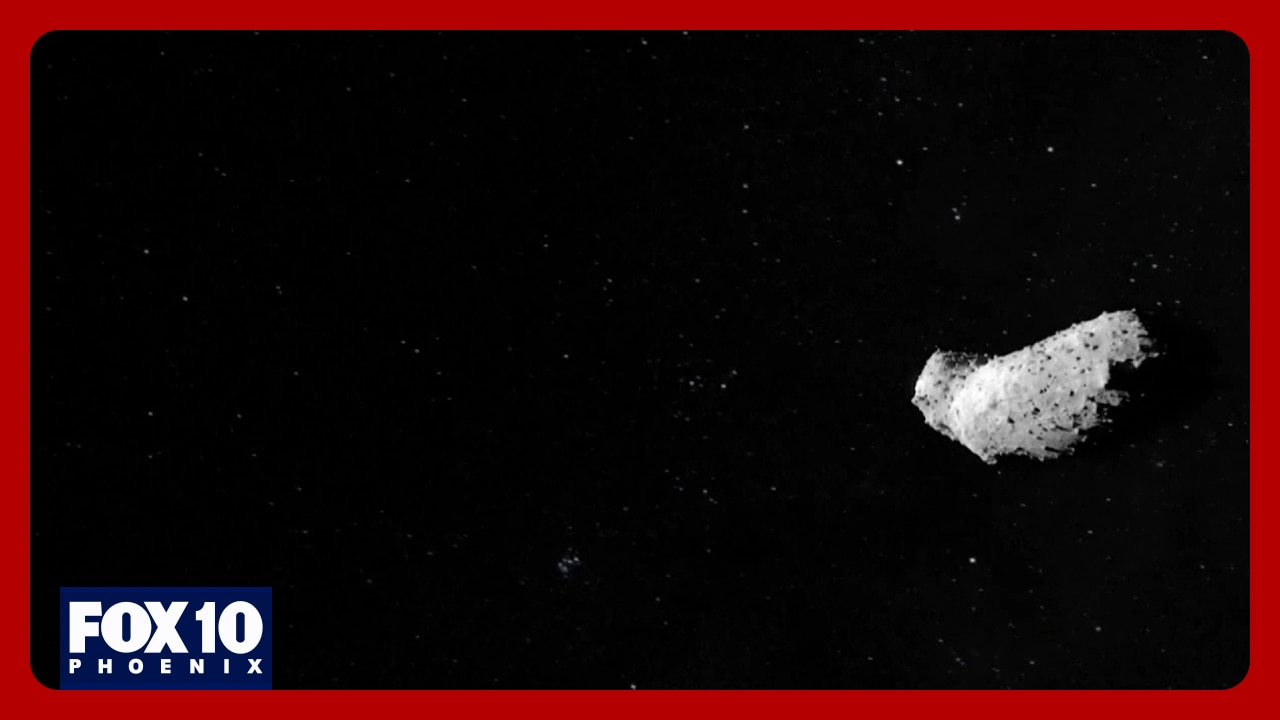
AZ observatory monitoring near-Earth asteroid
Scientists across the world, including some in Arizona, are monitoring an asteroid that has a very slim chance of hitting Earth in the near future. FOX 10's Steve Nielsen reports.
FLAGSTAFF, Ariz. - Scientists across the world are focusing on an asteroid that has a slim chance of hitting Earth.
Here's what to know about the asteroid, as well as the role one Arizona observatory is playing in observing the space rock in question.
What is the asteroid called?
Per NASA's website, the asteroid is named 2024 YR4. The asteroid is described as a near-Earth asteroid, defined as "an asteroid in an orbit that brings it into Earth’s region of the Solar System."
According to the Jet Propulsion Laboratory's Center for Near Earth Object Studies (CNEOS), 2024 YR4 was first discovered on December 27, 2024 by a NASA-funded telescope in Chile.
What CNEOS Is Saying:
"The object had a close approach with Earth on December 25, which is why it became bright enough to be detected in the asteroid surveys," read a portion of CNEOS' website.
How many near-Earth asteroids are there?
Figures from CNEOS show that from August 1980 to Feb. 6, 2025, scientists have discovered a total of 37,593 Near-Earth Asteroids.
How big is 2024 YR4?
Big picture view:
CNEOS' website states the asteroid is "most likely in the range of 40 to 90 meters (130 to 300 feet) in size." Officials say the estimate is based on measurements of the asteroid's brightness.
"The size cannot be further constrained without thermal infrared observations, radar observations, or imagery from a spacecraft that could closely approach the asteroid," CNEOS' website states.
What's the chance of 2024 YR4 hitting Earth?
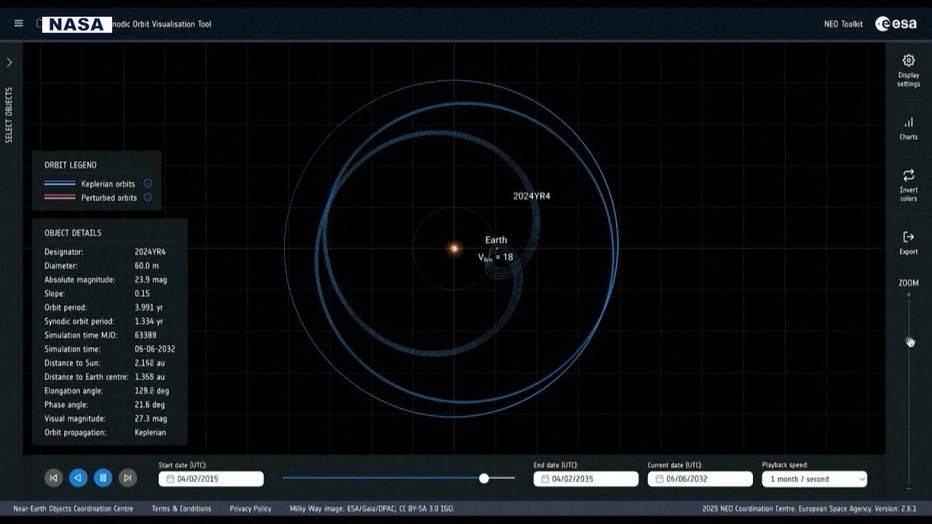
A map showing the purported orbit of asteroid 2024 YR4, in relation to Earth's orbit (Courtesy: NASA)
On Feb. 7, NASA officials said the chance of the asteroid impacting Earth stands at 2.3%.
Previously, on Jan. 29, officials with the International Asteroid Warning Network (IAWN) said that the impact probability was 1.3% on Dec. 22, 2032.
What the IAWN is Saying:
"While there is large uncertainty in whether the asteroid will impact Earth, if an impact occurs it will be on this date," read the document.
Where will the asteroid hit, if it does hit Earth?
Officials with the International Asteroid Warning Network (IAWN) state there is an "impact risk corridor" for 2024 YR4.
Per the document, the impact risk corridor for 2024 YR4 "extends across the eastern Pacific Ocean, northern South America, the Atlantic Ocean, Africa, the Arabian Sea, and South Asia."
Should the asteroid hit, the document states that "blast damage could occur as far as 50 km (~31.07 mi) from the impact site."
Once again, it should be noted that NASA officials, on Feb. 7, said the chance of 2024 YR4 impacting Earth stands at 2.3%.
What An Astronomer Is Saying:
"[It's] not gonna cause extinction events," said Nick Moskovitz with Lowell Observatory in Flagstaff. "It’s not ‘the end of the dinosaurs-like’ impact, but it would have significant regional consequences."
What are researchers doing to get more data on the asteroid?
Per the IAWN, "future observations will reduce the uncertainty in the 2024 YR4's trajectory and impact probability."
By the numbers:
The asteroid, according to people with IAWN, will be observable through early April, after which it will become too faint to be observed from Earth until June 2028.
What's next:
NASA officials say with more observations of the asteroid's orbit, the impact probability will become better known.
"It is possible that asteroid 2024 YR4 will be ruled out as an impact hazard, as has happened with many other objects that have previously appeared on NASA’s asteroid risk list, maintained by NASA’s Center for Near-Earth Object Studies," read NASA's website.
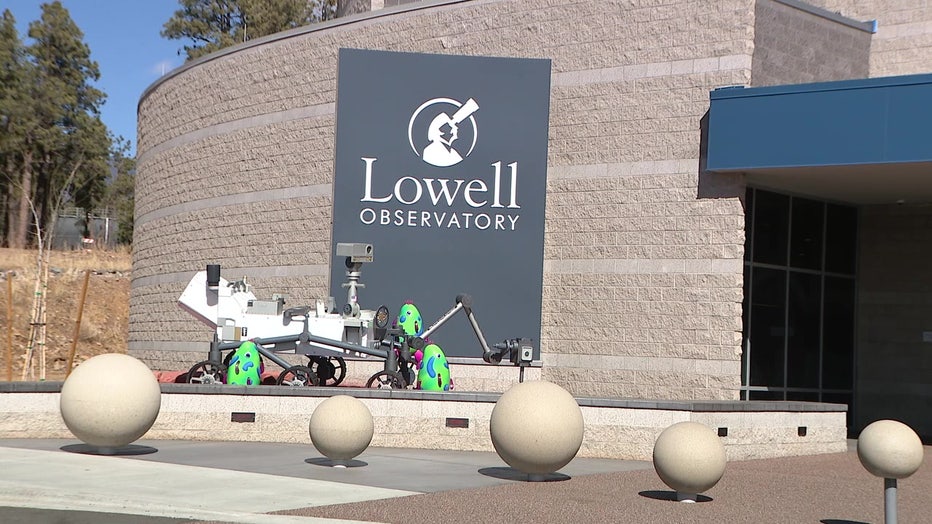
Lowell Observatory
Local perspective:
Lowell Observatory in Flagstaff is one of only three or four telescopes in the world that is currently monitoring the asteroid's path.
"Our hope is that as we continue to monitor we see that the trajectory in 2032 off of the Earth and the probability would go to zero," said Moskovitz.
Moskovitz said the equipment needed to see the asteroid has changed.
"Right now, we’re sort of in this transition where the telescopes like the telescope 4 m telescope 1617 feet across those are only telescopes in the world that can see it," said Moskovitz.
What would happen if scientists determine the asteroid will hit Earth?
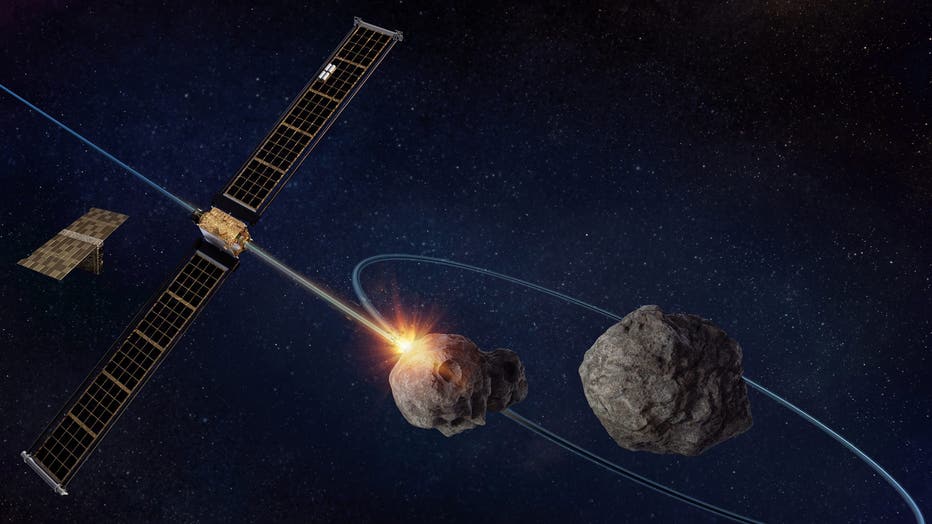
Artist rendering of the NASA Double Asteroid Redirection Test (DART) space probe approaching the asteroid Didymos and its minor-planet-moon Dimorphos. (Illustration by Nicholas Forder/Future Publishing via Getty Images)
Once again, it should be noted that as of Feb. 7, 2025, NASA officials put the probability of 2024 YR4 striking Earth at 2.3%.
Even if the odds fail humanity, scientists do have a certain level of experience with defending the planet against asteroid strikes.
Dig deeper:
Moskovitz and researchers from University of Arizona and Northern Arizona University were integral to a mission called "Double Asteroid Redirection Test" (DART).
According to the mission's website, the DART mission is NASA's demonstration of a technology that aims to adjust the speed and path of an asteroid by hitting it with a spacecraft that is described as a "kinetic impactor."
The mission involved sending a spacecraft to an asteroid named Dimorphos. The spacecraft hit Dimorphos in September 2022, and officials said based on subsequent measurements of the asteroid, the nearly head-on collision shortened the time it took for Dimosphos to orbit a larger asteroid named Didymos by 33 minutes.
Space missions take years of planning, but moskovitz believes that can be streamlined for planetary defense.
"We could simply copy DART," said Moskovitz. "We’ve done it before, down to the last screw. This would not take 10 years to do."