

Amazon Prime Day kicks off Tuesday, experts warn consumers to beware of scams
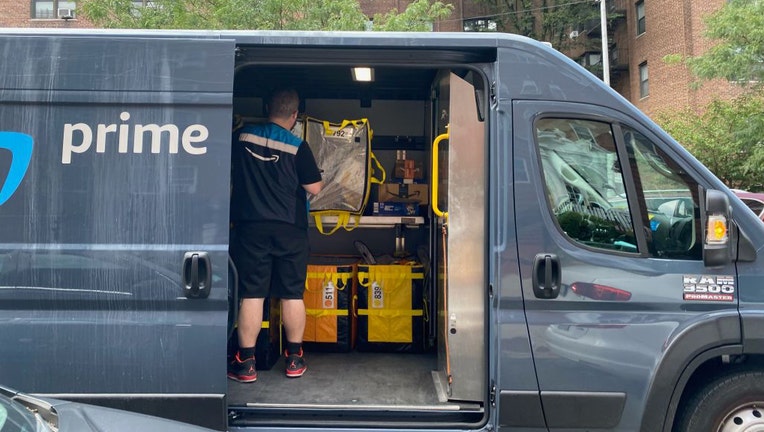
Amazon Prime delivery person in van sorting packages, Queens, New York. (Lindsey Nicholson/UCG/Universal Images Group via Getty Images)
NEW YORK - Amazon Prime Day is here. And, once again, experts are warning consumers of scams.
Scams targeting online shoppers — often by impersonating companies like Amazon and other major retailers — are nothing new. But phishing attempts increase amid busy spending seen during significant sales events — from Black Friday to, of course, Prime Day, according to the Better Business Bureau.
"This is a huge moment on the retail calendar," Josh Planos, vice president of communications and public relations at the Better Business Bureau, told The Associated Press. "And because of that, it represents an enormous opportunity for a scammer, con artist or even just an unethical business or organization to capitalize on the moment and separate folks from their hard-earned money."
Prime Day, a two-day discount event, kicks off on Tuesday and runs through Wednesday. In guidance published last week, the Better Business Bureau reminded consumers to watch out for lookalike websites, too-good-to-be-true social media ads, unsolicited emails or calls and more near Prime Day and other sales events this month beyond Amazon's.z
RELATED: Amazon in talks to offer free mobile services to Prime members: Report
Scott Knapp, director of worldwide buyer risk prevention at Amazon, identifies two scams that the company has seen in recent years around Prime Day: Prime membership and order confirmation hoaxes.
Last year, for example, people reported getting unsolicited calls or emails saying that there was something wrong with their Prime membership. Then, they were asked for payment information, like a credit card, and sometimes login credentials as well, Knapp explained — adding that Amazon "or any reputable business" wouldn't ask for those details in that way.
Urging consumers to confirm an order they didn't place is also a common tactic at this time of year, he adds. Scammers might pick something expensive, like a smartphone, to get attention — and again ask for payment information or send a malicious link.
"We sell a lot of stuff and people know the (Amazon) name," Knapp told the AP. "Bad actors try to take advantage of that."
RELATED: Amazon bringing age verification for alcohol purchases to Amazon One palm recognition technology
Of course, there's loads of additional scams out there — it's hard to identify more specifics for this year's Prime Day before it begins. Still, experts add, scams will often iterate year after year.
"Typically, the bones remain the same," Planos said, pointing to repeating fake delivery scams, email phishing and more. "It’s always a ploy to separate consumers from (their) personal and payment information."
But online hoaxes are also constantly evolving to become more sophisticated, Planos and others warn. That means images might look more legit, text messages may sound more convincing and fake websites are starting to look very similar to your typical shopping destinations.
Artificial intelligence is also "starting to leak in," Knapp said. "But they still follow the same approaches. It’s just now a machine is maybe populating the email or text."
RELATED: Amazon Go stores to close in cities coast to coast
According to February data from the Federal Trade Commission, consumers reported losing about $8.8 billion to fraud in 2022, a 30% jump from 2021. Online shopping scams was the second most-reported form of fraud, following imposter scams, the FTC said.
Both the FTC and Better Business Bureau provide consumers with tips to avoid scams year-round. Guidance includes blocking unwanted messages, not giving financial information to unsolicited callers and checking links before clicking — secure websites, for example, will have "HTTPS" in the URL, Planos notes, never "HTTP."
Scammers will often pressure you to act immediately, experts say. It's important to pause and trust your gut. Experts also urge consumers to report scams to regulators.
Beyond scams that impersonate companies or retailers, it's also important to be cautious of counterfeit products and fake reviews which can be found on the sites of retailers you might trust. Just because you’re shopping on Amazon, for example, doesn’t mean you’re buying from Amazon, as the online shopping giant, like eBay, Walmart and others, has vast third-party marketplaces.
The quality and look of counterfeit products has significantly increased over recent years, Planos notes, making the activity difficult to police. A good rule of thumb is looking at the price tag — if the product is being sold for less than 75% of its year-round market rate "that's a pretty big red flag," he adds.
Sketchy sellers can show up on different platforms, including sites like Amazon, "all the time" Planos said, urging consumers to check out businesses at the Better Business Bureau's website. Like other scams, counterfeit products may increase around high spending periods like the holidays or, again, near sales events like Prime Day.
Amid increasing pressure to tackle counterfeit products, Amazon has reported getting rid of millions of phony products over recent years, and blocked billions of bad listings from making it on to its site. In 2022, the company said more than 6 million counterfeit items were "identified, seized and appropriately disposed of."
In a statement sent to The Associated Press on Monday, the Seattle-based e-commerce giant said it had "zero tolerance" for both counterfeit products and fake reviews, noting that the company blocked over 200 million suspected fake reviews in 2022.
Customers can also report fake reviews and other scams on Amazon's website, Knapp said. For "rare" cases when a customers purchase "an item that Amazon detects to be counterfeit," the company added, "we proactively contact the customer, inform them that they purchased a counterfeit product and we fully refund their purchase."