

Here's how much it costs to live comfortably in your state for 2026
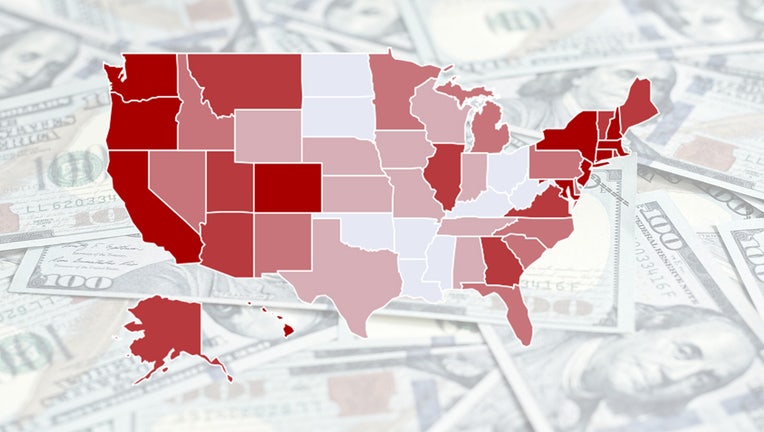
FILE - Photo of a map of the US with a background showing $100 USD. (Getty Images)
As Americans continue to grapple with high prices on groceries, gas, and other household essentials, even earning a six-figure salary doesn’t guarantee financial stability in these uncertain times.
A study conducted by SmartAsset found what it takes to live comfortably in each U.S. state in 2026.
50/30/20 budgeting system
Dig deeper:
The study analyzed the annual pre-tax income needed to live comfortably across all 50 U.S. states using the 50/30/20 budgeting framework, where 50% of income covers basic necessities (based on MIT’s Living Wage Calculator data), 30% is allocated to discretionary spending, and 20% goes toward savings and debt repayment.
Driven by rising costs in housing, groceries, and utilities, the study revealed that a single adult with no children needs at least $80,000 annually to live comfortably in every state, with the required salary exceeding $100,000 in nearly half of the states.
For a family of four (two working adults and two children), the required household income reaches $200,000 or more in 40 out of 50 states.
Hawaii and Massachusetts are the most expensive states
Local perspective:
Geographically, Hawaii and Massachusetts top the rankings as the most expensive states to maintain a comfortable lifestyle.
Hawaii requires the highest income for single adults at $129,002 per year (and $313,165 for a family of four), while Massachusetts commands the highest threshold for a family of four at $329,555 annually (and $127,213 for single adults), closely followed by California and New York.
The other side:
On the opposite end of the spectrum, Mississippi and West Virginia are the most affordable states; West Virginia requires the lowest salary for a single adult at $81,245, while Mississippi demands the lowest income for a family of four at $187,533.
Cost of living
Big picture view:
Year-over-year trends show that living costs continued to rise in most regions, led by Montana, which experienced the largest annual increase for single adults at 8.6% (reaching $100,797), followed by New York (8.4%) and Maine (6.5%).
Conversely, six states saw a slight decrease in the income required for single adults compared to 2025, with Tennessee experiencing the largest decline at -1.7% (dropping to $89,898), alongside minor drops in Maryland, Louisiana, Mississippi, North Carolina, and Texas.
The Source: Information for this article was taken from a SmartAsset study based on MIT data from February 2026, as well as 2025 data to calculate year-over-year changes. This story was reported from San Jose.