

Huntington’s Disease treated successfully for 1st time in landmark trial
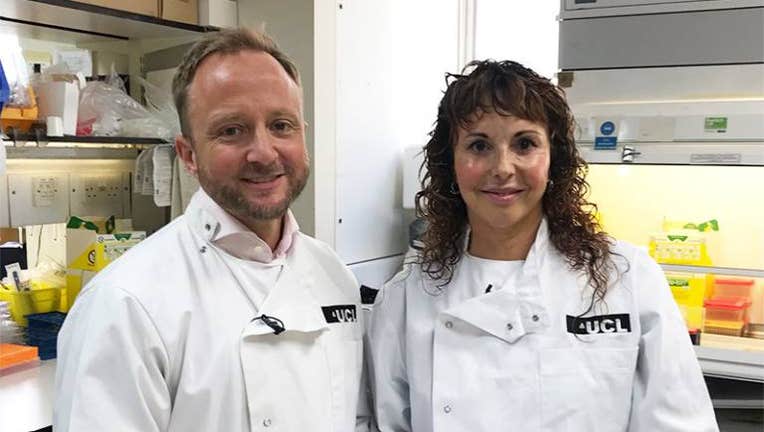
Professors Ed Wild and Sarah Tabrizi in a UCL lab.(Credit: University College London)
LONDON - Researchers in London said they have successfully treated Huntington's Diease, a first in the medical world.
The gene responsible for Huntington’s disease was identified in 1993, yet until now, no effective therapies had been available to prevent or slow its progression.
RELATED: Pfizer boosts push for obesity treatments with $4.9B deal for Metsera
What is Huntington's Disease?
Dig deeper:
Huntington's disease is a fatal, inherited disorder that causes nerve cells in parts of the brain to gradually break down and die, according to the National Institutes of Health.
Treatment for Huntington's Disease
Why you should care:
Researchers at University College London said they partnered with uniQure to conduct a gene therapy trial for those carrying the disease.
The study revealed that patients undergoing the treatment showed an overall 75% reduction in disease progression compared with a matched group of individuals with Huntington’s who did not receive the therapy.
RLEATED: Trump's Tylenol warning causes pushback from medical community
This marks the first drug trial to demonstrate a sustained and statistically significant slowing of Huntington’s progression.
AMT-130 is the first gene therapy tested in people with Huntington’s disease. It was developed by uniQure, a company based in the Netherlands and the United States.
So far, 29 patients have taken part in the early-stage trial, lasting up to three years. Twelve of them received a higher dose and have now completed the full 36 months. Their results are being compared to people in a long-term study called Enroll-HD, which tracks the natural course of Huntington’s without new treatments.
RELATED: James Van Der Beek makes surprise virtual appearance at 'Dawson's Creek' reunion
The latest results show that patients given a high dose of AMT-130 had 75% less disease progression after three years, based on a scale that measures movement, thinking, and daily function. They also did better on other important measures, including overall function and motor and cognitive tests.
Researchers also looked at levels of a protein called neurofilament light (NfL), which increases when brain cells are damaged. Normally, NfL levels rise by 20–30% over three years in Huntington’s, but in treated patients, the levels actually went down. This suggests the therapy may be slowing or altering the disease.
Overall, AMT-130 has been well-tolerated by patients, with side effects considered manageable.
What they're saying:
"This result changes everything," Professor Ed Wild, principal investigator of the UCL Huntington’s Disease Centre trial site at UCL and UCLH, said in a news release. "On the basis of these results it seems likely AMT-130 will be the first licensed treatment to slow Huntington’s disease, which is truly world-changing stuff. If that happens, we need to work hard to make it available to everyone who needs it, while working no less diligently to add more effective treatments to the list."
What's next:
uniQure plans to ask the US Food and Drug Administration early next year for accelerated approval to sell the drug, and will then apply in the UK and Europe.
The Source: The information in this story comes from the latest clinical trial results announced by researchers at University College London’s Huntington’s Disease Centre in collaboration with uniQure, the biotech company that developed the AMT-130 gene therapy. This story was reported from Los Angeles.