

IUCN Red List: Emperor penguins and Antarctic fur seals added to endangered list
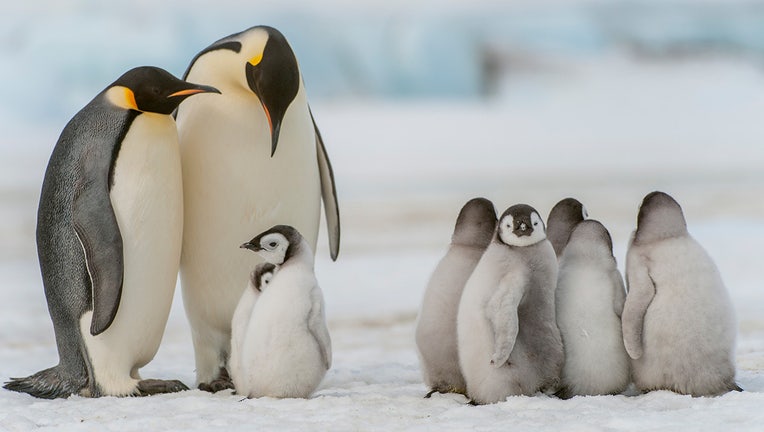
A group of Emperor penguins (Aptenodytes forsteri) with chicks on the fast ice at the Emperor penguin colony at Snow Hill Island in the Weddell Sea in Antarctica. (Photo by Wolfgang Kaehler/LightRocket via Getty Images)
One of the Antarctic’s most well-known and beloved animals is at the brink of extinction, and environmentalists are calling it a "stark warning" of the threat of climate change.
Earlier this week, the emperor penguin was placed onto the endangered list compiled by the International Union for Conservation of Nature (IUCN) for its Red List of Threatened Species, along with the Antarctic fur seal.
Big picture view:
Using satellite imagery, IUCN has determined that between 2009 and 2018 the number of adult emperor penguins dropped by 20,000, or 10% of their population. The agency attributed the loss to climate change and called on governments to take steps to protect the Antarctic environment. The coming decades could contribute to even greater rates of decline for the species.
What they're saying:
"Penguins are already among the most threatened birds on Earth," said Martin Harper, CEO of BirdLife International, which coordinated the emperor penguin assessment as the authority for birds on the IUCN Red List. "The emperor penguin’s move to Endangered is a stark warning: climate change is accelerating the extinction crisis before our eyes. Governments must act now to urgently decarbonise our economies."
Why emperor penguins are endangered
IUCN’s statement attributed the population loss primarily to the early break-up or loss of sea ice, which particularly wreaks havoc for the penguins’ chicks. The baby birds rely on ice that is fastened to the coast for survival before they become waterproof. If the ice breaks up, it notes, the chicks could die.
RELATED: Snowy owl, hammerhead sharks among 40 species gaining CMS protections
By the numbers:
IUCN painted a bleak picture for the penguins, fur seals, as well as the elephant seal. Already feeling the pressures of a changing environment are the Antarctic fur seals. A lack of available food has cut their population by more than half between 1999 and last year, the agency reported. Its report paints a similarly grim picture for emperor penguins, whose population is expected to halve by the 2080s. Meanwhile, disease is tearing through the southern elephant seal population, leaving them at risk.
Antarctic mammals at risk
The problem for the fur seal, which is now considered endangered, is that the warming climate has krill heading for deeper, colder waters. The shift has taken the biggest toll on pups under one-year-old, which results in the breeding population getting older and older, IUCN indicated. Additionally, they are facing predation by orcas and leopard seals, as well as competition from baleen whales, which also feed on the krill.
The southern elephant seal was moved to the vulnerable list in the wake of a form of avian flu, which is prevalent in five major subpopulations. The Highly Pathogenic Avian Influenza (HPAI) H5N1 has led to the death of 90% of newborn pups in some colonies and is prevalent among adult females.
The Source: Information for this article was taken from the International Union for Conservation of Nature. This story was reported from Orlando.