

Kids with head lice shouldn’t be sent home from school, new AAP guidance says
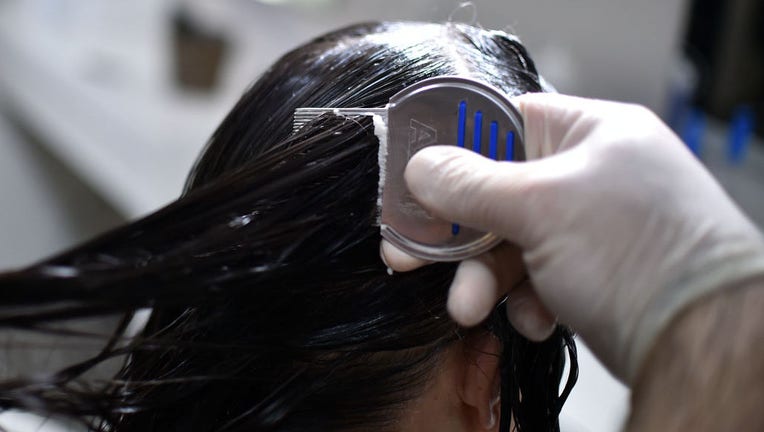
FILE IMAGE - A person removes head lice and nits from a customer using a lice comb. (Photo by Britta Pedersen/picture alliance via Getty Images)
A head lice diagnosis is neither a health hazard nor a sign of poor hygiene, and children should not miss school because of it, new guidance from the American Academy of Pediatrics states.
Instead, being sent home from school because of head lice "can result in significant stigma and psychological stress."
The new guidance, published online this week and in October 2022 Pediatrics journal, is an update on previous recommendations shared in 2015.
In the United States, head lice are most common among preschool and elementary children, and the household members of those children, according to the U.S. Centers for Disease Control and Prevention. Anywhere from 6 million to 12 million infestations occur annually in the U.S. among kids ages 3 to 11, the agency adds.
Head lice are spread by direct contact with the hair of an infested person and can spread by contact with clothing, such as hats, scarves, coats, or other personal items like combs and towels.
Head lice are not known to spread disease, the CDC states, and personal hygiene or cleanliness in the home or school has nothing to do with getting head lice.
But despite this information, head lice infestations still have a "significant stigma" in high-income countries, leading to "children and adolescents being ostracized from their schools, friends, and other social events," the AAP states in its newly published report.
As a result, "head lice can be psychologically stressful to the affected individual," it adds.
Beyond the risk of stigmatizing children suspected of having head lice, the AAP states that head lice screening programs in schools have not been proven to have "a significant effect over time on cases of head lice in the school setting" and are not cost-effective.
Instead, the AAP suggests that schools offer educational programs for families to help increase understanding and management of head lice in the community.
"Head lice are an unpleasant part of the human experience, but they can be successfully managed and are no reason for a child to miss school," said Dr. Dawn Nolt, lead author of the new AAP guidance.
"The AAP encourages pediatricians to serve as an educational resource for families, school districts and communities so that head lice may be treated and managed without stigma," Nolt added.
The report was written by the AAP’s Committee on Infectious Diseases, Committee on Practice and Ambulatory Medicine, and Section on Dermatology.

How to check for head lice and treatments
Head lice are tiny bugs about the size of a sesame seed that feed on small amounts of blood. Lice lay and attach their eggs to hair close to the scalp. Those eggs and their shell casings are called "nits."
Regular checks are a good way to spot head lice before they have time to multiply and infest in a child’s head, according to the AAP. Here’s how to check:
- Seat your child in a brightly lit room.
- Part their hair.
- Look for crawling lice and for nits on your child's scalp a section at a time.
- Live lice are hard to find. They avoid light and move quickly.
- Nits will look like small white or yellow-brown specks and be firmly attached to the hair near the scalp. The easiest place to find them is at the hairline at the back of the neck or behind the ears, the AAP says. Nits can be confused with many other things such as dandruff, dirt particles or hair spray droplets. The way to tell the difference is that nits are firmly attached to hair, while dandruff, dirt or other particles are not.
- Use a fine-tooth comb to help you search the scalp section by section.
In its report, the AAP recommends treatments that are safe and age-appropriate. Parents should call their pediatrician to ensure a proper diagnosis and treatment.
Topical agents, such as shampoos, lotions, and other Food and Drug Administration-approved products containing pyrethroids are typically the first-line treatment for head lice, the AAP says.
Click here for a list of U.S.-approved head lice medicines and more information about head lice.
This story was reported from Cincinnati.