

Watch: NASA Artemis II crew talks historic moon mission
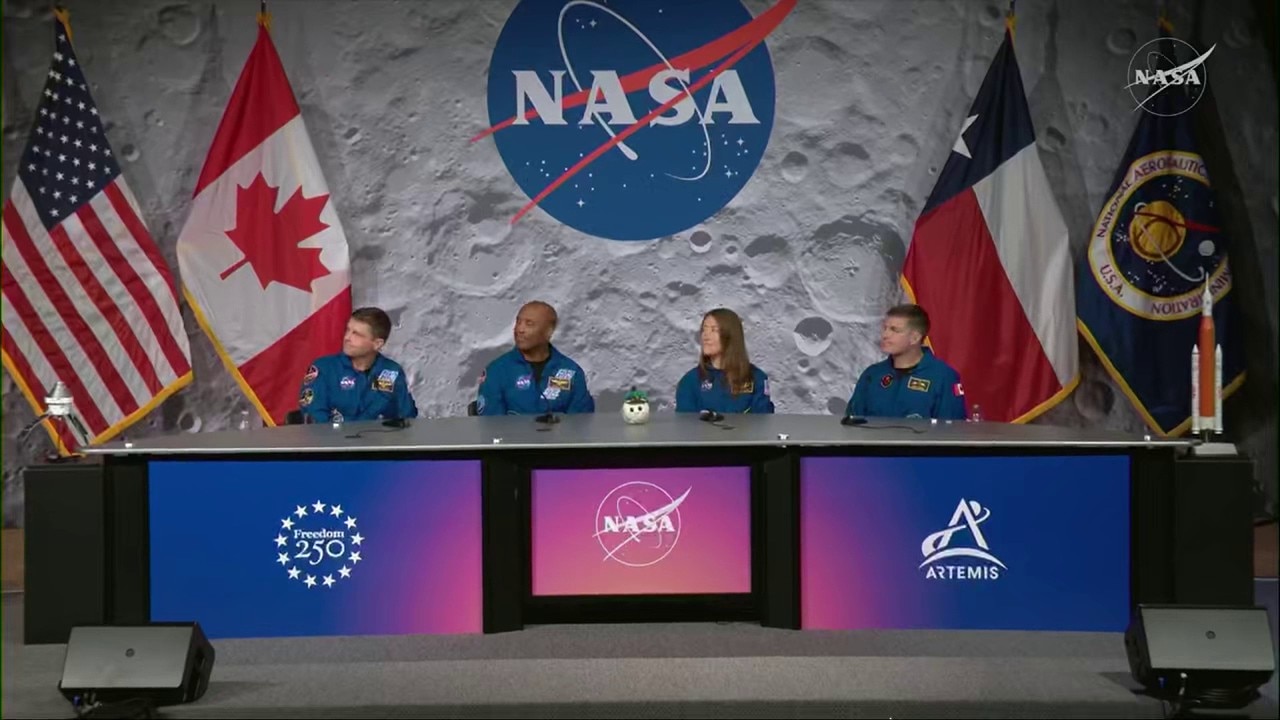
Artemis II crew talks moon mission | Full news conference
The Artemis II astronauts talked with the first time with journalists and media professionals following their historic 10-day mission to the moon and back.
NASA's Artemis II astronauts held a press conference on Thursday afternoon, April 16, to talk about their historic mission to the far side of the moon – becoming the first humans ever to see that side of the moon.
The Artemis II astronauts – NASA's Reid Wiseman, Victor Glover, and Christina Koch, and Jeremy Hansen, of the Canadian Space Agency – lifted off from Kennedy Space Center in Florida on April 1, reached the moon on April 6, and splashed down in the Pacific Ocean off the coast of California on April 10.
Here's what you need to know about the mission
A historic mission
NASA's Artemis II mission made history in several ways:
- It was the first space mission to the moon in more than 50 years (since the Apollo 13 mission in the 1970s)
- Artemis II aboard the Orion spacecraft traveled 252,756 miles from Earth, breaking the distance record set by Apollo 13
- Artemis II's astronauts were the first humans to not only see the lunar surface with the naked eye, but also to see the far side of the moon.
- It was the second critical test of the Space Launch Systems (SLS) rocket and the Orion spacecraft.
Artemis II - By the numbers
By the numbers:
- 4 - Number of astronauts aboard the Orion space craft
- 10 - How long the space flight was, from lift off to splashdown (April 1-10)
- 25,000 MPH - How fast the Orion spacecraft traveled through space on its way to the moon and back
- 7,000 - The number of images taken during the lunar flyby on April 6
- 7 - How long in hours the lunar flyby lasted
- 252,756 - The farthest distance Artemis II traveled from Earth to the moon
- 695,081 - The total distance in miles that Artemis II flew, from lift off to splashdown
- 4,067 - How close to the lunar service that Artemis II got (as its closest distance)
- 2 - The number of craters that the Artemis II astronauts recommended be named: Integrity, named after the Orion spacecraft, and Carroll, named in honor of Commander Reid Wiseman's late wife
- 8.8 - The level of thrust in pounds (8.8M) at lift off
What is the Artemis II mission?
Artemis II was the second test flight in the Artemis program, whose overall goal is to land rovers and humans on the moon and to build a "moon base."
During Artemis II, NASA tested the success of the Space Launch Systems (SLS) rocket, as well as the Orion spacecraft.
"With astronauts aboard for the first time, engineers put Orion through a full in‑flight evaluation. The crew tested the spacecraft’s life support systems, confirming Orion can sustain humans in deep space. During several piloting demonstrations, crew members took manual control of the spacecraft, flying Orion to validate its handling and collect data that will guide future rendezvous and docking operations with human-rated landers during Artemis III and beyond," NASA said.
Other tests helped determine how future missions would be flown to the moon, such as how the spacecraft performs during crew exercise, emergency procedures, and how the spacecraft interacts with the astronauts' spacesuits.
The Source: NASA has been sharing a lot of information about the Artemis program, the Artemis II mission and discoveries, on its website, social media accounts, and during live news events and conferences.