

Rocks found by NASA's Mars rover offer strongest hints yet of past life

Largest piece of Mars on Earth fetches $5.3M at auction
University of Iowa Associate Professor Ken Gayley joins LiveNOW's Austin Westfall to discuss the largest piece of Mars on Earth fetching more than five million dollars at auction.
NASA’s Perseverance Mars rover has discovered rocks in a dry river bed that could have signs of ancient microscopic life.
But until those samples are brought back to Earth, no conclusions can be reached, scientists said Wednesday.
Signs of past life on Mars
What we know:
Collected last summer, the sample is from reddish, clay-rich mudstones in Neretva Vallis, a river channel that once carried water into Jezero Crater. This outcrop of sedimentary rock, known as the Bright Angel formation, was surveyed by Perseverance’s science instruments before the drill came out.
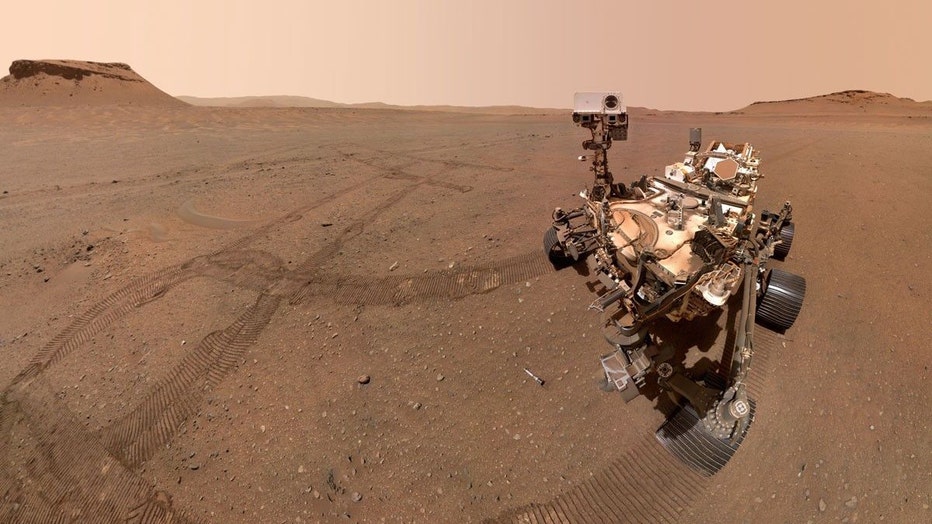
FILE - NASA's Perseverance Mars rover takes a selfie (NASA)
The findings appeared in the journal Nature.
RELATED: See it: Photos show glowing baby planet outside of our solar system
Along with organic carbon, a building block of life, a team of researchers found minuscule specks, dubbed poppy seeds and leopard spots, that were enriched with iron phosphate and iron sulfide. On Earth, these chemical compounds are the byproducts when microorganisms chomp down on organic matter. Microorganisms commonly interact with minerals in Antarctic lakes.
What they're saying:
Scientists are calling it an "exciting discovery," but they’re quick to point out that non-biological processes could be responsible.
"That’s part of the reason why we can’t go so far as to say, ‘A-ha, this is proof positive of life,’’’ lead researcher Joel Hurowitz of Stony Brook University told The Associated Press. "All we can say is one of the possible explanations is microbial life, but there could be other ways to make this set of features that we see."
MORE: See the clearest photo yet from the surface of Mars
Either way, Hurowitz said it’s the best, most compelling candidate yet in the rover’s search for potential signs of long-ago life. It was the 25th sample gathered; the tally is now up to 30, with six more to go.
"It would be amazing to be able to demonstrate conclusively that these features were formed by something that was alive on another planet billions of years ago, right?" Hurowitz said. But even if that’s not the case, it’s "a valuable lesson in all of the ways that nature can conspire to fool us."
What we don't know:
It’s unclear when the samples will be retrieved and brought back to Earth for lab testing. NASA’s ambitious plan to return the samples is on hold as the agency seeks cheaper, quicker options.
Until the samples are transported off of Mars by robotic spacecraft or astronauts, scientists will have to rely on Earthly stand-ins and lab experiments to evaluate the feasibility of ancient Martian life, according to Hurowitz.
How does the Mars Perseverance rover work?
The backstory:
Roaming Mars since 2021, the rover cannot directly detect life. Instead, it carries a drill to penetrate rocks and tubes to hold the samples gathered from places judged most suitable for hosting life billions of years ago.
When Perseverance launched in 2020, NASA expected the samples back on Earth by the early 2030s. But that date slipped into the 2040s as costs swelled to $11 billion, stalling the retrieval effort.
The Source: This report includes information from NASA and The Associated Press.