

Trump moves to replace rejected tariffs with new import taxes
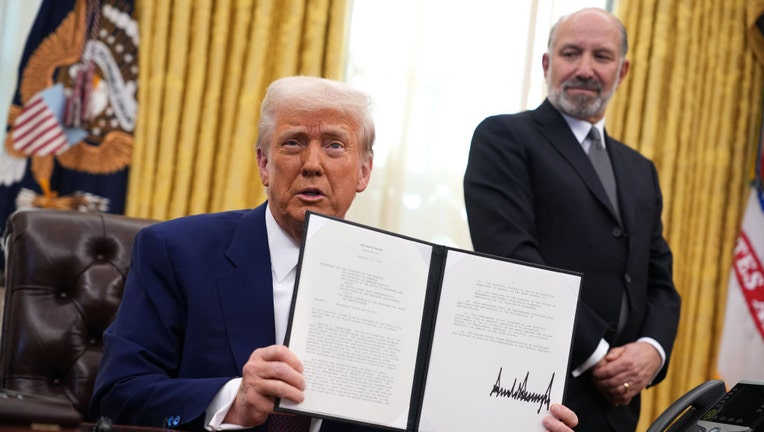
FILE-President Donald Trump, joined by Secretary of Commerce Howard Lutnick, delivers remarks after signing an executive order on reciprocal tariffs in the Oval Office at the White House on February 13, 2025 in Washington, D.C. (Photo by Andrew Harni
The Trump administration is working on a plan to place more durable tariffs in place to keep revenue flowing into the U.S. Treasury after the Supreme Court ruled in February that President Donald Trump’s tariffs were in violation of federal law.
Following the SCOTUS ruling, Trump launched temporary import taxes to replace his tariffs. But those makeshift levies expire in less than three months.
Beginning this week, the Office of the U.S. Trade Representatives will start hearings in two probes that are expected to lead to a new round of U.S. tariffs — taxes paid by importers in the United States and passed on through higher prices to consumers who are already agitated by the high cost of living.
RELATED: Supreme Court rules Trump's tariffs violated federal law
According to the Associated Press, hearings will be held Tuesday and Wednesday into whether 60 economies — from Nigeria to Norway and accounting for 99% of U.S. imports — do enough to outlaw the trade in products created by forced labor.
And next week, the Trump administration plans to hold hearings on whether 16 U.S. trading partners — including China, the European Union and Japan — are overproducing goods, reducing prices, placing U.S. manufacturers at a disadvantage.
Referencing Erica York of the Tax Foundation, the AP reported that the economies being probed represent 70% of U.S. imports, according to Erica York of the Tax Foundation. It’s also possible that the investigation may lead to new tariffs.
The AP also noted that the Trump administration has brought the cases under Section 301 of the Trade Act of 1974, which enables tariffs and other sanctions against countries found to engage in "unjustifiable," "unreasonable" or "discriminatory" trade practices.
Supreme Court rules Trump’s tariffs violated federal law
Dig deeper:
The Supreme Court ruled on February 20 that the International Emergency Economic Powers Act (IEEPA) does not authorize President Donald Trump to impose his global tariffs.
The high court’s decision revolved around tariffs enforced under an emergency powers law, including the sweeping "reciprocal" tariffs Trump levied on nearly every other country.
February’s ruling came amid a spate of short-term wins on the Supreme Court’s emergency docket that have allowed Trump to move forward with extraordinary flexes of executive order on issues, including high-profile firings to major federal funding cuts.
RELATED: Explain tariffs to me: What are they? How do they work?
The backstory:
Trump’s tariff case was related to lawsuits filed by an educational toy manufacturer and a family-owned wine and spirits importer challenging President Donald Trump’s tariffs, FOX Business reported.
In September 2025, the Trump administration requested that the Supreme Court rule quickly that Trump had the power to impose sweeping import taxes under federal law.
The administration filed a petition requesting that the high court reverse an appeals court ruling that determined most of Trump’s tariffs are an illegal use of an emergency powers law, which gives the President broad authority to regulate a variety of economic transactions following a declaration of national emergency.
The Constitution grants Congress the power to impose taxes, including tariffs. However, over the years, legislators have surrendered control to the president.
The Source: Information for this story was provided by The Associated Press and previous FOX Local reporting. This story was reported from Washington, D.C.