

US strikes Iran air defense system, unveils new effort to monitor Tehran’s borders
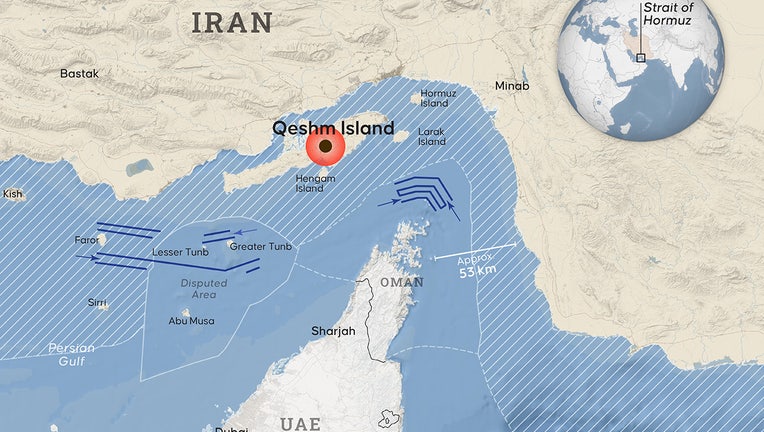
An infographic titled "Qeshm Island" created in Ankara, Turkiye on November 3, 2026. (Photo by Omar Zaghloul/Anadolu via Getty Images)
The U.S. military struck an Iranian air defense system on Friday, a day before unveiling a new initiative aimed at preventing Tehran from moving advanced weapons and materials along ground routes near the Middle Eastern country’s borders.
Big picture view:
President Donald Trump confirmed the strike Friday evening when speaking with reporters following Iranian state media reports of explosions in the Suza area of Qeshm Island, a crucial area for oil shipments.
What they're saying:
"They knocked out -- they built a little bit of an anti-aircraft device and we knocked it out in about 15 minutes, maybe five," Trump said on Friday evening. The president did not provide any more information about the attack.
Task Force Iron Gate
What's next:
On Saturday, U.S. Central Command announced Task Force Iron Gate and linked the effort to the ongoing naval blockade in the Arabian Sea and Gulf of Oman. As part of the newly formed task force, 20 civilian and military workers based in Tampa, Florida, will monitor Iran’s land borders and the Caspian Sea, to prevent movement of illicit items.
What they're saying:
"The establishment of Task Force Iron Gate reinforces the success of our ironclad blockade against Iran at sea," Adm. Brad Cooper said. "Strengthening CENTCOM's collaboration with U.S. interagency partners will further constrain Iran's ability to finance terrorism, rebuild weapons factories, and replenish their military."
By the numbers:
The task force is charged with tracking advanced weapons systems, dual-use technologies, sanctioned materials, and illegal revenue sources, Centcom explained. It went on to credit the ongoing naval blockade as stopping Iran from exporting more than $25 billion worth of crude oil.
RELATED: Trump asks UFC President Dana White to be next press secretary
Iran’s post-election warning
Also on Saturday, Iranian Supreme National Security Council chief Mohsen Rezaei issued a new threat toward the U.S., taunting the Trump administration over recent Republican losses in the midterm elections.
"You lost the war and the election. Vance has conceded, Rubio is heading for the exit, Hegseth is about to be fired, and the CENTCOM commander is now a podcaster!" Rezaei wrote before pledging a "devastating response" if the U.S. were to restart hostilities.
New nuclear proposals
Tehran is currently considering new proposals regarding its nuclear program presented by chief mediator Qatar, two Middle East government officials told The Associated Press. One of the officials, however, noted that Iranian leaders will not resume negotiations with Washington until the U.S. agrees to several core conditions of any peace plan.
Those conditions, which Trump has previously declined, include ending the blockade, lifting sanctions, unfreezing its assets, issuing compensation for war damage, and ending hostilities elsewhere, including Israeli actions in Lebanon.
The proposed plan would see both sides implement concessions over a two-day period that would include a reopening of the Strait of Hormuz, and it would culminate in deeper talks about what to do about Iran’s nuclear program.
Post-election diplomacy
Tuesday’s midterm elections, which upended the political landscape in Washington, spurred a new rush of diplomatic efforts, aimed at easing tensions in the Middle East. Qatari officials have confirmed that Trump had spoken to Emir Tamim Bin Hamad Al Thani and its defense minister had spoken to Defense Secretary Pete Hegseth.
Iran’s Foreign Minister Abbas Araghchi has also been talking to leaders in Iraq, Tunisia, and Egypt this week. Egyptian Foreign Minister Badr Abdelatty urged both sides on Friday to be flexible and find compromise solutions to prevent another escalation. Abdelatty has also talked to Emirati Foreign Minister Abdullah Bin Zayed Al Nahyan about the importance of continued negotiations and avoiding another military confrontation.
The Source: Information for this article was taken from U.S. Central Command, The Associated Press, and Fox News. This story was reported from Orlando, Florida.