

When is daylight saving time in 2026?

Trump's remarks on eliminating daylight saving time
President Donald Trump previously promised to eliminate daylight saving time.
Across much of the U.S., the clocks change twice each year. In the spring, they move forward an hour to mark the start of daylight saving time.
When clocks change or "spring forward," sunsets shift later, adding more usable daylight after work and school across the country.
While early risers may notice dimmer mornings at first, the payoff comes in longer – and lighter – evenings.
Here’s what to know about the start of daylight saving time 2026.
When is daylight saving time 2026?
Big picture view:
According to federal law, daylight saving time always starts on the second Sunday in March and ends on the first Sunday in November.
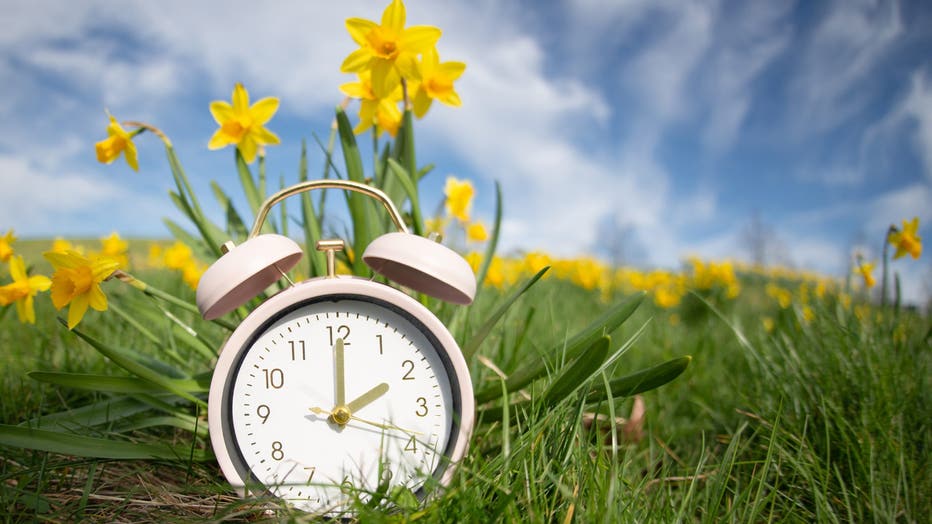
When clocks change or "spring forward," sunsets shift later. (Credit: Getty Images)
This means that daylight saving time will begin at 2 a.m. on Sunday, March 8, 2026. Clocks will be set forward one hour, so sunrise and sunset will occur an hour later.
Which states don’t observe daylight saving time?
Dig deeper:
The list of states and territories that won’t be changing their clocks on March 8 includes:
- Hawaii
- Arizona
- American Samoa territories
- Guam
- Northern Mariana Islands
- Puerto Rico
- U.S. Virgin Islands
The history of daylight saving time
The backstory:
The concept of daylight saving time can be attributed to three people, according to David Prerau, a computer scientist and author of "Seize the Daylight."
The first person was Benjamin Franklin in the 18th century. Franklin noted that waking up closer to sunrise gave him more hours of daylight to illuminate his home. This allowed him to use fewer smoky and expensive candles, which helped him save energy.
The second person was George Bernard Hudson, an entomologist and astronomer who proposed the idea of moving clocks forward to the Wellington Philosophical Society.
The third person was William Willett in the early 20th-century United Kingdom. A builder and member of the Royal Astronomical Society, Willett introduced a bill in the British Parliament to officially enact a time change.
While none of the three individuals saw their idea of saving daylight enacted, the idea was later revived for another purpose – war.
The practice of daylight saving time in the U.S. started in 1918 during World War I as a way to conserve fuel.
By moving the clocks ahead an hour, backers believed the country could divert a bit of coal-fired electricity to the military instead of using it for an hour of home power. It was reenacted in World War II.
Will the US ever stop daylight saving time?
Dig deeper:
Every year, there’s talk about ending the time change, but it never translates into action.
In 2024, Trump promised to eliminate daylight saving time, which would leave standard time ("falling back") year-round. Conversely, a bipartisan bill named the Sunshine Protection Act to make daylight saving time permanent has stalled in Congress for the last several years.
"So this should be the easiest one of all," Trump said last year when asked about the time change. "But it's a 50/50 issue. And if something is a 50/50 issue, it's hard to get excited about it. I assume people would like to have more light later, but some people want to have more light earlier because they don't want to take their kids to school in the dark … It’s something I can do … but a lot of people like it one way, a lot of people like it the other way. It's very even. And usually I find where that's the case, what else do we have to do?"

Daylight Saving Time: Can it cause health issues?
Most of America springs forward for daylight saving time and losing that hour of sleep can do more than leave you tired and cranky the next day. LiveNOW from FOX's Josh Breslow spoke to Dr. Jigme Sethi, physician executive of sleep medicine for Medical University of South Carolina's Regional Health Network.
While Trump doesn’t have the authority as president to end the time change, this can be done by either Congress or the Secretary of Transportation.
A poll from Gallup found Americans’ opinions about daylight saving time have shifted dramatically in the last couple of decades.
The majority of Americans, 54%, said they were ready to do away with the practice, according to the poll run by Gallup last January.
RELATED: As daylight saving time approaches, most Americans say they're ready to end it
This was the first time Gallup asked Americans their opinions about daylight savings time since 1999, and found that views about the practice have shifted dramatically over the last 26 years.
In 1999, 73% favored daylight saving time, similar to the 74% who did so in a 1990 poll.
In last year’s poll, only 40% of Americans favored DST.
The Source: This story was reported from Los Angeles. Chris Williams, Heather Miller, FOX Weather contributed.