

Bill aiming to protect IVF treatment in US blocked by Senate Republicans

Significance of Alabama's frozen embryo decision
Emma Waters with the Heritage Foundation joins LiveNOW's Andrew Craft to break down the Alabama Supreme Court's frozen embryos ruling.
WASHINGTON - Senate Republicans have blocked a bill that would protect access to in vitro fertilization, objecting to a vote on the issue Wednesday even after widespread backlash to a recent ruling by the Alabama Supreme Court that threatens the same practice.
Sen. Tammy Duckworth (D-Ill.) attempted to pass the bill by unanimous consent, allowing any senator to object and derail the motion.
Sen. Cindy Hyde-Smith (R-Miss.) objected to a request for a vote that killed the bill.
Duckworth has used IVF treatments to have her two children after struggling with years of infertility. Following Alabama's frozen embryo ruling, her bill aimed to establish a federal right to IVF treatment.
RELATED: Alabama Supreme Court: Frozen embryos are 'children' under state law
Democrats have immediately seized on the election-year ruling, warning that other states could follow Alabama’s lead and that other rights could be threatened as well in the wake of the U.S. Supreme Court’s decision to overturn Roe vs. Wade and the federal right to an abortion in 2022.
"Mark my words, if we don’t act now, it will only get worse," Duckworth said.
Do Republicans support IVF?
This is the second time Republicans have blocked Duckworth's bill.
Bringing it up again, Democrats said they are challenging GOP senators to display real support for IVF access after many this week issued statements criticizing the Alabama ruling.
Hyde-Smith defended the Alabama ruling, saying, "I support the ability for mothers and fathers to have total access to IVF and bringing new life into the world. I also believe human life should be protected."
Republicans widely hold the stance that the federal government should not interfere with state-level actions on reproductive care after the Dobbs v. Jackson Supreme Court ruling in 2022 left decisions on abortion restrictions up to states.
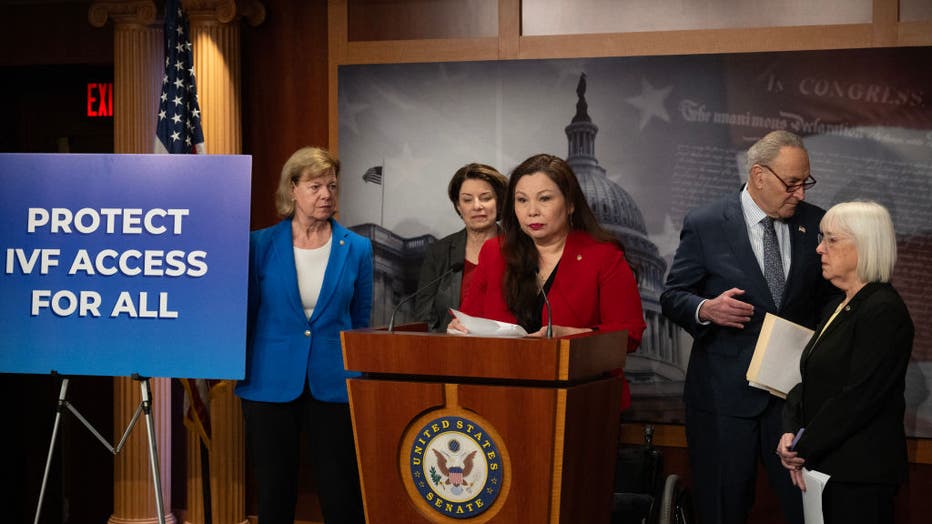
US Senator Tammy Duckworth (D-IL) speaks during a news conference, on protections for access to in vitro fertilization as (L-R) Senator Tammy Baldwin (D-WI), Senator Amy Klobuchar (D-MN), Senate Majority Leader Chuck Schumer (D-NY) and Senator Patty
But after the Alabama ruling, many Republican leaders, including former President Donald Trump, made calls to argue for the importance of supporting the treatments, emphasizing that they are pro-life and pro-family, according to a person familiar with the calls.
Even Alabama Sen. Katie Britt responded to the ruling, saying, "defending life and ensuring continued access to IVF services for loving parents are not mutually exclusive."
Other Republicans agreed. Texas Sen. Ted Cruz, one of the more vocal opponents of abortion in the Senate, said he supports IVF and believes it is "entirely life-affirming."
Kansas Sen. Roger Marshall, a former obstetrician, said he’d referred patients for IVF treatments for 25 years in his practice. "We are the pro-family party, and there’s nothing more pro-family than helping couples have a baby," Marshall said.
Senate Majority Leader Chuck Schumer said on Tuesday that Republicans who have denounced the Alabama ruling "are like the arsonist who set a house on fire and say, why is it burning?"
What this means for the future of IVF
After the Alabama Supreme court ruled that frozen embryos created during fertility treatments can be considered children under state law, it left clinics vulnerable to lawsuits and restricted access to treatment.
"This means the wrongful death of a minor act can be extended to all children despite what state they’re in – be it the embryonic state in the womb or born," Emma Waters, a research associate with the Heritage Association told LiveNOW from FOX.
READ MORE: Alabama Supreme Court ruling: Frozen embryos, IVF future explained
The new ruling has caused many doctors nationwide to worry about possible national implications of the recent court decision.
It could "substantially restrict access to a very vital fertility treatment that has helped countless folks today expand their families," Dr. Jason Griffith, a reproductive endocrinologist in Houston, told the Associated Press. "When you look at the percentage of pregnancies in the United States that result from in vitro fertilization, it’s around 2%."
It could also increase the cost of IVF for many families — although it’s unclear by how much — because of things like additional storage fees and liability costs, he said. One cycle of IVF, including all embryos transferred, now costs about $15,000 to $25,000, Griffith said.
Stephanie Weaver and The Associated Press contributed to this story. It was reported from Los Angeles.