

Blood moon total lunar eclipse happens March 3 - How you can see it
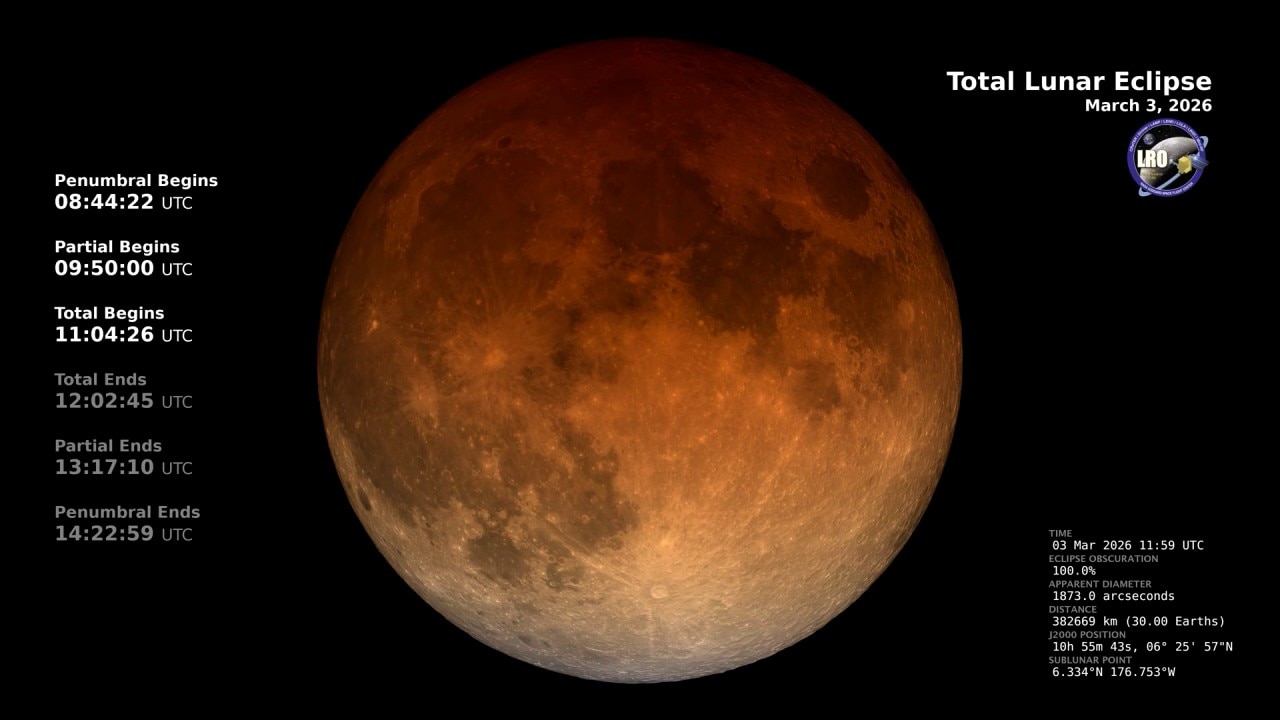
Telescopic view of a total lunar eclipse
Data visualization showing a telescopic view of the Moon as the March 2026 total lunar eclipse unfolds. (Credit: NASA’s Scientific Visualization Studio)
Calling all sky watchers! Don’t forget to look up March 3 for the blood moon total lunar eclipse.
The celestial event should be visible from the U.S. but you might need to wake up early (especially if you’re on the West Coast) to catch it.
Here’s what you need to know:
When is the total lunar eclipse?
The total lunar eclipse will take place in the early morning hours of March 3, 2026 (Tuesday).
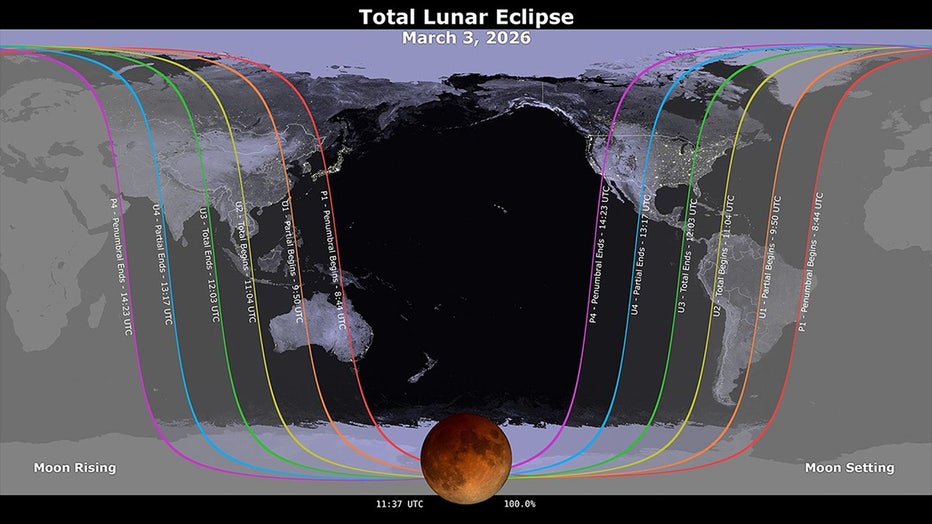
FILE - Map showing where the March 3, 2026 lunar eclipse is visible. Contours mark the edge of the visibility region at eclipse contact times, labeled in UTC. (NASA’s Scientific Visualization Studio)
What time is the total lunar eclipse?
Timeline:
- Eclipse begins: The moon will make its way into Earth’s shadow beginning at 3:44 a.m. ET (12:44 a.m. PT).
- Partial eclipse begins: The moon will appear to have a "bite" taken out of it at this point. This portion of the eclipse will begin at 4:50 a.m. ET (1:50 a.m. PT).
- Totality: The moon will be entirely in Earth’s shadow and will be tinted a coppery red (hence it being the blood moon total lunar eclipse). This will take place at 6:04 a.m. ET (3:04 a.m. PT).
- Partial eclipse ends: The moon will begin making its way out of Earth’s shadow beginning at 8:17 a.m. ET (5:17 a.m. PT).
- Eclipse ends: The entire eclipse should be finished by 9:23 a.m. ET (6:23 a.m. PT).
Tips on viewing the total lunar eclipse
What you can do:
You won’t need any special equipment to view the total lunar eclipse, but if you have a telescope and binoculars handy, it can’t hurt to use them, according to NASA.
For optimal viewing, try to find somewhere that has very little light pollution.
What is a total lunar eclipse?
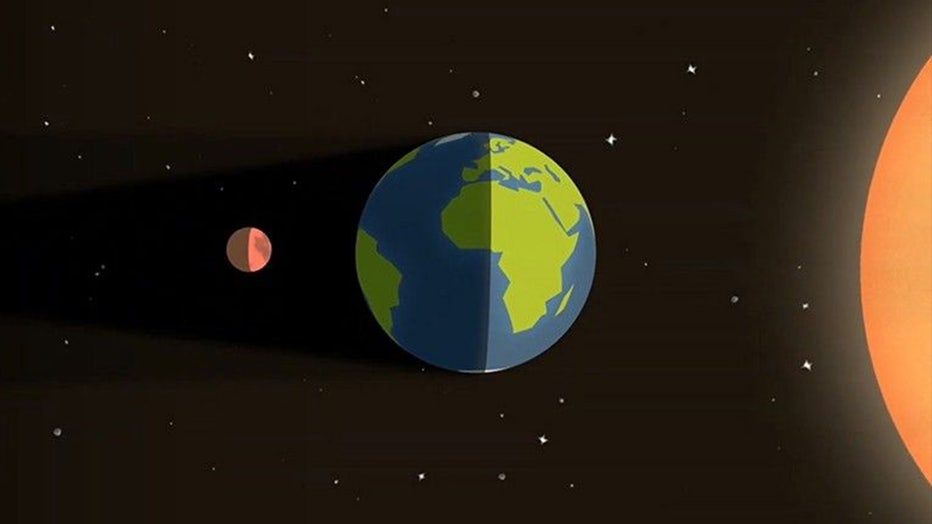
FILE - Alignment of the Moon, Earth, and Sun during a lunar eclipse (not to scale). (Credit: NASA's Scientific Visualization Studio)
Dig deeper:
A total lunar eclipse takes place when the Earth passes directly between the moon and the sun.
The giant shadow Earth casts on the moon will give it a reddish/copper hue. This event only happens during a full moon phase.
The Source: Information for this article was taken from the NASA website and Earthsky.org. This story was reported from San Jose.