

Can the U.S. 'run' Venezuela? What the law says about Maduro's arrest

FULL REMARKS: Trump says US will ‘run’ Venezuela after Maduro captured
The United States carried out a large-scale strike in Venezuela early Saturday. President Donald Trump said the country’s leader, Nicolás Maduro, and his wife Cilia Flores had been captured and flown out of the country. President Trump addressed the nation at a news conference on the capture of Venezuelan President Maduro. United States Secretary of War Pete Hegseth also delivered remarks on the events.
The U.S. attack on Venezuela and the capture of President Nicolás Maduro sent shockwaves around the world, raising serious questions about whether the aggression violated international law.
After months of military action in the region, U.S. forces launched more than 150 aircraft overnight Saturday — including bombers, fighter jets, surveillance planes, helicopters and drones — from 20 bases in the Western Hemisphere, according to Dan Caine, the chairman of the Joint Chiefs of Staff. Maduro and his wife, Cilia Flores, were taken by warship to New York, where they’ll face narco-terrorism conspiracy charges.
President Donald Trump said Saturday that the U.S. will "run" Venezuela, at least temporarily, and tap its vast oil reserves to sell to other nations.
Was it legal?
Dig deeper:
The Venezuela attack goes beyond even the most high-profile historical examples of aggressive American actions toward autocratic governments in Panama, Iraq and beyond, legal experts say.
MORE:
According to The New York Times, Maduro’s capture appears to be a violation of the United Nations Charter, a treaty ratified by the United States.
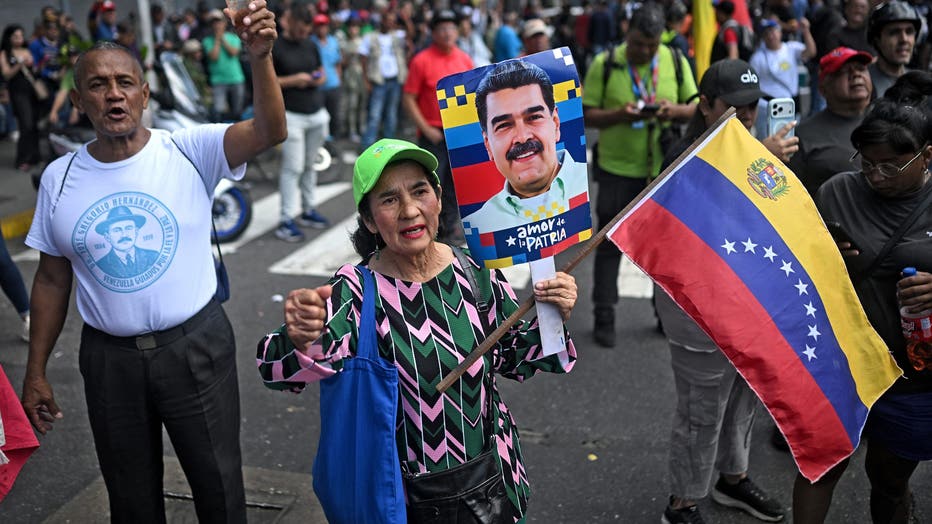
Supporters of Venezuela's President Nicolas Maduro with a national flag and a portrait of him, gather in the streets of Caracas on January 3, 2026, after US forces captured him. (Photo by Federico PARRA / AFP via Getty Images)
The charter states that a nation may not use force on the sovereign territory of another country without U.N. Security Council approval, unless the action was in self-defense. Typically, when the U.S. uses force without U.N. approval, it has the permission of a host government and a claim of self-defense.
Trump said a helicopter was hit and a few U.S. military members were injured, but no Americans were killed and no U.S. aircraft were destroyed. It’s still unclear how many members of the Venezuelan military were killed.
What they're saying:
"This is clearly a blatant, illegal and criminal act," Jimmy Gurule, a Notre Dame Law School professor and former assistant U.S. attorney, told The Associated Press.
The administration has conducted 35 known boat strikes against vessels around Venezuela since September, killing more than 115 people.
Michael Schmitt, a former Air Force lawyer and professor emeritus at the U.S. Naval War College, said the entire operation — the boat strikes as well as the apprehension of Maduro — are a clear violation of international law.
"Lawyers call it international armed conflict," Schmitt said. "Lay people call it war. So as a matter of law, we are now at war with Venezuela because the use of hostilities between two states clearly triggers an internal armed conflict."
Was Congress notified?
Congress has broad authority to authorize or limit the president's war powers, but it has not done either in Venezuela, even after Trump effectively declared that trafficking of drugs into the U.S. amounts to armed conflict requiring the use of military force. That’s a new rationale for past and future actions.

Trump: US oil companies will invest in Venezuela
President Donald Trump said Saturday that the United States will be strongly involved in Venezuela's oil industry, stating that American companies will invest billions of dollars in the country's energy sector following the capture of Nicolás Maduro. Will Freeman with the Council on Foreign Relations joins LiveNOW's Christina Evans to break down the latest on tensions between the US and Venezuela.
Congressional leaders of the "gang of eight," which includes House and Senate leaders from both political parties as well as lawmakers leading on the Intelligence committees, were not told about the operation until after it began. Secretary of State Marco Rubio said because of the nature of the surprise operation, it was not something that could be shared beforehand with the lawmakers.
What's next:
House Speaker Mike Johnson, R-La., said the administration "is working to schedule briefings" for lawmakers when they return to Washington next week.
The Senate is also expected to vote on a bipartisan war powers resolution that would block the use of U.S. forces against Venezuela unless authorized by Congress.
When’s the last time this happened?
The backstory:
Maduro’s arrest comes exactly 36 years after U.S. forces captured Panama's strongman Manuel Noriega, the last time the U.S. took such extraordinary action in Latin America. The U.S. invaded Panama in 1989 to arrest Noriega on drug trafficking charges.

Trump: No Americans killed in Maduro capture
President Donald Trump explained Saturday that no Americans were killed in the strikes on Venezuela that led to the capture of Venezuelan leader Nicolas Maduro. LiveNOW's Josh Breslow spoke with Mark Cancian at the CSIS to break down the latest.
In Panama, however, the U.S. had national security interests like the Panama Canal at stake, along with the safety of American citizens and U.S. military installations in the country. And opposition candidate Guillermo Endara was immediately sworn in as president of Panama, with no direct occupation by the United States, The New York Times reports.
The Source: This report includes information from The Associated Press, The New York Times and previous FOX Local reporting.