

Dead, pregnant endangered fin whale found on bow of Alaska cruise ship

Divers' close encounter with whale after spectacular breach
A group of divers in French Polynesia recorded an incredible sight of a breaching whale that swam underneath them. Credit: Bella Massey via Storyful
A cruise ship arrived in Seward, Alaska, on June 19 carrying more than visiting tourists returning from a scenic voyage.
Draped over the massive vessel's bulbous bow was the body of a 61-foot pregnant endangered fin whale, prompting a federal investigation into what officials believe was a fatal vessel strike.
According to NOAA Fisheries Alaska, it was determined that the endangered whale was freshly dead in good nutritional condition, with plenty of blubber and muscle after the whale was towed to a local beach for examination.
While the official cause of death is still pending, preliminary necropsy findings showed blunt force trauma to the jaw, spine and ribs consistent with a vessel strike.
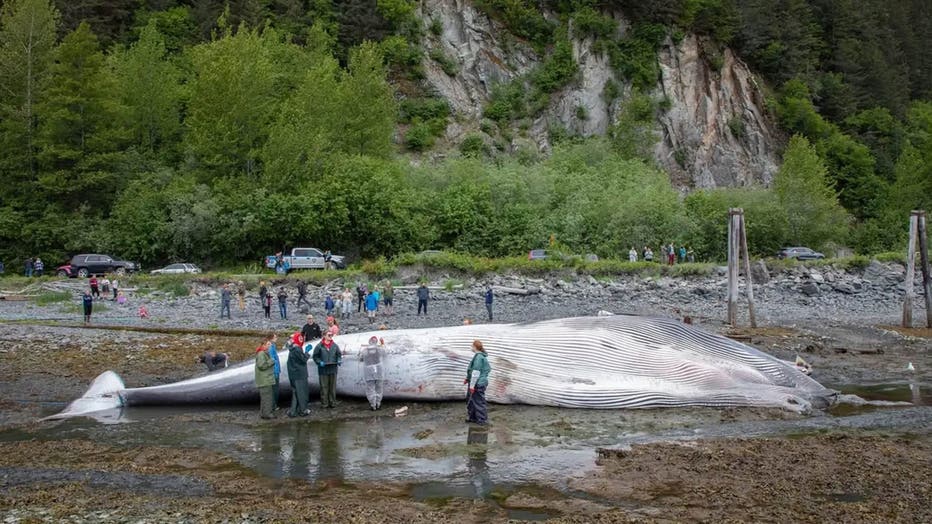
Alaska SeaLife Center staff perform a necropsy on a deceased fin whale in Seward, Alaska on June 20, 2026. (NOAA Fisheries Permit #24359, Alaska SeaLife Center | Kaiti Grant)
The cruise ship carrying the massive dead whale was the Ovation of the Seas, operated by Royal Caribbean Group, a 14-deck vessel that can hold more than 4,000 passengers.
In a statement, a Royal Caribbean Group spokesperson said, "We are deeply saddened by the whale incident involving one of our ships en route to Seward and take any impact to marine life with the utmost seriousness. We are cooperating fully with NOAA, and we will partner with them following their final investigative findings. Our respect for the ocean is at the core of everything we do,"
A law enforcement investigation into the matter is ongoing, according to NOAA Fisheries Alaska.
"Thank you to our partners, local volunteers, and the community for your cooperation and support during the response effort," NOAA Fisheries Alaska said in Facebook post.
The dead, endangered whale will be towed out to sea, where it will sink and feed a wide variety of deep-sea marine life.
Since 1970, fin whales have been classified as an endangered species after the species' population was decimated by commercial whaling in the 1800s and 1900s and is protected under the Marine Mammal Protection Act, according to the Alaska Department of Fish and Game.
Under the Marine Mammal Protection Act, killing a protected whale in a vessel strike is classified as a "take," a legal term that includes harassing, hunting, capturing or killing a marine mammal. Whether a take results in enforcement action depends on the circumstances of the incident and NOAA's investigation.