

House passes Daylight Saving Time bill: What it means for your state
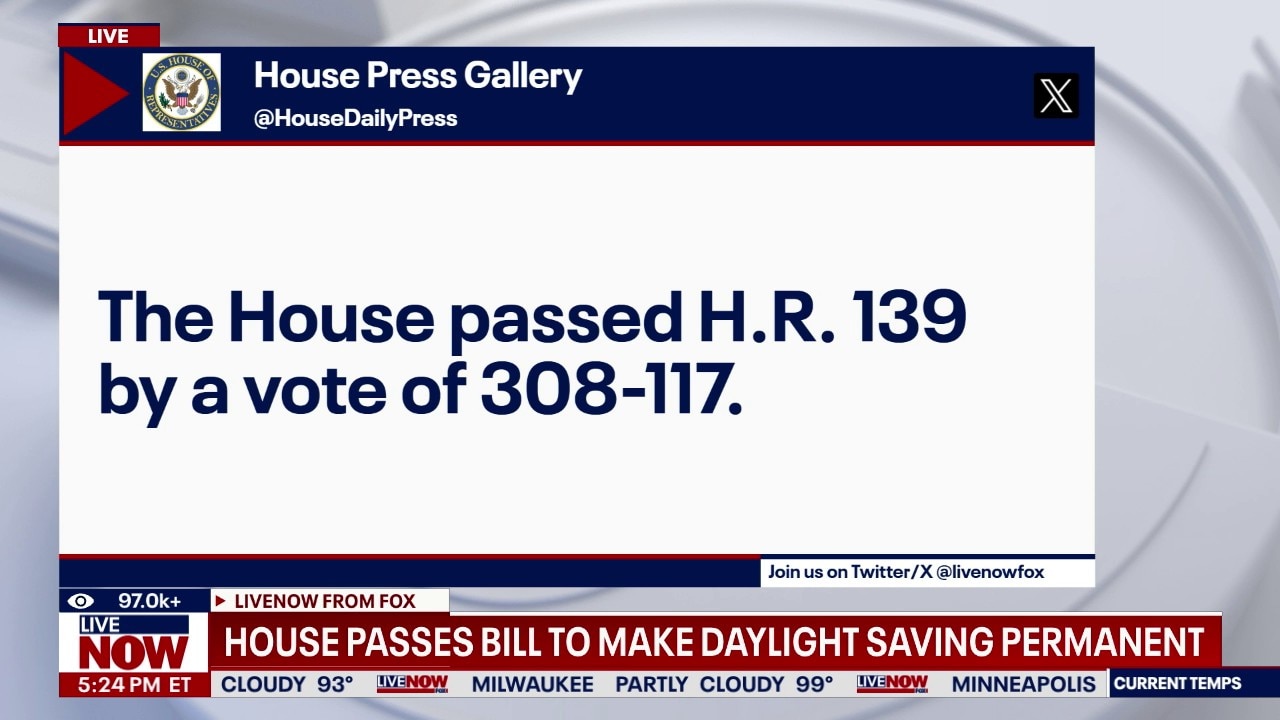
House passes bill to make Daylight Saving Time permanent
Tuesday afternoon, the House of Representatives approved a measure known as the "Sunshine Protection Act", which would make Daylight Saving Time permanent. The vote was 308-117. The bill now heads to the Senate.
WASHINGTON - The U.S. House has passed the Sunshine Protection Act, which would allow states to enact Daylight Saving Time year-round — with an option to opt out. The legislation now heads to the Senate, which will need to approve it for it to become law.
The Sunshine Protection Act requires states to observe year-round daylight saving time, but states can opt out of it before the act takes effect. The last clock change would happen in March 2027, when we will change our clocks — spring ahead — and no longer set our clocks back an hour — fall back — in November.
Several states — Alabama, Colorado, Delaware, Florida, Georgia, Idaho, Louisiana, Maine, Minnesota, Mississippi, Montana, Oklahoma, Oregon, South Carolina, Tennessee, Texas, Utah, Washington, and Wyoming — have already passed legislation making Daylight Saving Time permanent.
FO;E = An alarm clock stands next to a bed in which a woman is sleeping. Daylight saving time begins in Germany on 29.03.2026. Photo: Elisa Schu/dpa (Photo by Elisa Schu/picture alliance via Getty Images)
What's next:
The Senate will now take up the legislation which the upper changer will need to approve for it to become law. In 2022, the Senate approved a bill to make daylight saving time permanent, but it faced opposition in the House.
President Donald Trump has repeatedly urged Congress to make Daylight Saving Time permanent and end the twice-a-year ritual of changing clocks.
History of Daylight Saving Time
The backstory:
Daylight saving time is defined as a period between spring and fall when clocks in most parts of the country are set one hour ahead of standard time. According to federal law, it always starts on the second Sunday in March and ends on the first Sunday in November.
The practice of springing forward in the U.S. started in 1918 during World War I as a way to conserve fuel. By moving the clocks ahead an hour, backers believed the country could divert a bit of coal-fired electricity to the military instead of using it for an hour of home power. It was reenacted in World War II.
It was repealed again when the war ended, but some states — and even some cities — continued to observe daylight saving time while others kept standard time year-round. That meant driving relatively short distances could result in a time change.
By 1966, airlines and other businesses tired of such quirks and pushed Congress to pass the Uniform Time Act. It codified daylight saving time, although it has been modified periodically.
Most Americans already set their clocks forward one hour each spring to preserve more evening daylight before "falling back" one hour in November.
Daylight Saving Time is observed in 48 states. Hawaii and Arizona do not observe Daylight Saving Time, but the Navajo Nation in northeastern Arizona does observe it. Several U.S. territories — American Samoa, Guam, Northern Mariana Islands, Puerto Rico, and the Virgin Islands — also do not observe Daylight Saving Time.
The Source: This article includes information from FOX News and previous FOX Local reporting. This story was reported from Orlando.