

Iowa law banning most abortions after about 6 weeks takes effect
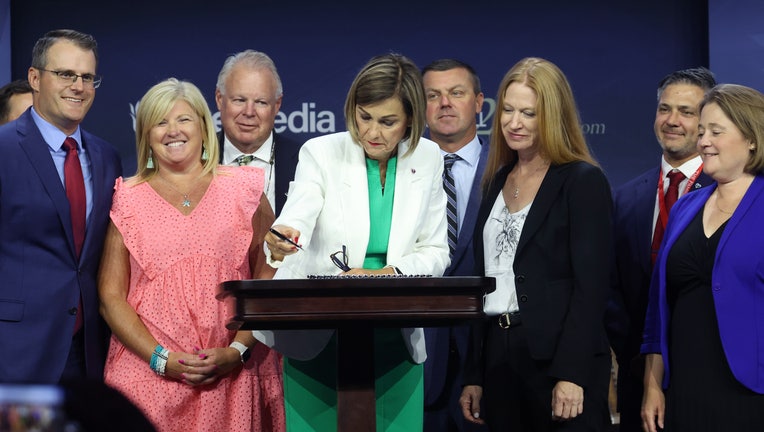
Iowa Governor Kim Reynolds signs into law a bill that will ban most abortions after around six weeks of pregnancy during a visit to the Family Leadership Summit on July 14, 2023 in Des Moines, Iowa. (Photo by Scott Olson/Getty Images)
Iowa’s ban on most abortions after about six weeks of pregnancy was signed into law Friday by Gov. Kim Reynolds, but a judge is still considering abortion advocates’ request to put the restrictions on hold.
The new legislation prohibits almost all abortions once cardiac activity can be detected, which is usually around six weeks of pregnancy and before many women know they are pregnant. That’s a dramatic shift for Iowan women; abortion had been legal up to 20 weeks of pregnancy.
Reynolds signed the measure into law in front of 2,000 conservative Christians barely a mile away from where a court hearing for the request to postpone the state’s new ban took place.
That hearing ended Friday with the judge saying a decision may be made next week.
READ MORE: Few Americans support full abortion bans, including in states that have them, AP-NORC poll finds
The legal challenge was filed Wednesday morning by the ACLU of Iowa, Planned Parenthood North Central States and the Emma Goldman Clinic.
The split screen punctuates a bitter battle between abortion advocates and opponents in Iowa that has dragged on for years and will likely, for now, remain unresolved as the courts assess the law’s constitutionality.
READ MORE: One year without Roe v. Wade: Here's where abortion laws stand in your state
The bill passed with exclusively Republican support late on Tuesday at the conclusion of a rare, 14-hour special legislative session.
The new measure will be considered in the context of decisions by the U.S. Supreme Court and Iowa’s Supreme Court last year, when both reversed themselves on rulings that had affirmed a woman’s fundamental constitutional right to abortion.
Those decisions prompted Reynolds to ask the court to reinstate her blocked 2018 law, which is nearly identical to the new one. The state’s high court deadlocked last month, prompting Reynolds to call lawmakers back to the Iowa Capitol.
"The Iowa Supreme Court questioned whether this legislature would pass the same law they did in 2018, and today they have a clear answer," Reynolds said Tuesday in a statement. "Justice for the unborn should not be delayed."
Planned Parenthood North Central States said Wednesday they are preparing to have to refer patients to other states if the law isn’t blocked but are hopeful there will not be an interruption in their services.
"We are seeking to block the ban because we know that every day this law is in effect, Iowans will face life-threatening barriers to getting desperately needed medical care — just as we have seen in other states with similar bans," Rita Bettis Austen, legal director for the ACLU of Iowa, said in a statement.
As of Wednesday, 200 patients were scheduled for abortions at Iowa Planned Parenthood or the Emma Goldman Clinic this week and next, according to the court filings. Most of them past the six-week mark in their pregnancies.
There are limited circumstances under the measure that would allow for abortion after the point in a pregnancy where cardiac activity is detected: rape, if reported to law enforcement or a health provider within 45 days; incest, if reported within 145 days; if the fetus has a fetal abnormality "incompatible with life"; or if the pregnancy is endangering the life of the pregnant woman.
Most Republican-led states have drastically limited abortion access in the year since the U.S. Supreme Court overturned Roe v. Wade and handed authority on abortion law to the states. More than a dozen states have bans with limited exceptions and one state, Georgia, bans abortion after cardiac activity is detected. Several other states have similar restrictions that are on hold pending court rulings.