

Nissan pauses US production of 3 models amid tariff uncertainty

Latest reactions after Trump’s tariff announcement
On Monday, President Donald Trump announced a 25% tax on imported goods from South Korea and Japan. The President cited persistent trade imbalances with two of the United States’ most crucial allies in Asia. LiveNOW’s Austin Westfall is speaking with Nestpoint Managing Director John Thomas, addressing questions on international reactions.
LOS ANGELES - Nissan has temporarily suspended U.S. production of three vehicle models meant for Canada, the automaker confirmed to Reuters Wednesday, as a result of rising trade tensions between the U.S. and Canadian governments.
The Japanese carmaker said production of the Pathfinder and Murano SUVs—assembled in Tennessee—and the Frontier pickup, made in Mississippi, has been halted for Canadian export. The company did not specify when the suspension began or how long it would last, but characterized it as a short-term move.
"This is a short-term and temporary measure, and we remain hopeful that ongoing discussions between the U.S. and Canadian governments will lead to a successful agreement in the near future," Nissan said in a statement.
The production freeze, first reported by Japan’s Nikkei newspaper, comes amid retaliatory tariffs between the U.S. and Canada on auto imports, which began after the Trump administration imposed a 25% tariff on vehicles in April.
Why is Nissan halting production for Canada?
The backstory:
The U.S. imposed a 25% tariff on auto imports earlier this year, prompting Canada to respond with retaliatory tariffs on U.S.-made vehicles. These trade restrictions have disrupted cross-border auto flows and forced companies like Nissan and Mazda to shift their manufacturing priorities.
Nissan confirmed the affected vehicles—Pathfinder, Murano, and Frontier—are assembled in the U.S. and had been shipped to Canada prior to the tariffs. With cross-border costs now higher, production for the Canadian market has been paused indefinitely.
Mazda also suspended Canada-bound production at its Alabama plant in May and reallocated manufacturing to focus on U.S. demand.
The production pause affects three Canada-bound models: Pathfinder, Murano, and Frontier—all made in the U.S.
Nissan said 80% of its Canadian sales come from models sourced from Mexico and Japan, including the Versa, Sentra, and Rogue.
The company sold around 104,000 vehicles in Canada last fiscal year—just 3% of its global sales.
What we don't know:
Nissan has not announced when the production suspension will end.
It’s unclear whether further U.S.-Canada negotiations could ease the tariffs or whether other automakers will follow suit.
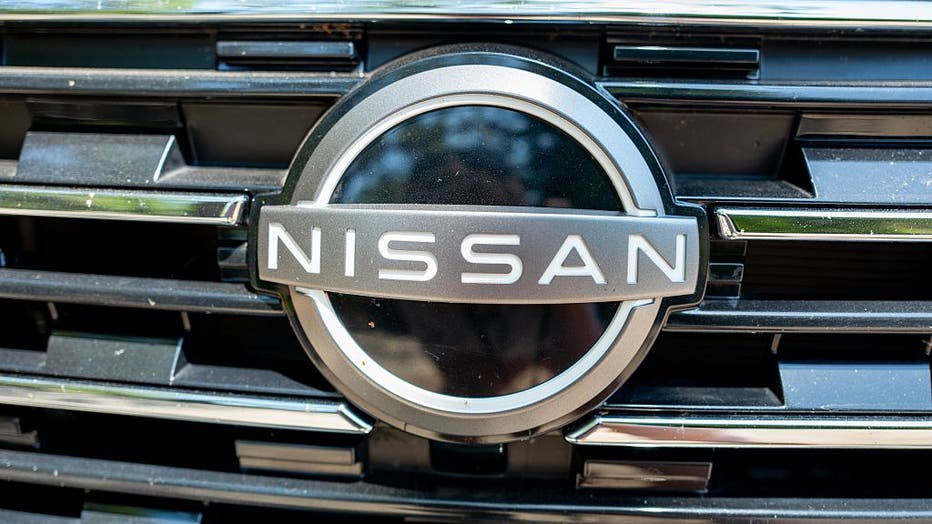
The Nissan logo is seen on the grille of a vehicle. The automaker recently halted U.S. production of several Canada-bound models due to retaliatory tariffs between the U.S. and Canada. (Photo by Smith Collection/Gado/Getty Images)
The impact on Canadian dealerships and availability of Nissan models remains uncertain.
By the numbers:
Nissan has also reportedly asked some suppliers to delay payments, as it scrambles to improve liquidity amid slumping sales and an aging vehicle lineup. Although Canada is a relatively small market for the company, the disruption underscores the broader financial and operational challenges Nissan faces in 2025.
- Nissan reported a $4.5 billion net loss for the financial year ending in March.
- The automaker faces 700 billion yen (~$4.8 billion) in debt due this fiscal year.
- Its credit rating has been downgraded to junk status by all three major rating agencies.
The Source
This article is based on reporting from Reuters and a public statement from Nissan Motor Co. confirming the production suspension. The initial report on the production halt was published by Japan’s Nikkei newspaper. Additional context on trade tariffs and Nissan’s financial situation was included in Reuters’ July 10 coverage and company earnings reports.
The Source: This article is based on reporting from Reuters and a public statement from Nissan Motor Co. confirming the production suspension. The initial report on the production halt was published by Japan’s Nikkei newspaper. Additional context on trade tariffs and Nissan’s financial situation was included in Reuters’ July 10 coverage and company earnings reports.