

Watch: Fascinating video shows plant 'breathing'

Video shows stomata on plant "breathing" in
Scientists have developed a tool that can observe the microscopic movements of the stomata on plants "breathing" in carbon dioxide. (Credit: University of Illinois at Urbana-Champaign Institute for Sustainability, Energy, and Environment)
Researchers at the University of Illinois at Urbana-Champaign shared that by using a new "Stomata In-Sight" system, they were able to capture plant "breathing" in.
Dig deeper:
The groundbreaking new tool can help scientists see how much carbon dioxide is being taken in via the stomata, as well as how much water is being lost.
Special cells surrounding the stomata allow it to open and close in response to environmental conditions, Andrew Leakey at the Department of Plant Biology and the Institute for Genomic Biology at the University of Illinois, told LiveNOW from FOX.
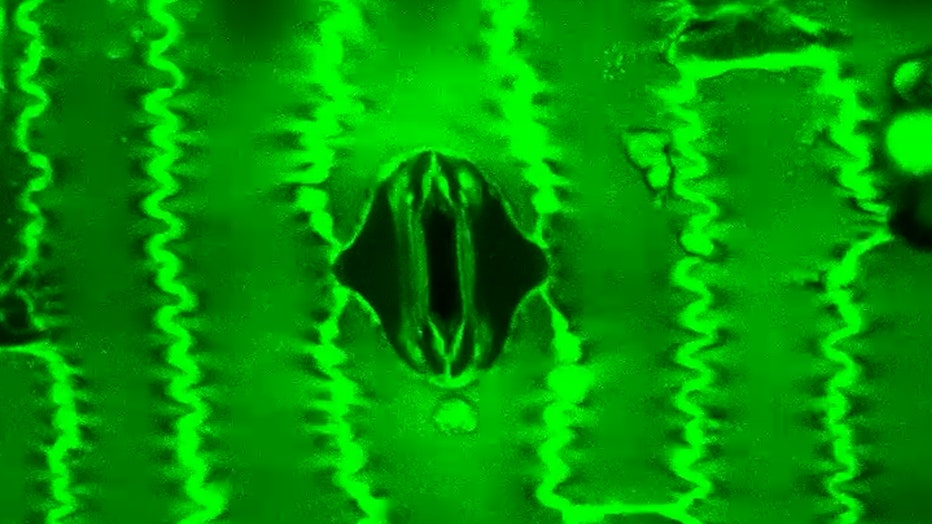
Still image taken from video showing stomata on plant opening and closing/breathing. (Credit: University of Illinois at Urbana-Champaign Institute for Sustainability, Energy, and Environment)
What they're saying:
"For example they open the pore in the light and close it in the dark. This happens in order to allow photosynthesis to happen when conditions are favorable, but to minimize the loss of water from the interior of the leaf to the atmosphere. When plants don't have access to enough water — because the weather is hot and dry, or because we forget to water them — they start to dry out and don't grow as well," Leakey explained.
What are stomata?
The leaves of all plants are covered in tiny pores called stomata, which is Greek for "mouth."
Each pore is a microscopic opening that allows carbon dioxide in, where it is then captured by photosynthesis and converted into sugars, Leakey said.
"The plant can then use those sugars to grow and produce the food, animal feed, fuel and other raw materials we and the other life on Earth depends upon," Leakey continued.
Why you should care:
Being able to quantify this can help how plants are bred and can help develop crops that need less water to grow. This will then hopefully lead to creating more reliable produce for food, biofuel and bioproducts in areas that experience drought, researchers said.
The Source: Information for this article was taken from a study published in the journal Plant Physiology on Nov. 17, 2025. This story was reported from San Jose.