

Winter solstice 2025: What to know about the shortest day of the year
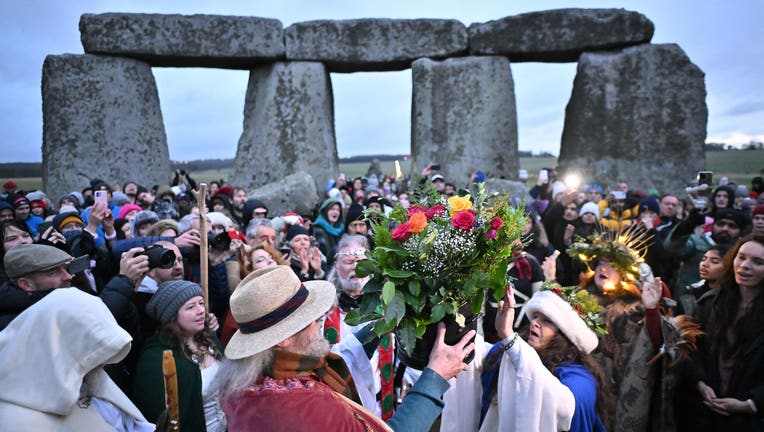
FILE - Revellers celebrate the pagan festival of 'Winter Solstice' at Stonehenge in Wiltshire in southern England on December 22, 2023. (Photo by BEN STANSALL/AFP via Getty Images)
The winter solstice is almost here to mark the shortest day of the year.
Each year, the winter solstice brings the least amount of daylight and the longest night.
When is the winter solstice?
Timeline:
This year, the winter solstice will occur on Sunday, Dec. 21, at 10:03 am. EST when the Northern Hemisphere is tilted the farthest away from the Sun.
The Northern Hemisphere’s winter solstice always falls on December 21 or 22, depending on when the Earth makes one full revolution around the sun. In the Southern Hemisphere, the winter solstice is on June 20 or 21.
RELATED: When is the official start of winter? Here's why meteorological winter begins on December 1
Winter solstice is the start of astronomical winter, but meteorological winter begins three weeks earlier on Dec. 1. Meteorologists label winter as December through the end of February – the three coldest months of the year in the Northern Hemisphere.
Which cities are the darkest?
Local perspective:
According to FOX Weather, in cities like Miami, Houston, Atlanta, and Los Angeles, residents will experience at least three to four hours less daylight. New York City and Chicago will see about six hours less, while cities such as Minneapolis, Portland, and Seattle will have roughly seven hours less daylight.
What is the winter solstice?
Big picture view:
The winter solstice marks the start of each hemisphere’s winter season.
Earth’s axis is tilted by 23.5 degrees which causes one half of the planet to be pointed away from the sun and the other half is pointed towards it at the time of the solstice.
That’s why the other half of Earth experiences summer while we experience winter.
Winter solstice celebrations
The darkest day of the year has been celebrated possibly as early as the Stone Age, according to History.com. Neolithic monuments in Scotland and Ireland, built around 3,000 B.C., are aligned with sunrise on the winter solstice.
Stonehenge, one of the world’s best-known prehistoric monuments located in Wiltshire, England, is oriented toward the winter solstice sunset — which may have been a place of December rituals for people of the Stone Age.
The Source: This report includes information from FOX Weather, History.com and previous LiveNow from FOX reporting.