

A third of US parents give fever-reducing meds to their kids when it’s not needed

What is the difference? COVID-19, the flu, the common cold
Health experts advise getting tested by a health care provider but here are some key differences between COVID-19, the flu and the common cold as told by a nurse educator.
LOS ANGELES - A third of U.S. parents are giving their kids fever-reducing medication when it may not be needed, according to a new C.S. Mott Children’s Hospital National Poll.
According to researchers, it may be tempting to give your child anything to make them more comfortable when they’re feeling sick, however, unnecessarily giving a child this medication could postpone the correct diagnosis by masking pain and other symptoms.
"Fever is a signal that the child has an illness and the body is attempting to fight off the cause. When parents suspect their child may have a fever, their first decision is whether to take the child’s temperature. Some parents do this at the first sign of any problems, while others choose to monitor their child, and likely consider other factors such as whether the child has additional symptoms of illness," poll authors write.
When should you give your child fever reducing medications?
The Mott Children’s Hospital report says parents should know that giving medication to lower a child’s temperature doesn’t necessarily cure the illness faster.
In fact, as long as your child maintains a low-grade fever, this might be the best way to help fight off the infection.
"This is consistent with research showing that, at increased temperatures, our immune cells are more effective at destroying the viruses and bacteria that cause infection," Mott Children’s Hospital writes.
Another alternative to medicine is simply to monitor the temperature. Keep the child comfortable by giving them light clothing and making sure they stay hydrated.
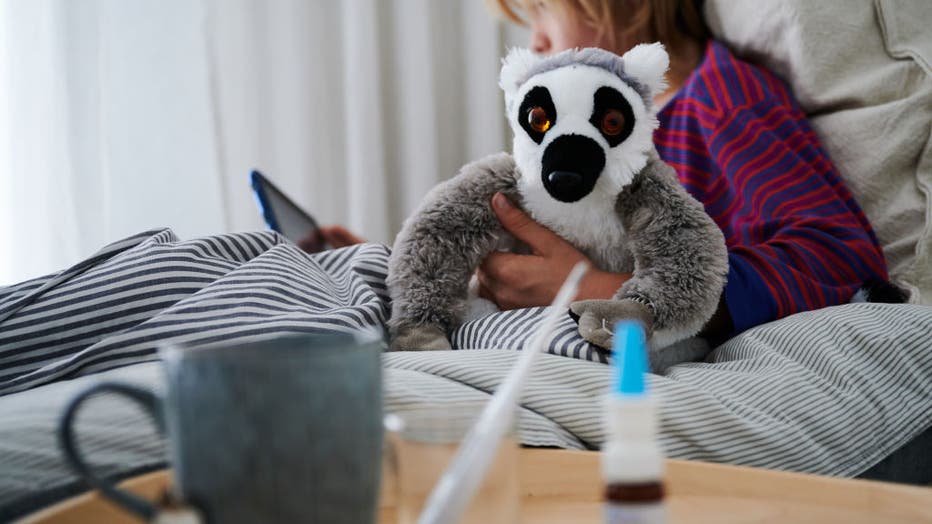
ILLUSTRATION - 11 September 2021, Berlin: A fever thermometer, nasal spray and a cup of tea stand in front of a bed in which a child with a cuddly toy is looking at a tablet. Photo: Annette Riedl/dpa (Photo by Annette Riedl/picture alliance via Getty
Should you give you child fever-reducing medications prior to a vaccine?
Mot Children’s Hospital writes, "While this was a common practice in the past, it is not currently recommended due to concerns that it may reduce the effectiveness of vaccines."
It may be worrisome to watch your child struggle with a fever, but it’s actually a sign that their immune system is responding to the vaccine.
That said, it is extremely important to monitor your child's temperature for abnormal levels. Obviously if your child's fever is running drastically above low-grade levels, it is recommended to seek medical treatment.
When should you contact your doctor?
- Children 0-3 months: Any fever should prompt a call
- Children 4-12 months: Parents should call if the fever is accompanied by signs of decreased activity, increased fussiness, or decreased urine output.
- Children 2 or younger: Call your doctor if a fever that reaches 104° remains for more than 24 hours.