

Amazon’s Project Kuiper launches first full batch of satellites from Florida

Amazon’s Project Kuiper launches from Florida
Amazon’s Project Kuiper launched its first full satellite mission using a United Launch Alliance (ULA) Atlas V rocket from Cape Canaveral.
ORLANDO, Fla. - Amazon’s Project Kuiper launched its first full batch of satellites from Florida using a United Launch Alliance (ULA) Atlas V rocket. The rokcet lifted off just after 7 p.m., from Space Launch Complex-41 at Cape Canaveral.
ULA rocket delivers Project Kuiper into orbit
What we know:
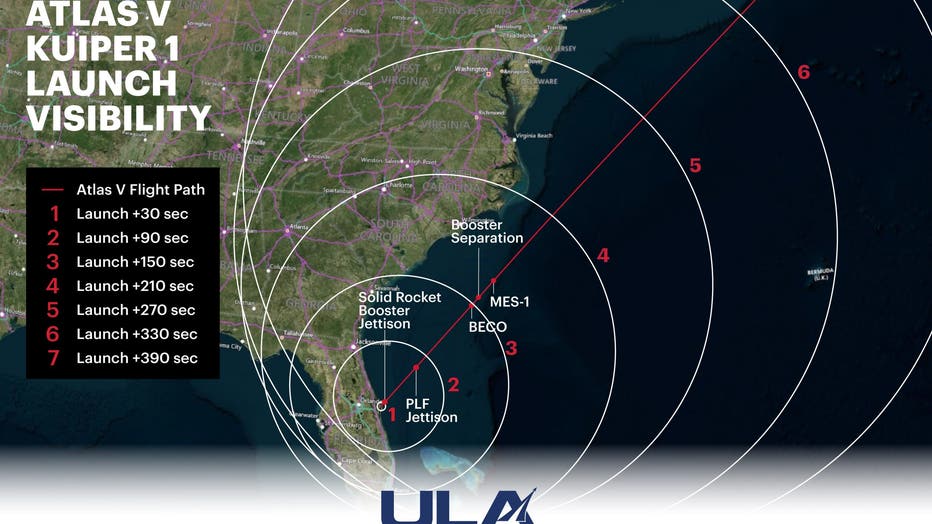
The mission aims to deploy the first operational satellites of a planned 3,200-satellite constellation into low Earth orbit (LEO), approximately 280 miles (450 kilometers) above Earth. Countdown operations are proceeding smoothly, with no issues reported by the ULA launch team. Liftoff is targeted for 7:01 p.m. EDT (2300 UTC), and the rocket will follow a northeasterly trajectory.
The rocket that launched on Monday has flown 14 times, including launches of NASA's New Horizons to study Pluto, Juno to orbit Jupiter and a variety of national security missions.
What we don't know:
While Amazon has completed extensive ground testing, uncertainties remain about how the final satellite design will perform once deployed in orbit.
The mission marks the first deployment of the full-production Kuiper satellites, meaning some operational characteristics and performance metrics will only become clear after launch. It's also unknown how quickly the satellites will be integrated into the wider Kuiper network for customer service activation later this year.
The backstory:
Project Kuiper has been in development for several years, with Amazon aiming to create a global broadband network serving underserved and remote communities. A critical milestone was reached in October 2023, when Amazon successfully launched two prototype satellites via an Atlas V 501 rocket during the Protoflight mission.
Those early tests paved the way for today's improved satellite systems, including advancements in phased array antennas, processors, solar arrays, propulsion, and optical inter-satellite links. The satellites now also feature a special dielectric mirror film to reduce their visibility to astronomers.
Big picture view:
Project Kuiper represents Amazon’s entry into the growing field of satellite internet providers, competing with companies like SpaceX’s Starlink. The goal is to provide fast, reliable, low-latency internet access to virtually any point on the globe. If successful, Project Kuiper could transform connectivity for millions of people, especially in rural and underserved regions.
The launch is also another step in solidifying Amazon’s ambitions in space-based infrastructure, technology, and communications.
What they're saying:
"We’ve designed some of the most advanced communications satellites ever built, and every launch is an opportunity to add more capacity and coverage to our network," said Rajeev Badyal, vice president of Project Kuiper.
STAY CONNECTED WITH FOX 35 ORLANDO:
- Download the FOX Local app for breaking news alerts, the latest news headlines
- Download the FOX 35 Storm Team Weather app for weather alerts & radar
- Sign up for FOX 35's daily newsletter for the latest morning headlines
- FOX Local: Stream FOX 35 newscasts, FOX 35 News+, Central Florida Eats on your smart TV
The Source: This story was written based on information shared by United Launch Aliance and Amazon.