

Can noncitizens vote? State-by-state laws
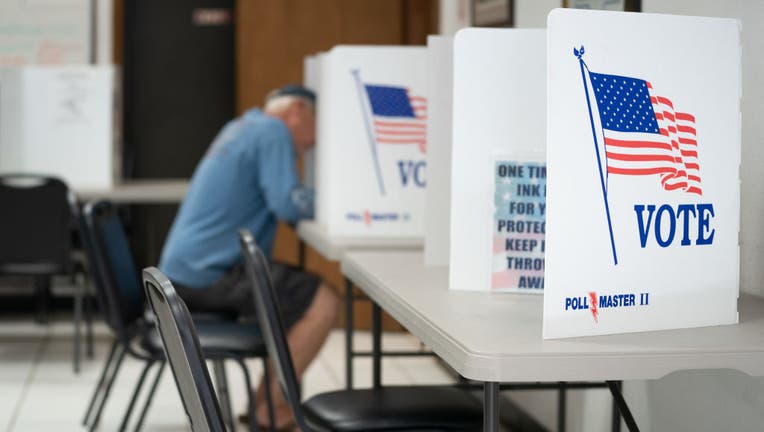
FILE - A man fills out a ballot at a voting booth on May 17, 2022 in Mt. Gilead, North Carolina. North Carolina is one of several states holding midterm primary elections.
LOS ANGELES - In the United States, the ability for noncitizens to vote varies widely depending on federal, state, and local laws. While federal law explicitly prohibits noncitizens from voting in federal elections—including presidential, U.S. House, and U.S. Senate races—states and localities have more leeway when it comes to determining voting rights in state and local elections.
As of 2024, no state constitutions explicitly allow noncitizens to vote in state or local elections, but certain municipalities have passed laws that permit noncitizens to vote in local elections. Conversely, several states have taken steps to ensure noncitizens are banned from voting altogether.
Federal law on noncitizen voting
The Illegal Immigration Reform and Immigrant Responsibility Act (IIRIRA) of 1996 prohibits noncitizens from voting in federal elections and establishes penalties, including fines and imprisonment, for violations. However, this law does not apply to state or local elections, leaving it up to individual states and municipalities to determine their own policies on noncitizen voting.
The U.S. Congress passed the IIRIRA as a way to crack down on illegal immigration while still protecting the rights of legal residents. Former President Bill Clinton supported the measure, emphasizing that it would reinforce the rule of law without punishing those living legally in the U.S.
Where can noncitizens vote in local elections?
While federal law bans noncitizen voting in national elections, a few U.S. cities and municipalities have extended voting rights to noncitizens for local matters, including school board elections and city council races. These areas typically argue that noncitizens, especially permanent residents, have a vested interest in local governance and services like education and transportation.
The following municipalities allow noncitizen voting in some or all of their local elections:
- San Francisco, California: Noncitizens can vote in school board elections. Proposition N, passed in 2016, allowed noncitizen parents or guardians of children in the San Francisco Unified School District to vote in school board elections.
- Oakland, California: Approved in 2022, a charter amendment allows noncitizens who are parents or legal guardians to vote in school board elections.
- Takoma Park, Maryland: One of the first cities to restore noncitizen voting rights in 1992, noncitizens can vote in all local elections.
- Burlington, Vermont: In 2023, the city extended voting rights to noncitizens for local elections.
- Montpelier and Winooski, Vermont: Passed in 2021, these cities allow noncitizens to vote in local elections.
Each of these policies has faced opposition and legal challenges. For example, a California Court of Appeal upheld San Francisco’s noncitizen voting law in 2023 after it was initially overturned for conflicting with the state constitution.
States that prohibit noncitizen voting
In response to concerns about voter fraud and the influence of noncitizens in local politics, several states have passed constitutional amendments explicitly banning noncitizen voting in all elections. As of 2024, seven states have such provisions in place:
- Alabama
- Arizona
- Colorado
- Florida
- Louisiana
- North Dakota
- Ohio
These states have taken steps to clarify their constitutions to ensure that only U.S. citizens can vote in both state and local elections. For instance, North Dakota’s Measure 2, passed in 2018, changed the wording in the state constitution from "every citizen" being eligible to vote to "only a citizen."
Upcoming ballot measures in 2024
In 2024, several states are introducing ballot measures to further define citizenship requirements for voting. States including Iowa, Missouri, Kentucky, and South Carolina will be voting on measures to ban noncitizen voting in their constitutions.
Proponents of these measures argue that they are necessary to preserve the integrity of the voting system, while opponents claim they are redundant and target noncitizens unfairly.
What are the arguments for and against noncitizen voting?
Advocates for noncitizen voting argue that legal residents, especially those who pay taxes and send their children to public schools, should have a say in how their local communities are governed. They point out that noncitizens are often deeply embedded in their local communities, contributing economically and socially.
Opponents, however, argue that allowing noncitizens to vote undermines the importance of citizenship. They contend that voting is a fundamental right of U.S. citizens and that noncitizen voting dilutes the votes of legal residents. Legal challenges have been mounted across the country to stop noncitizens from voting in local elections, often with mixed results.