

Certain soaps could make you more or less attractive to mosquitoes, study finds
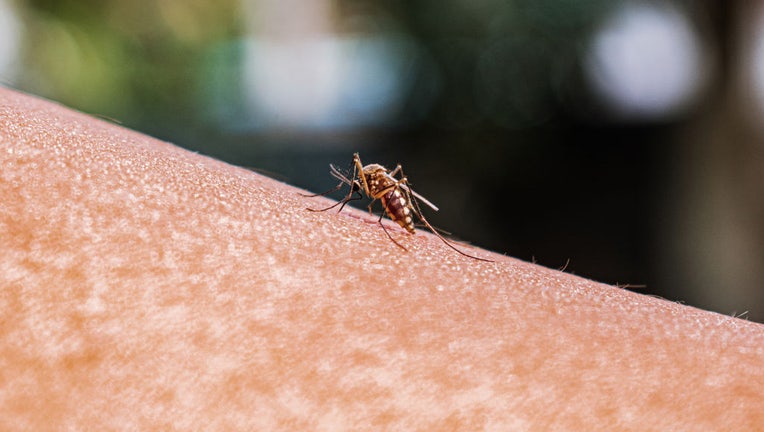
FILE - An adult female Anopheles mosquito bites a human body. (Photo by Soumyabrata Roy/NurPhoto via Getty Images)
Why are some people seemingly a mosquito magnet, while others are able to avoid those pesky bites? A new, small study suggests that certain soaps and scents may make one more or less attractive to the insects.
However, the effects vary between people – and each person’s unique human scent also plays a role, according to the researchers.
The study, conducted by researchers at Virginia Tech and published on May 10 in the journal iScience, included four human volunteers whose chemical odors were studied both when unwashed, and after they had washed themselves with each of four brands of soap: Dial, Dove, Native, and Simple Truth.
The team also analyzed the odor profiles of the soaps themselves.
Soap-washing was found to impact the mosquitoes’ preferences, but this differed between soap types and the human volunteers. Washing with Dove and Simple Truth increased the attractiveness of some – but not all – volunteers, while washing with Native soap tended to repel mosquitoes.
"It's remarkable that the same individual that is extremely attractive to mosquitoes when they are unwashed can be turned even more attractive to mosquitoes with one soap, and then become repellent or repulsive to mosquitoes with another soap," senior study author and neuroethologist Clément Vinauger said in a statement.
The research team used female Aedes aegypti mosquitoes for the study, which only feed on blood after mating – compared to males, which feed exclusively on nectar. This species of mosquito is a known vector of several viruses, including yellow fever, dengue, chikungunya, and Zika.
The study also considered the effects of exhaled carbon dioxide (CO2), which humans exhale and is an important cue for mosquitoes. The team conducted the mosquito preference trials on fabric that had absorbed the human volunteer’s odors rather than on the humans themselves.
"Everybody smells different, even after the application of soap. Factors like your physiological status, lifestyle, diet, and places you frequent all affect the way you smell," co-author and biologist Chloé Lahondère in a media release. "Soaps drastically change the way we smell, not only by adding chemicals but also by causing variations in the emission of compounds that we naturally produce."
Soap scent to repel mosquitoes? Study suggests coconut
To identify the specific ingredients that attract and repel mosquitoes, the researchers looked at the chemical compositions of the different soaps.
The team identified four chemicals associated with mosquito attraction and three chemicals associated with repulsion, including a coconut-scented chemical that is a key component in American Bourbon and a floral compound used to treat scabies and lice.
The team combined these chemicals to create and test attractive and repellent odor blends, which had strong impacts on mosquito preference.
"With these mixtures, we eliminated all the noise in the signal by only including those chemicals that the statistics were telling us are important for attraction or repulsion," Vinauger said. "I would choose a coconut-scented soap if I wanted to reduce mosquito attraction."
The team said it aims to expand the study results and find some general patterns by testing more soap varieties and more people. They also plan to explore how soap impacts mosquito preference over a longer period of time.
"We're very curious to look at the time course of this effect—so for example, if you take a shower in the morning, does it still matter to mosquitoes in the evening?" Vinauger said.
Other ways to prevent mosquito bites
To best prevent mosquito bites, the U.S. Centers for Disease Control and Prevention recommends using insect repellent with active ingredients such as DEET, Picaridin (known as KBR 3023), IR3535, Oil of lemon eucalyptus (OLE), Para-menthane-diol (PMD), and 2-undecanone.
"When used as directed, Environmental Protection Agency (EPA)-registered insect repellents are proven safe and effective, even for pregnant and breastfeeding women," the CDC states on its website.
Dress babies and children in clothing that covers arms and legs, and cover strollers and baby carriers with mosquito netting, the agency says.
Stopping mosquitoes from laying eggs in or near water can also help prevent bites.
"Once a week, empty and scrub, turn over, cover, or throw out items that hold water, such as tires, buckets, planters, toys, pools, birdbaths, flowerpots, or trash containers," the CDC says.
This story was reported from Cincinnati.