

Divers discover ancient Bronze Age sword off the coast of England
South West Maritime Archaeological Group
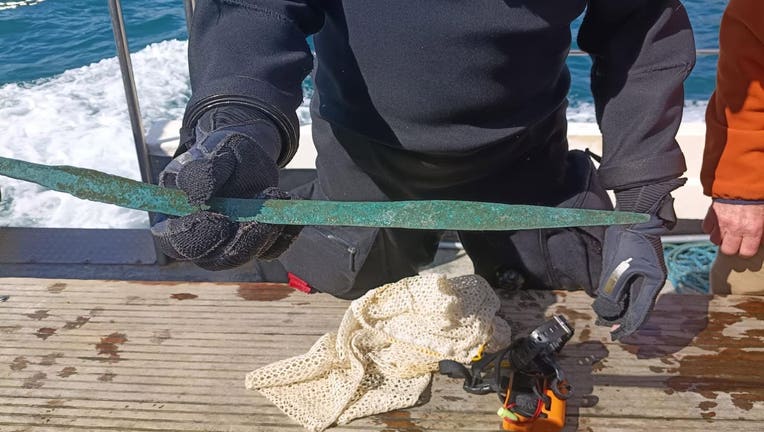
A British archaeological team recently announced the discovery of a rare Bronze Age sword during a dive off England's south west coast, shedding new light on the region's ancient maritime history.
The discovery was made earlier this year by the South West Maritime Archaeological Group (SWMAG) while investigating a wreck site long known for its 17th-century shipwrecks as well as even older prehistoric artifacts.
Archaeologists Becky Gill and Catherine Gill recovered the sword in the Salcombe area, an internationally significant prehistoric maritime site where previous discoveries have pointed to extensive Bronze Age trade and seafaring activity.
Dig deeper:
Experts say the weapon dated back to the middle or late Bronze Age, but due to the erosion of being buried, likely for centuries, would make it harder to pinpoint an exact age.
What they're saying:
"A kid at Christmas does not come close to the excitement of finding this sword," said one of the divers, Catherine Gill. "It is testament to the dedication of every member of the team, past and present, as well as a lesson in following your intuition and gut instinct. I’m proud to be a part of the next chapter of this important site."
The other diver, Becky Gill, spoke of the thrill of the historic find and what it meant to their team, "I wonder where and who made it, who was planning to use it, and who was the last person to touch it, before us, around 3000 years ago."
What's next:
The sword will eventually be donated to the British Museum to be studied and made available for further research.
The Bronze Age
Big picture view:
The Bronze Age was a prehistoric era in human history, spanning approximately 3300 to 1200 BCE in the Near East and 2200 to 800 BCE in Europe. The period was defined by humans learning to smelt copper and tin into bronze, forming a stronger alloy that reshaped warfare, farming and other crafts of early human history.
The period saw the rise of early civilizations like the Sumerians and Babylonians and the rise of Ancient Egypt with the creation of the Pyramids of Giza. However, climate change, famine and rebellions contributed to the fall of cities and the cut off of trade routes. The collapse helped usher early societies into the Iron Age.
The Source: This story was written with information provided by the South West Maritime Archaeological Group. This story was reported from Orlando.