

From bassets to bolonki: American Kennel Club adds 3 new breeds

FILE - Bolonka dog Rosi sits in the morning on the banks of the Elbe against the backdrop of the old town amidst wild chives. Photo: Robert Michael/dpa (Photo by Robert Michael/picture alliance via Getty Images)
The American Kennel Club has added three dogs to its list of recognized breeds in the U.S., including one named for a U.S. president and another from Cold War-era Russia.
Joining the official AKC roster makes them eligible for many U.S. dog shows and will likely increase their visibility to the pet-loving public. The AKC recognizes 205 breeds, including these three newcomers.
Here’s a closer look:
The basset fauve de Bretagne
Pronunciation:
bah-SAY’ fove deh breh-TAHN’-yeh
Fawn-colored, low-set dog from Brittany. A hardy, sociable, compact hound that can hunt all day — and needs mental and physical activity.
RELATED: Meet Aloka, the peace dog winning hearts nationwide during Walk for Peace
By the numbers:
12.5 to 15.5 inches at the base of the neck; 23 to 39 pounds
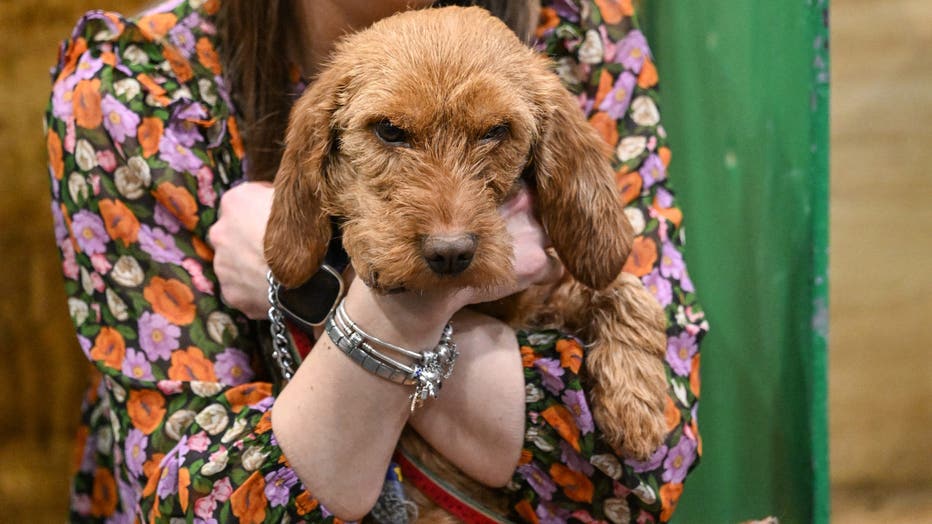
FILE - Basset Fauve de Bretagne dog on day two of Crufts 2022 at National Exhibition Centre on March 11, 2022 in Birmingham, England. (Photo by Katja Ogrin/Getty Images)
The backstory:
Versions of these coarse-coated, tan-hued hounds go back at least as far as 16th-century French aristocratic circles. The breed has been championed in the U.S. in recent years by Cindy Hartman, a South Carolina service dog trainer who brought a pair of fauve puppies back from France in 2001. She has since trained and placed about 20 fauves as medical alert dogs for people with diabetes, she said.
What they're saying:
"They’re wicked smart, and so if you’re wanting a dog that’s just going to lay around all day long, a fauve is not for you," Hartman said. "But yet, when challenged mentally and physically, they’re happy to come in with you and curl up on the sofa for the evening."
The Teddy Roosevelt terrier
A solid, energetic small canine that will rid your barn of rodents, alert you to strangers, do dog sports — or just entertain you with its antics.
By the numbers:
8 to 14 inches at the base of the neck; 8 to 25 pounds
The backstory:
Originally seen as a short-legged variant of the rat terrier, these dogs were deemed a breed of their own in 1999. The breed was named for President Theodore Roosevelt because of his fondness for dogs, including terriers.
VIDEO: Officer glides onto frozen New Jersey lake to rescue a trapped dog
What they're saying:
"They know how to get you to laugh," says Cindy Rickey of Waynesville, North Carolina, the secretary of the American Teddy Roosevelt Terrier Club. While many terrier breeds are known for being independent-minded, her Teddy competes in obedience. "They’re terriers, no doubt about it, but they also have this tremendous desire to please," she explains.
The Russian tsvetnaya bolonka
Pronunciation:
zvit-NEYE'-ah boh-LON'-kah
Russian colored lapdog. A sweet but clever little companion that wants playful interaction, not just snuggling (though it likes that, too).
By the numbers:
Up to 10¼ inches at the base of the neck; 7 to 9 pounds

FILE - Bolonka dog Rosi sits in the morning on the banks of the Elbe against the backdrop of the old town amidst wild chives. Photo: Robert Michael/dpa (Photo by Robert Michael/picture alliance via Getty Images)
The backstory:
The breed was developed in Soviet-era Leningrad (now St. Petersburg) after World War II as a pet for apartment dwellers. American fans have been working to establish bolonki (the proper plural) in the U.S. since the early 2000s.
What they're saying:
"Having a bolonka is like having a 3-year-old kid running around your house. … They can enjoy their time lying on the couch with you, but you’ve got to be prepared to play with them and keep them entertained," says Denise Dang of Oklahoma City, the secretary of the Russian Tsvetnaya Bolonka Club of America. Owners also need to care for a thick, wavy coat that’s low-shedding but can get matted. Even if it’s cut fairly short, a bath every couple of weeks is wise, Dang says.
The Source: This report includes information from The Associated Press.