

Rescued humpback whale stranded again in Germany’s Baltic Sea
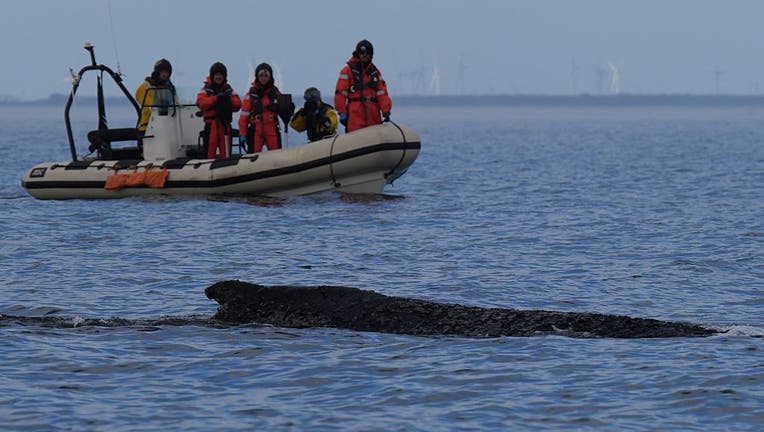
A humpback whale swims in the Baltic Sea accompanied by inflatable boats. The whale stranded in the Baltic Sea off Niendorf had freed itself the night before. The animal is now swimming in the Baltic Sea again and is accompanied by coastguard vessels
BERLIN - A humpback whale that had been rescued after spending several days trapped in shallow waters at a Baltic Sea resort in Germany became stranded once more on Saturday after being unable to navigate back to the Atlantic Ocean.
Dig deeper:
The complicated and delicate efforts to rescue the 39-49 feet whale off a sandbank at Timmendorfer Strand beach earlier this week captivated Germans — with media sending news alerts of updates on its progress and streaming live video from the scene.
The whale became a popular topic of conversation across the country, with people exchanging text messages about the rescue efforts.
An excavator was used on Thursday to dig an escape channel after earlier unsuccessful efforts to coax the whale back toward deeper water, including using coast guard and fire department boats to create large waves.
RELATED: Video: Florida cat's face-to-face encounter with gator lurking outside home
It finally swam through the man-made channel early on Friday, and rescuers lost track of it until it was spotted the following day, further east near the coastal town of Wismar, in the state of Mecklenburg-Pomerania.
Greenpeace confirmed on Saturday that the mammal had become stranded again, German news agency dpa reported.
What they're saying:
A spokesperson for Mecklenburg-Pomerania's environment ministry told dpa that "after managing to free itself from its plight, the whale was spotted again at noon today in Wismar Bay."
It was not immediately known if another rescue attempt would be mounted.
RELATED: Spiders the size of a human hand are spreading throughout the US
It is not clear why the whale swam into the Baltic Sea. Some experts pondered that the animal may have lost its way when it swam after a shoal of herring, while another theory is that the whale is likely a male, as males tend to migrate.
Why you should care:
The marine mammal cannot survive in the Baltic Sea long-term. Among other issues, the salt concentration of the water isn't high enough and the creature has already developed a skin disease, local media reported. It also won't be able to find the right kind of nutrition it needs.
If it is to survive it will need to return to the Atlantic Ocean, which is a journey of several hundred kilometers (miles) through German and Danish waters.
The Source: The Associated Press contributed to this report. The information in this story comes from a combination of official statements and media reporting in Germany. This story was reported from Los Angeles.