Flood Watch
until MON 5:00 AM MST, Eastern Cochise County below 5000 ft including Douglas/Wilcox, Upper Gila River and Aravaipa Valleys including Clifton/Safford, Southeast Pinal County including Kearny/Mammoth/Oracle, Western Pima County including Ajo/Organ Pipe Cactus National Monument, Dragoon/Mule/Huachuca and Santa Rita Mountains including Bisbee/Canelo Hills/Madera Canyon, Tucson Metro Area including Tucson/Green Valley/Marana/Vail, Tohono O'odham Nation including Sells, Baboquivari Mountains including Kitt Peak, Upper San Pedro River Valley including Sierra Vista/Benson, Chiricahua Mountains including Chiricahua National Monument, Galiuro and Pinaleno Mountains including Mount Graham, Santa Catalina and Rincon Mountains including Mount Lemmon/Summerhaven, White Mountains of Graham and Greenlee Counties including Hannagan Meadow, South Central Pinal County including Eloy/Picacho Peak State Park, Upper Santa Cruz River and Altar Valleys including Nogales, Northwest Plateau, Lake Havasu and Fort Mohave, North Phoenix/Glendale, Aguila Valley, Mazatzal Mountains, Tonopah Desert, Gila Bend, San Carlos, East Valley, Northwest Pinal County, Northwest Valley, Southeast Valley/Queen Creek, Globe/Miami, Deer Valley, Fountain Hills/East Mesa, Apache Junction/Gold Canyon, Buckeye/Avondale, Tonto Basin, Rio Verde/Salt River, South Mountain/Ahwatukee, Dripping Springs, Southeast Gila County, Pinal/Superstition Mountains, Scottsdale/Paradise Valley, New River Mesa, Sonoran Desert Natl Monument, West Pinal County, Superior, Cave Creek/New River, Central Phoenix, Yavapai County Mountains, Little Colorado River Valley in Navajo County, Western Mogollon Rim, Coconino Plateau, Chinle Valley, Yavapai County Valleys and Basins, Oak Creek and Sycamore Canyons, Grand Canyon Country, Chuska Mountains and Defiance Plateau, Northeast Plateaus and Mesas South of Hwy 264, Little Colorado River Valley in Coconino County, Black Mesa Area, Marble and Glen Canyons, Northeast Plateaus and Mesas Hwy 264 Northward, Northern Gila County, White Mountains, Kaibab Plateau, Eastern Mogollon Rim, Little Colorado River Valley in Apache County

NASA finds ‘puffiest’ planets so far: ‘Comparable to cotton candy’
Published June 26, 2026 12:59 PM MST

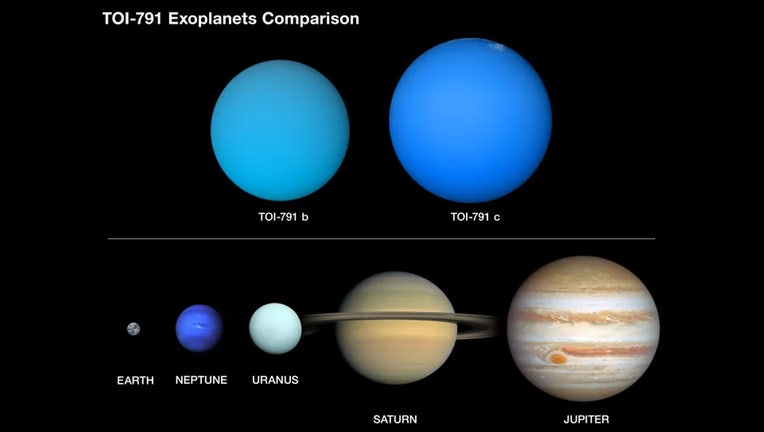
FILE - This graphic depicts the two giant planets orbiting the Sun-like star TOI-791 as compared to some of the planets in our solar system. (NASA / Daniel Rutter)

Data collected from NASA’s TESS (Transiting Exoplanet Survey Satellite) mission discovered two new "super puff" planets.

The reason why these planets are described as being "puffy" is because their density is so light – despite being huge – that they’re comparable to cotton candy, according to NASA.

Dig deeper:

The two planets have been named TOI-791 b and TOI-791 c.

They are being described as the "puffiest" worlds ever found by NASA. 

Both planets are orbiting a sun-like star named TOI-791 that is approximately 1,113 light years away from Earth.

The planets have unusually long orbits and are actually locked into an orbital pattern that allows them to pull at each other gravitationally.

By the numbers:

TOI-791 b is nearly the same size as Jupiter but it only has about 3% of Jupiter’s mass, NASA explained. 

TOI-791 c is bigger than Jupiter but only has about 5.9% of Jupiter’s mass. 

What they're saying:

"Only a handful of these super-puffy planets are known, and it is even rarer to find two in the same system," said lead author George Dransfield of Oxford  University’s Department of Physics in Oxford, England. "Their extremely low densities make them fascinating targets for understanding how planetary systems form and evolve."

What's next:

Scientists hope that further study of these puffy planets can inform us about planetary evolution. 

The Source: Information for this article was taken from a NASA news release published on June 24, 2026. This story was reported from San Jose. 

Air and SpaceScienceU.S.News