

Sweden close to becoming first 'smoke-free' country in Europe
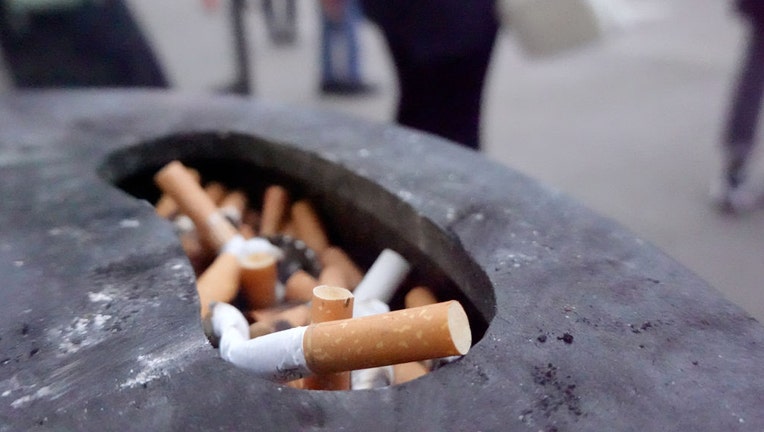
FILE - Cigarette butts sit in an ashtray at a bus stop. (Photo by Marcus Brandt/picture alliance via Getty Images)
STOCKHOLM - Summer is in the air, cigarette smoke is not, in Sweden's outdoor bars and restaurants.
As the World Health Organization marked "World No Tobacco Day" on Wednesday, Sweden, which has the lowest rate of smoking in the Europe Union, is close to declaring itself "smoke-free" — defined as having fewer than 5% daily smokers in the population.
Many experts give credit to decades of anti-smoking campaigns and legislation, while others point to the prevalence of "snus," a smokeless tobacco product that is banned elsewhere in the EU but is marketed in Sweden as an alternative to cigarettes.
Whatever the reason, the 5% milestone is now within reach. Only 6.4% of Swedes over 15 were daily smokers in 2019, the lowest in the EU and far below the average of 18.5% across the 27-nation bloc, according to the Eurostat statistics agency.
Figures from the Public Health Agency of Sweden show the smoking rate has continued to fall since then, reaching 5.6% last year.
"We like a healthy way to live, I think that’s the reason," said Carina Astorsson, a Stockholm resident. Smoking never interested her, she added, because "I don’t like the smell; I want to take care of my body."

Study suggests cigarette smokers live in more pain
The study was linked to increased levels of pain — even after quitting.
The risks of smoking appear well understood among health-conscious Swedes, including younger generations. Twenty years ago, almost 20% of the population were smokers — which was a low rate globally at the time. Since then, measures to discourage smoking have brought down smoking rates across Europe, including bans on smoking in restaurants.
France saw record drops in smoking rates from 2014 to 2019 but that success hit a plateau during the height of the COVID-19 pandemic — blamed in part for causing stresses that drove people to light up. About one-third of people aged 18 to 75 in France professed to having smoked in 2021 — a slight increase on 2019. About a quarter smoke daily.
Sweden has gone further than most to stamp out cigarettes, and says it’s resulted in a range of health benefits, including a relatively low rate of lung cancer.
"We were early in restricting smoking in public spaces, first in school playgrounds and after-school centers, and later in restaurants, outdoor cafes and public places such as bus stations," said Ulrika Årehed, secretary-general of the Swedish Cancer Society. "In parallel, taxes on cigarettes and strict restrictions on the marketing of these products have played an important role."
She added that "Sweden is not there yet," noting that the proportion of smokers is higher in disadvantaged socio-economic groups.

Cigarette smoking in the US fell to an all-time low in 2018
The CDC first began collecting data on prevalence of cigarette use in 1965, and 2018 marked the lowest rate of cigarette use since.
The sight of people lighting up is becoming increasingly rare in the country of 10.5 million. Smoking is prohibited at bus stops and train platforms and outside the entrances of hospitals and other public buildings. Like in most of Europe, smoking isn’t allowed inside bars and restaurants, but since 2019 Sweden’s smoking ban also applies to their outdoor seating areas.
On Tuesday night, the terraces of Stockholm were full of people enjoying food and drinks in the late-setting sun. There was no sign of cigarettes, but cans of snus could be spotted on some tables. Between beers, some patrons stuffed small pouches of the moist tobacco under their upper lips.
Swedish snus makers have long held up their product as a less harmful alternative to smoking and claim credit for the country’s declining smoking rates. But Swedish health authorities are reluctant to advise smokers to switch to snus, another highly addictive nicotine product.
"I don’t see any reason to put two harmful products up against each other," Årehed said. "It is true that smoking is more harmful than most things you can do, including snus. But that said, there are many health risks even with snus."
RELATED: Cases of human metapneumovirus spiked this spring, CDC says – what is it?
Some studies have linked snus to increased risk of heart disease, diabetes and premature births if used during pregnancy.
Swedes are so fond of their snus, a distant cousin of dipping tobacco in the United States, that they demanded an exemption to the EU’s ban on smokeless tobacco when they joined the bloc in 1995.
"It’s part of the Swedish culture, it’s like the Swedish equivalent of Italian Parma ham or any other cultural habit," said Patrik Hildingsson, a spokesman for Swedish Match, Sweden’s top snus maker, which was acquired by tobacco giant Philip Morris last year.
He said policymakers should encourage the tobacco industry to develop less harmful alternatives to smoking such as snus and e-cigarettes.
"I mean, 1.2 billion smokers are still out there in the world. Some 100 million people smoke daily in the EU. And I think we can (only) go so far with policymaking regulations," he said. "You will need to give the smokers other less harmful alternatives, and a range of them."
WHO, the U.N. health agency, says Turkmenistan, with a rate of tobacco use below 5%, is ahead of Sweden when it comes to phasing out smoking, but notes that’s largely due to smoking being almost nonexistent among women. For men the rate is 7%.
WHO attributes Sweden’s declining smoking rate to a combination of tobacco control measures, including information campaigns, advertising bans and "cessation support" for those wishing to quit tobacco. However, the agency noted that Sweden’s tobacco use is at more than 20% of the adult population, similar to the global average, when you include snus and similar products.
"Switching from one harmful product to another is not a solution," WHO said in an email. "Promoting a so-called ‘harm reduction approach’ to smoking is another way the tobacco industry is trying to mislead people about the inherently dangerous nature of these products."
Tove Marina Sohlberg, a researcher at Stockholm University’s Department of Public Health Sciences, said Sweden’s anti-smoking policies have had the effect of stigmatizing smoking and smokers, pushing them away from public spaces into backyards and designated smoking areas.
"We are sending signals to the smokers that this is not accepted by society," she said.
Paul Monja, one of Stockholm’s few remaining smokers, reflected on his habit while getting ready to light up.
"It’s an addiction, one that I aim to stop at some point," he said. "Maybe not today, perhaps tomorrow."
RELATED: Poor eating habits in college can lead to long-term health problems, study suggests
___
Associated Press writer John Leicester in Paris contributed to this report.