

Alzheimer's drugs may enter brain faster with new ultrasound tool, study finds
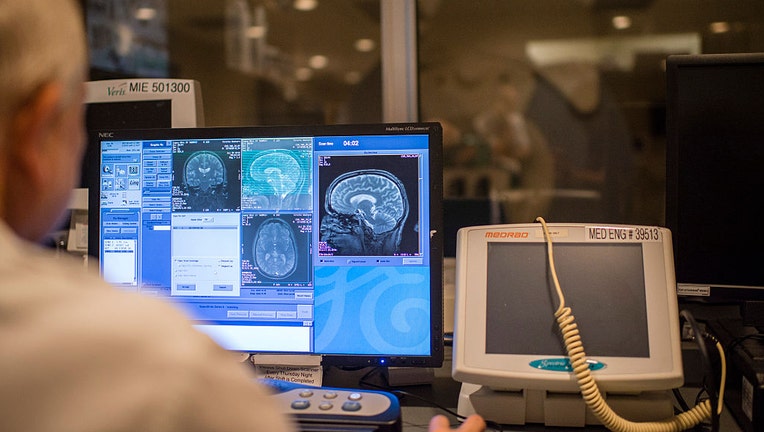
FILE-A doctor reviews brain scan images taken at an MRI room at a hospital. (Brian B. Bettencourt/Toronto Star via Getty Images)
WASHINGTON - Scientists have found a way to help Alzheimer’s drugs seep inside the brain faster — by temporarily breaching its protective shield.
The novel experiment was a first attempt on just three patients. But in spots in the brain where the new technology took aim, it enhanced removal of Alzheimer’s trademark brain-clogging plaque, researchers reported Wednesday.
"Our goal is to give patients a head start," by boosting some new Alzheimer’s treatments that take a long time to work, said Dr. Ali Rezai of West Virginia University’s Rockefeller Neuroscience Institute, who led the study.
At issue is what’s called the blood-brain barrier, a protective lining in blood vessels that prevents germs and other damaging substances from leaching into brain from the bloodstream. But it also can block drugs for Alzheimer’s, tumors and other neurologic diseases, requiring higher doses for longer periods for enough to reach their target inside the brain.
RELATED: First Alzheimer's disease risk assessment blood test for consumers hits market

5 healthy lifestyle habits identified as lowering Alzheimer's risk
A combination of physical activity, not smoking, light alcohol consumption, a good diet and cognitive activities may help lower the risk of the disease by as much as 60 percent, a study found.
Now scientists are using a technology called focused ultrasound to jiggle temporary openings in that shield. They inject microscopic bubbles into the bloodstream. Next, they beam sound waves through a helmetlike device to a precise brain area. The pulses of energy vibrate the microbubbles, which loosen gaps in the barrier enough for medications to slip in.
Prior small studies have found the technology can safely poke tiny holes that seal up in 48 hours. Now Rezai’s team has gone a step further — administering an Alzheimer’s drug at the same time.
Some new Alzheimer’s drugs, on the market or in the pipeline, promise to modestly slow worsening of the mind-robbing disease. They're designed to clear away a sticky protein called beta-amyloid that builds up in certain brain regions. But they require IV infusions every few weeks for at least 18 months.
RELATED: Alzheimer's drug Leqembi could roll out to certain US health care systems in next few months
"Why not try to clear the plaques within a few months?" Rezai said, his rationale for the proof-of-concept study.
His team gave three patients with mild Alzheimer's monthly doses of one such drug, Aduhelm, for six months. Right after each IV, researchers aimed the focused ultrasound on a specific amyloid-clogged part of each patient’s brain, opening the blood brain-barrier so more of that day’s dose might enter that spot.
PET scans show patients’ amyloid levels before and after the six months of medication. There was about 32% greater plaque reduction in spots where the blood-brain barrier was breached compared to the same region on the brain’s opposite side, researchers reported in the New England Journal of Medicine.
This pilot study is elegant but too tiny to draw any conclusions, cautioned Dr. Eliezer Masliah of the National Institute on Aging.
Still, "it's very exciting, compelling data," added Masliah, who wasn’t involved with the research. "It opens the door for more extensive, larger studies definitely."
Rezai is about to begin another small test of a similar but better proven drug named Leqembi. Eventually large studies would be needed to tell if combining focused ultrasound with Alzheimer’s drugs makes a real difference for patients.
Masliah said it's also important to closely check whether speedier plaque reduction might increase the risk of a rare but worrisome side effect of these new drugs — bleeding and swelling in the brain.
Alzheimer’s isn’t the only target. Other researchers are testing if breaching the blood-brain barrier could allow more chemotherapy to reach brain tumors, and ways to target other diseases.
The Associated Press Health and Science Department receives support from the Howard Hughes Medical Institute’s Science and Educational Media Group. The AP is solely responsible for all content.