

Dartmouth provost resigns after AI detector flags his writing
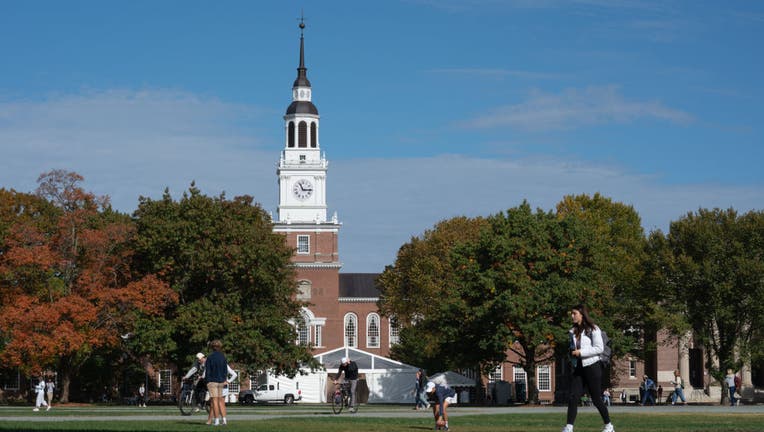
Baker-Berry Library on the campus of Dartmouth College in Hanover, New Hampshire, U.S., on Friday, Oct. 15, 2021. Photographer: Bing Guan/Bloomberg via Getty Images
A top Dartmouth College administrator resigned after a faculty committee found he used artificial intelligence to help write materials, including a Washington Post guest column about AI cheating.
The announcement Wednesday of Provost Santiago Schnell’s departure from the Ivy League university comes as colleges across the country grapple with how to transform teaching as more assignments can be completed with AI tools.
Dartmouth touts itself as the birthplace of AI, saying the field got its start at the school in Hanover, New Hampshire, in 1956 when a small group of scientists gathered for a summer research project on the topic. A conference commemorating the 70th anniversary — titled "What Must Remain Human?" — began Thursday.
How artificial intelligence can impact defense spending
Zane Mountcastle, CEO of Picogrid, joins LiveNOW from FOX to talk about how artificial intelligence can impact defense spending.
What they're saying:
University President Sian Leah Beilock said in a written statement that keeping Dartmouth at the forefront of AI means "leading through an environment that is fluid and fast-changing."
"That is why, as leaders, it is so critical that we model the transparency and human judgment that we expect from our students and scholars," the president wrote, adding that Schnell’s departure was "his decision" and that the school wishes him well.
RELATED: Linda McMahon plans to 'fire' herself from the Department of Education: Here's why
The other side:
Schnell referred questions to his attorneys, who didn’t immediately respond to an email from The Associated Press seeking comment.
Dig deeper:
Issues arose after the news outlet Semafor ran guest columns in major newspapers through an AI filter. Schnell’s August column in the Post, titled "Universities are fighting AI cheating. But there’s a deeper problem," was found to be entirely written by AI.
Schnell defended himself, saying at the time he used ChatGPT to "refine a few arguments" but that the column was based on his "own thinking."
The college paper, The Dartmouth, then ran other publications from Schnell through an AI detector. Writing that predated ChatGPT’s 2022 public release was found to be human-written, but high rates of AI use were detected in his recent writing.
Schnell told the paper in an email last month that he uses AI for "language refinement, copyediting, improving clarity and organization and making writing processes more efficient." The paper ran the statement through an AI-detector and found it was AI-written.
In a follow-up statement, Schnell told the paper that he "developed the substance and wrote a draft" of the email, then "used an AI tool to assist with language and clarity."
An investigation ensued, and the faculty committee found that Schnell used AI to "meaningfully alter his writing" and "was not forthcoming about his AI use."
The backstory:
Schnell, a Venezuelan-born mathematical biologist, previously taught and held leadership roles at the University of Notre Dame, the University of Michigan and Indiana University, according to his LinkedIn profile.
The Source: The Associated Press contributed to this report. The information came from an Associated Press report, statements from Dartmouth College President Sian Leah Beilock, comments Schnell provided to The Dartmouth, and findings from a faculty committee investigation. This story was reported from Los Angeles.