

Most US adults are declining COVID boosters as CDC warns of health risks: 'Relatively little protection'
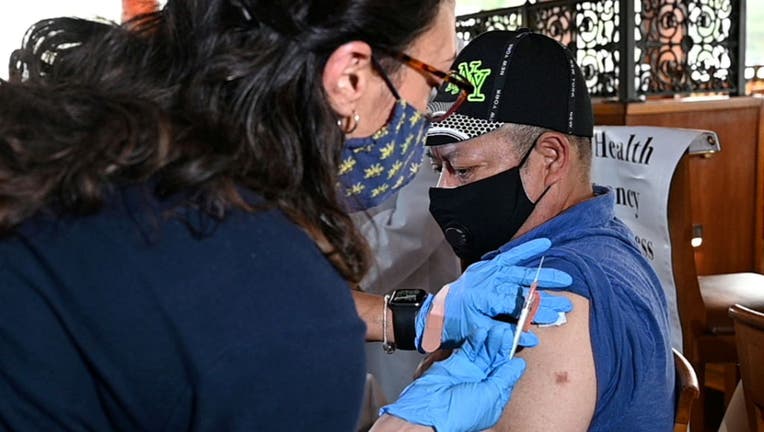
Westbury, N.Y.: Angel Human, an employee at Cafe Baci in Westbury, New York, gets his Covid-19 vaccination, on August 3, 2021, in a initiative by Nassau County Executive Laura Curran to further increase vaccinations by offering them at places of busi
Adults who aren’t current on their COVID-19 vaccine booster doses may have "relatively little remaining protection" against hospitalization compared to those who haven’t been vaccinated at all, suggests a new study from the Centers for Disease Control and Prevention (CDC).
The study spanned multiple states and examined more than 85,000 hospitalizations of people with "COVID-like illness."
Dr. Shana Johnson, a physical medicine and rehabilitation physician in Scottsdale, Arizona, was not involved in the CDC study but reviewed its findings.
PRIOR COVID INFECTION PROVIDES JUST AS MUCH PROTECTION AS VACCINES, NEW STUDY FINDS
The good news, Johnson said, is that the bivalent mRNA vaccine protects against the most severe COVID-19 outcomes, including hospitalization and critical disease (ICU admission and death), Johnson said.

COVID emergency is over, WHO says
The World Health Organization declared Friday that the COVID-19 emergency is officially over, but what does that mean? Dr. William Schaffner with Vanderbilt University joined LiveNOW from FOX's Josh Breslow to explain.
The not-so-good news: The durability or duration of protection was not great, she noted.
"For adults, the vaccine effectiveness dropped from 62% at two months after vaccination to 24% at four to six months for protection against COVID-19 hospitalization," Johnson said.
"Durability was better for preventing critical COVID-19 disease, at 50% at four to six months after vaccination."
The vaccine was found to be effective for longer periods in people without immunocompromising conditions (weakened immune systems).

President Biden signs resolution to end COVID-19 national emergency | LiveNOW from FOX
President Joe Biden on Monday signed a bipartisan congressional resolution that will end the COVID-19 national emergency. The national emergency allowed the government to take sweeping steps to respond to the virus and support the country's economic, health and welfare systems.
"These data support updated recommendations allowing additional optional bivalent COVID-19 vaccine doses for certain high-risk populations," the CDC stated in a discussion of the study findings on its website.
"All eligible persons should stay up to date with recommended COVID-19 vaccines."
Only 20% of US adults receiving booster doses
Despite the CDC’s September 2022 recommendation that all vaccinated people 12 years and older should receive a booster dose, the vast majority of Americans have not received it.
WOMEN MORE LIKELY TO SUFFER FROM ‘LONG COVID,’ BUT HEALTHY HABITS CAN LOWER THE RISK
As of May 10, 2023, only one in five (20.5%) U.S. adults had received a bivalent booster dose.

Did COVID originate in a lab?
The U.S. Department of Energy has said with "low confidence" that COVID could have originated from a lab leak in China. Dr. Karl Minges, a professor at University of New Haven, spoke with LiveNOW from FOX's Josh Breslow to break down the report.
And most of that group had received their last vaccine dose more than a year ago, the CDC reported in the study findings.
"Uptake has been quite low," Dr. Marc Siegel, professor of medicine at NYU Langone Medical Center, told Fox News Digital.
"It makes complete sense for adults — especially those in high-risk groups, including the elderly and those with chronic disease — to have a bivalent shot if they haven't already had one."
Dr. Siegel was not involved in the CDC's study.
‘COVID is still with us’
While cases and deaths continue to decline in the U.S., Siegel warned that "COVID is still with us," citing the "huge" outbreak currently happening in China.
"Here in the U.S., with XBB subvariants still predominating, we do have a lot more population immunity than China does," he noted.
CLICK HERE TO SIGN UP FOR OUR HEALTH NEWSLETTER
"That immunity is due to both prior infection as well as vaccination," he said.
"But the vaccine effect on decreasing severity or preventing long COVID is not forever — after a year, that effect has certainly declined significantly," he also said.
Vaccine provides ‘broader coverage’
"This study looked at the durability, or how long the bivalent mRNA vaccine protects people from hospitalization and critical illness from COVID-19," Johnson told Fox News Digital.
What the study did not evaluate was previous COVID-19 infection or natural immunity, she explained.
"The authors note that since a large portion of the population has experienced COVID, they have some level of protection from natural immunity, but the vaccine provides additional benefit," she said.
CLICK HERE TO GET THE FOX NEWS APP
"Natural immunity confers a benefit, but the vaccine provides broader coverage, which protects against more variants."
Read more of this story from FOX News.