

Look up: Northern lights could be visible for some upper states this week
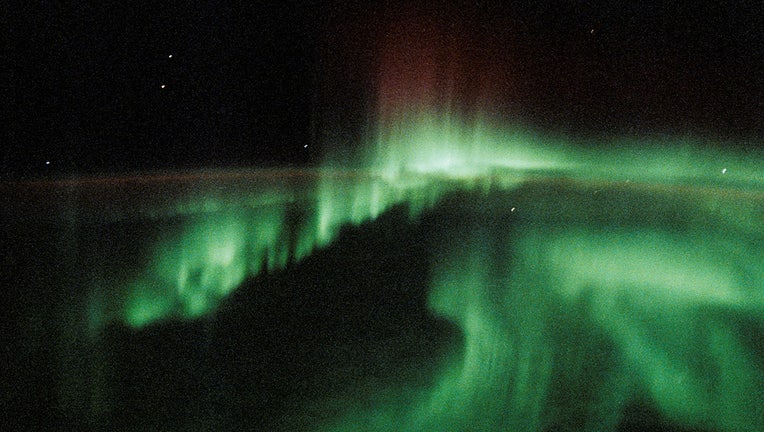
FILE - This 35mm frame represents one of the more spectacular views of Aurora Australis, photographed by the crew. The crew observed and photographed a great deal of auroral activity from the Earth-orbiting Space Shuttle Endeavour during the eight-da
Get excited sky watchers.
The Space Weather Prediction Center issued a G2 storm watch beginning tonight that could lead to potential northern lights for the upper United States.
Here’s what to know:
G2 storm watch
Dig deeper:
The National Oceanic and Atmospheric Administration’s Space Weather Prediction Center issued a G2 geomagnetic storm watch beginning March 19 - March 21.
A coronal mass ejection (CME) was observed on March 16 and the energy it emitted is making its way toward Earth.
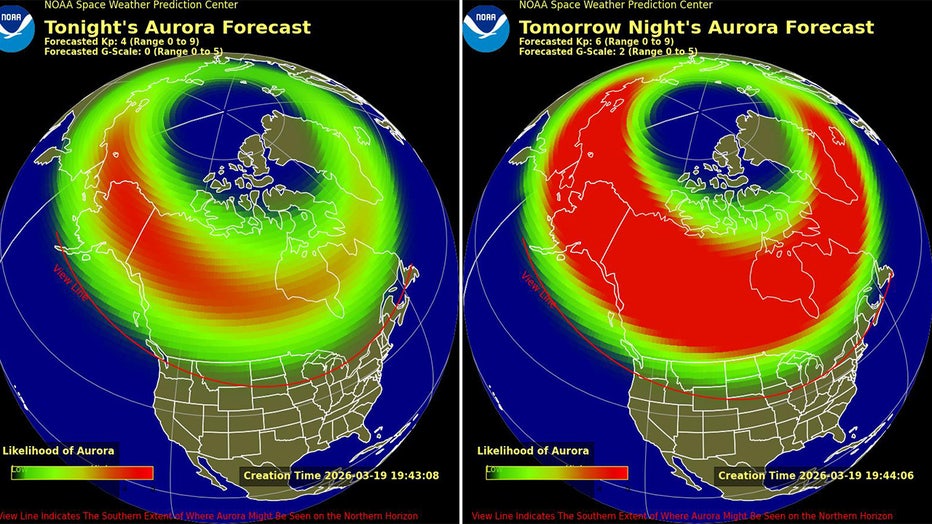
Aurora forecast for March 19 and March 20. (SWPC)
Northern lights possible
Northern lights are expected to be visible for some northern and upper Midwest states, the SWPC said.
From New York to Idaho, people could get a chance to see auroras in the night sky.
What they're saying:
"Yes - there is potential for the aurora to develop tonight (Thursday), tomorrow night (Friday), and even the next night (Saturday) - if we do observe the anticipated storm arrivals and if our forecast of a G2 level develops, this would allow the northern tier of the country to have a chance to see the northern lights," Shawn Dahl with the NOAA told FOX.

How to survive a coronal mass ejection
Most of Earth's modern power grids are more than capable of handling a large solar flare or coronal mass ejection but, what if a particularly strong space weather event took place?
Where and when to look
What you can do:
To observe the northern lights, be sure to look toward the northern horizon, Dahl advised. Attempt to find a place that has little to no light pollution and "be patient."
For even more best practices to see northern lights, click here.
The Source: Information for this article was taken from an emailed correspondence with Shawn Dahl of the NOAA and the Space Weather Prediction Center’s website dashboard. This story was reported from San Jose.