

Astronomers discover 1st green star in space as white dwarfs break color rules
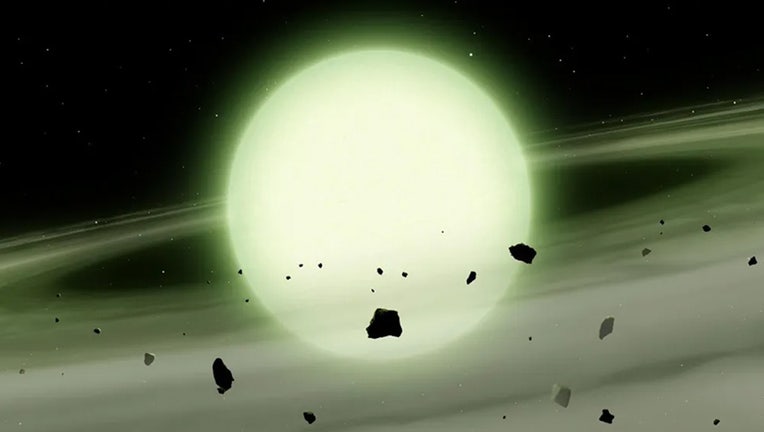
FILE - Enriched from above: The cool white dwarf WDJ1330+6435 has accreted sodium-rich rocky material from its planetary system into its atmosphere. (Credit: Mark A. Garlick/University of Warwick)
Everything you might have thought you knew about white dwarfs is about to change.
Astronomers at the University of Warwick just discovered that white dwarf stars don't just glow pale blue or white — they can shine green, pink, purple, and cyan.
Rainbow of stars
Dig deeper:
Researchers at the University of Warwick believe they have found evidence of white dwarf stars glowing in a range of colors when viewed with the naked eye.
Granted, no white dwarf star is close enough to actually see with our naked eye. However, with the use of a star's color spectrum (which is basically its ‘fingerprint’ produced when starlight is split apart by wavelength) researchers can determine what color the star would appear to the human eye.
What they're saying:
"It turns out these incredibly dense stars can produce colours nobody expected, and some of them genuinely surprised me," said Dr Mark Hollands, Warwick Prize Fellow in the Astronomy and Astrophysics Group, University of Warwick, who led the work.
A green star
The green star researchers found the most striking is called WD J1330+6435.
It’s about 4,000 degrees Celsius and is mixed with accreted rocky material from its planetary system.
This first-of-its-kind star is enriched with calcium, lithium and sodium, which is what gives it its green tinge, researchers said.
What each color shows about a star
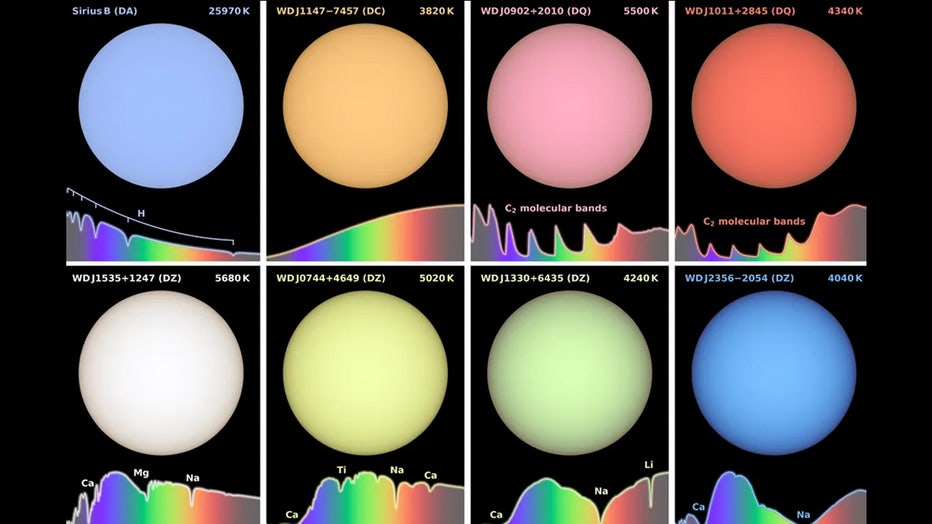
FILE - Colour-accurate simulated images of white dwarfs. (Credit: Mark Hollands/University of Warwick)
Big picture view:
Pink/purple: A white dwarf that appears pink or purple means it is carbon-rich, meaning, it’s got a lot of debris from shattered asteroids and comets.
Yellow: When a white dwarf appears yellow, this means it contains remnants of old planetary systems.
Cyan/pale blue: A white dwarf that is mixed with hydrogen and helium atmospheres will have a more cyan/light blue tinge.
The Source: Information for this article was taken from a University of Warwick news release published on Oct. 15, 2026. This story was reported from San Jose.