

Arizona monsoon 2026: Preparing for microbursts, flash floods, and haboobs

2026 Arizona monsoon outlook reveals El Niño trends
The FOX 10 Weather Experts break down atmospheric patterns, flash flood dangers, and what to expect from the 2026 summer storm season.
PHOENIX - Arizona's monsoon is the ultimate paradox: months of relentless heat shattered in an instant by Mother Nature's fury.
We're breaking down every element of Arizona's seasonal monsoon, including the wind, dust, rain, and heat. This year, the team wanted to hear from the public to test local knowledge of summer storms and try to dispel myths about the monsoon. Later, the annual monsoon outlook will attempt to predict whether 2026 can match last year's late-arriving storm activity.
What is a monsoon?
First, it is important to understand what the monsoon is. When asked if they had been through an Arizona monsoon season yet, one resident replied, "Yes, I have. Those are the scariest things I've ever seen in my life. Be ready for it. Be ready for dust storms. And then behind it comes the rain. Just be ready for it. I love my season when it hits."
The monsoon is a seasonal change in the wind pattern, a change that brings moisture to a typically very dry state. Most of the year, the wind flow is from the west, keeping the region fairly dry with periodic storm systems running past and bringing wet weather. During the summer, attention shifts to the south. Summer heating creates a dome of high pressure over Mexico that begins to shift northward by June. Eventually, the dome settles over the Four Corners region, where it wobbles around the rest of summer.
That location shifts the winds to a more southerly flow, a flow that is perfect for transporting moisture into the state. Winds flow clockwise around high pressure, grabbing upper-level moisture from the Gulf. At the same time, the southwest U.S. and northern Mexico begin to heat up more rapidly than the ocean waters nearby. That hot air rises and a thermal low develops. With counterclockwise motion, this pattern pushes low-level moisture from the Pacific and the Gulf of California toward Arizona. It is this moisture combo that gives the region its best shot at summer storms.
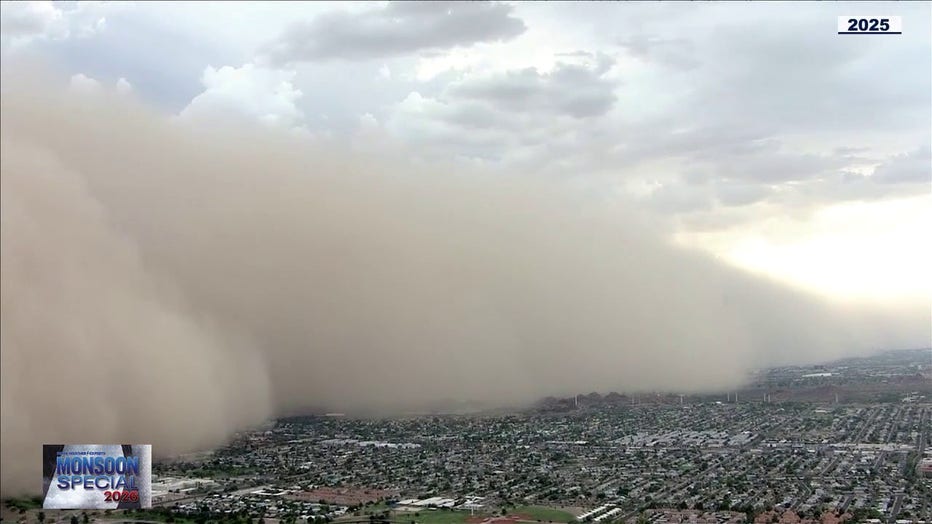
File: A "wall" of dust moves through the Phoenix metro area in 2025.
To get an idea of how unpredictable the monsoon can be, look no further than 2025. For the first few months, it felt like another monsoon with abnormally dry conditions across much of central Arizona. But it was the last third of the season that provided the most substantial monsoon moisture. In late August, a massive 5,000-foot-tall, 50-mile-wide wall of dust swallowed the southeastern Phoenix area. It brought lightning, heavy rain, and even some flash flooding.
September storms were even more dangerous. Several people were killed in Globe and Miami after the area received more than two inches of rain in less than an hour, causing massive flooding. The post-monsoon period was also very active, with the remnants of tropical storms Priscilla and Raymond dumping plenty of rain in the first few weeks of October. A supercell tracked south to north through Chandler, Guadalupe, Tempe, and Scottsdale.
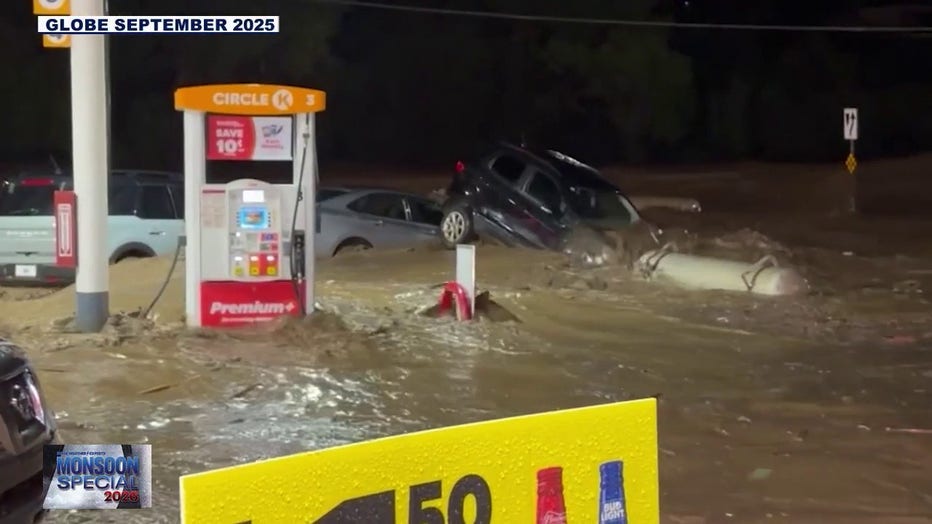
File: Monsoon damage in Globe, AZ (September 2025)
What is a microburst?
One of the most destructive elements of the monsoon are microbursts. A microburst forms within a thunderstorm, requiring a powerful updraft. An updraft is created by rising air, which allows the thunderstorm to grow taller and stronger, suspending water droplets, hail, and air. Eventually, the air cools, becoming more dense and too heavy for the updraft to support. This is when the action happens down on the ground. A column of dense air and moisture topples out of the storm, rushing to the ground in a dramatic display that often looks like a bucket of water pouring from the sky.
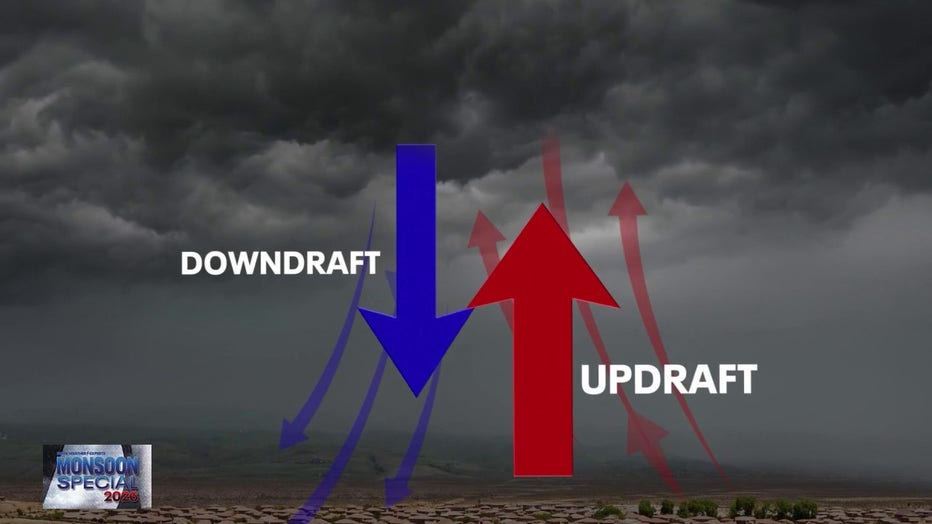
As the air and rain plummet to the surface, the air already on the ground is forced outward. The air spreads in every direction, creating a wall of damaging winds. Those winds can reach up to 100 miles per hour or stronger, the equivalent of an EF1 tornado. Microbursts are relatively small in scale, typically under 2.5 miles in diameter. But in that footprint, trees and power lines can go down. Roofs might peel off, and sometimes semi-trucks can even flip.
During a recent storm, residents found themselves caught directly in the path. "Okay, so we are in the middle of a haboob," one occupant said. Another person inside the vehicle stated, "I can see out of our headlights and my phone like the best... It's blowing up... can't see anything. We're in the middle of the Haboob. We are in our car."
What is a haboob?
A haboob is another term for a dust storm, and they happen every year in Phoenix, especially during the monsoon. It starts with sunny blue skies and a growing cloud of brown coming up on the horizon. Growing larger and taller as it comes into view, a huge wall of dust races forward until it takes over, turning day into night. Dust storms can be dramatic in Phoenix, with some climbing thousands of feet tall.
In 2025, there were several photo-worthy dust storms that happened as monsoon storms ramped up. The conditions have to be just right. When a strong thunderstorm forms, heavy rain cools the air within the storm, and this cool, dense air quickly sinks to the ground. This is called a downdraft. The downdraft hits the ground and sends cooler air in all directions away from the storm, creating what is known as an outflow boundary.
Outflow boundaries can travel hundreds of miles away from a storm. When strong storms build over the desert or the mountains adjacent to Phoenix, outflow boundaries can travel into the city, picking up loose dust and dirt along the way to form dust storms. Dust storms are common in Phoenix when outflow boundaries travel over the farmland south of the city. These dust storms are considered convective.
Dust storms can also form synoptically, which would be from a larger-scale system like a cold front. Several dust storms occur in Phoenix per year, but up until now, there has not been a way to officially distinguish their intensities. That is where the newest Phoenix dust storm scale comes into the picture.
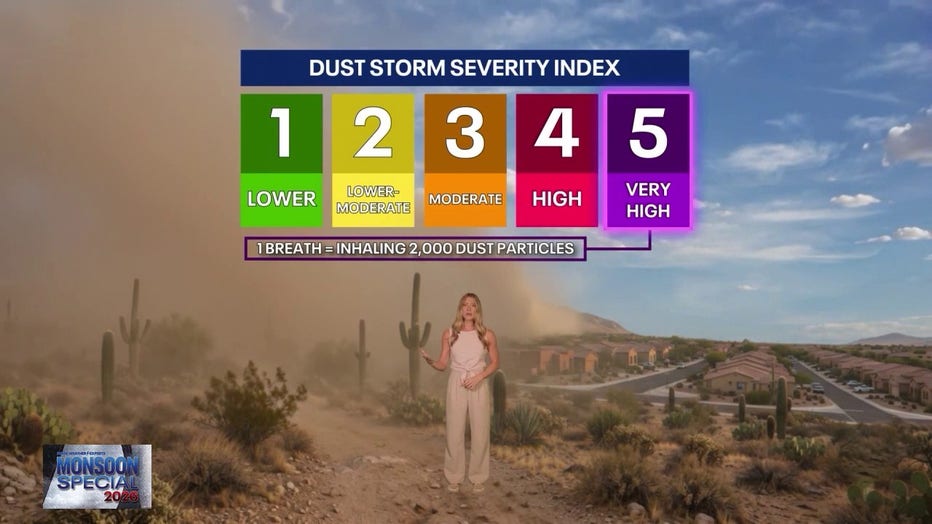
Thirteen organizations have been collaborating to create the scale, which will go active this year. Any dust storms that occur will be ranked as category one through category five. Dust storms will be ranked after the event happens, similar to the enhanced Fujita scale used for tornadoes.
What they're saying:
Dr. Ryan Heintzman, a teaching professor at Arizona State University's School of Geographical Sciences and Urban Planning, is one of 22 individuals involved.
"The purpose of the dust storm scale is to create awareness about the dust events in the Valley, looking at events that happen both during the summer monsoon season, which are usually convective with thunderstorms, or during the kind of shoulder seasons where we get synoptic events like cold fronts," Heinzman said. "And so it's a way for us to categorize that based on dust concentrations in the air when these dust storms come through."
There are also three subcategories that help define the dust storm in more depth: the duration of the event, the widespread nature of the dust, and the wind speeds. All of this information will be measured by 22 sensors across Phoenix.
"The scale is primarily based off of particulate matter concentrations," Heinzman explained. "In particular, it's PM10, which is about five to 10 lengths of the human hair, five to 10 of those pieces of dust is the diameter of a human hair. So they're very small. The primary category one concentration of dust is a thousand micrograms per cubic meter. And then a category five is five times that amount. So 5,000 micrograms per cubic meter of dust."
Micrograms per cubic meter can sound a little complicated, so the scale breaks this down into understandable terms by providing insight into how the intensity of a storm affects the air people breathe. During a category one dust storm, a person inhales about 300 particles of dust in just one breath. Standing outside for an hour during a category one event results in inhaling about 250,000 particles of dust. In a category five storm, one breath sends 2,000 particles of dirt into the lungs, totaling 1.3 million pieces of dust in one hour.
When evaluated like that, heavy dust exposure from dust storms presents clear challenges for the human body. Dr. Frank Lavecchio, an emergency physician at Valleywise Health, explained what happens when people breathe in this amount of dust.
"The body sees that, and they say, we gotta get rid of this dust," Lavecchio said. "And that leads to inflammation. So you get acute inflammation and an acute inflammation attack can lead to an attack of asthma, coughing, crying, we call it, and your nose running. We see based upon emergency department data that when PM10 rises, we see more patients in the emergency department with respiratory complaints, especially those with asthma and COPD. They're more likely to develop pneumonia, they're more likely to develop attacks during that time."
Older individuals, young children with developing lungs, anyone with asthma, chronic lung disease, or heart issues, and outdoor workers face the highest risk from dust exposure. However, across all demographics, there is a higher chance of contracting valley fever during and after dust storms. Residents can mitigate the threats of dust by staying indoors during and after dust storms, monitoring outdoor air quality, and wearing a mask if conditions are unhealthy. Those with asthma should use an inhaler before going outside. It is also important to change home air filters regularly and utilize HEPA filters.
The intense dust storm that occurred on August 25, 2025, was actually only a category two dust storm. Even though it was very tall and dark, the dust only lasted for 10 to 15 minutes before the rain cleared the air. This short-term dust exposure caused the storm to rank low on the scale. The dust storm scale will help residents understand these dust events better, opening the door to future research to benefit society, health, and the environment.
What is flash flooding?
Flash flooding can happen anywhere, from a neighborhood street to a river in the high country. It happens in Arizona during severe thunderstorms when a lot of rain falls in a short time.
In the local arid climate, the ground is parched and solid, making it hard for rapid rainfall to soak in. Instead, especially in mountainous areas, rainfall quickly runs downhill into creeks, rivers, and washes. In a matter of minutes, a normally dry riverbed can turn into a raging stream, overtaking roads, homes, or vehicles.
What's the difference between a watch and a warning?
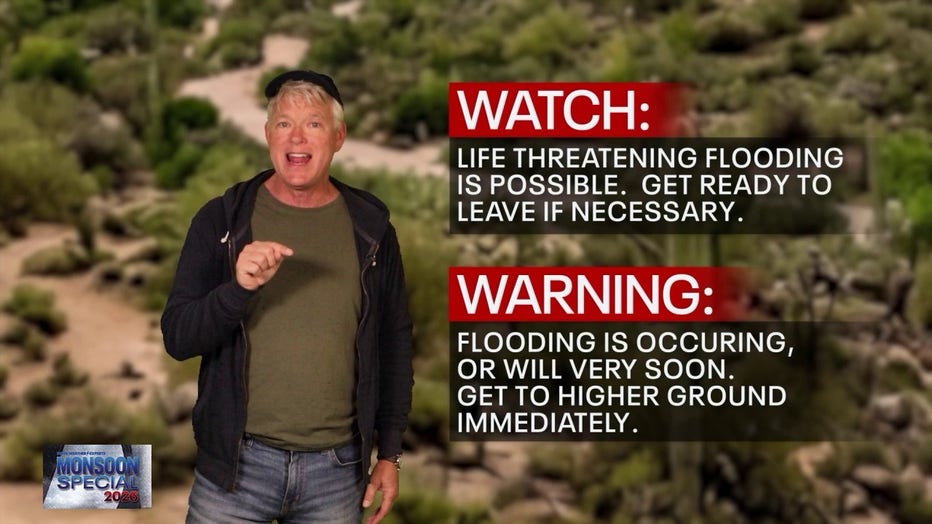
It does not take much water to become dangerous. About six inches of water can knock a person off their feet. Twelve inches of moving water is enough to lift a small car, and 24 inches of moving water will pick up an SUV or a pickup truck. Furthermore, flash flooding can occur miles away from the storm that caused it, taking drivers and hikers by surprise.
This is why weather experts always alert the public if flash flood watches or warnings are issued.
A watch alerts residents of the potential for life-threatening flooding, while a warning means the flooding is happening or will happen very soon, requiring immediate action. The quickest way to stay safe during flash flooding is to get to higher ground immediately and never cross a flooded road.
Extreme heat relief
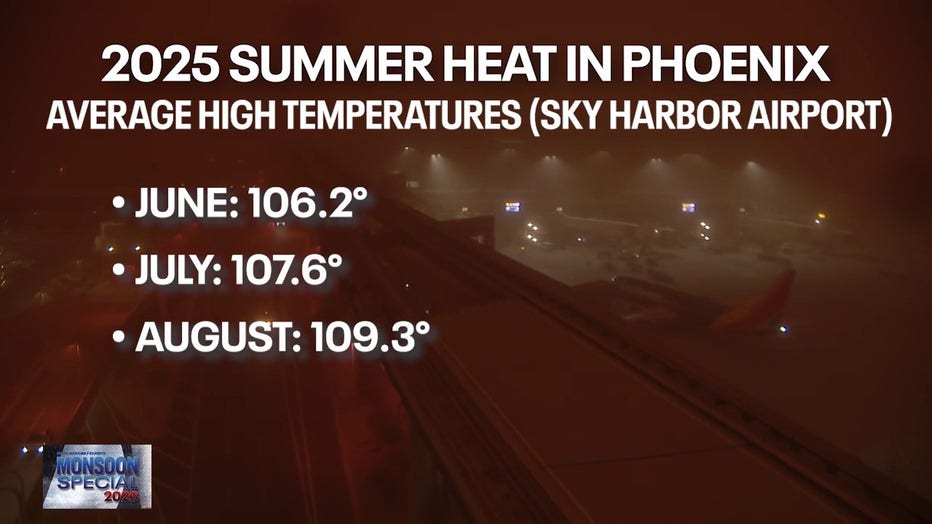
While it is well known that Arizona is hot, temperatures feel even hotter in Phoenix due to the heat island effect. This summer, local officials face extreme temperatures that can be dangerous. While the monsoon is most associated with storms, the heat can have the biggest impact on residents. Local officials have outlined nearly two dozen heat response actions to keep residents safe and cool.
A local official noted that members of the city council treat extreme heat with urgency and take an all-hands-on-deck approach. Some of those actions include creating more publicly accessible cool spaces and drinking locations. A heat respite center near Central Avenue and Jackson Street will remain open 24/7 for anyone who needs relief from the summer heat. Additionally, a number of libraries will have extended hours, such as the Cholla Library near the old Metrocenter Mall, which will stay open until 9 p.m. MST.
What you can do:
The city is also reminding hikers about the dangers of hitting the trails this summer on extreme heat days. Camelback and Piestewa Peak trails will be closed from 8 a.m. to 5 p.m. MST. This policy also applies to certain trails along South Mountain.
The Phoenix Fire Department officials advise hikers to start early or wait until the sun starts to go down, and to always drink plenty of water.
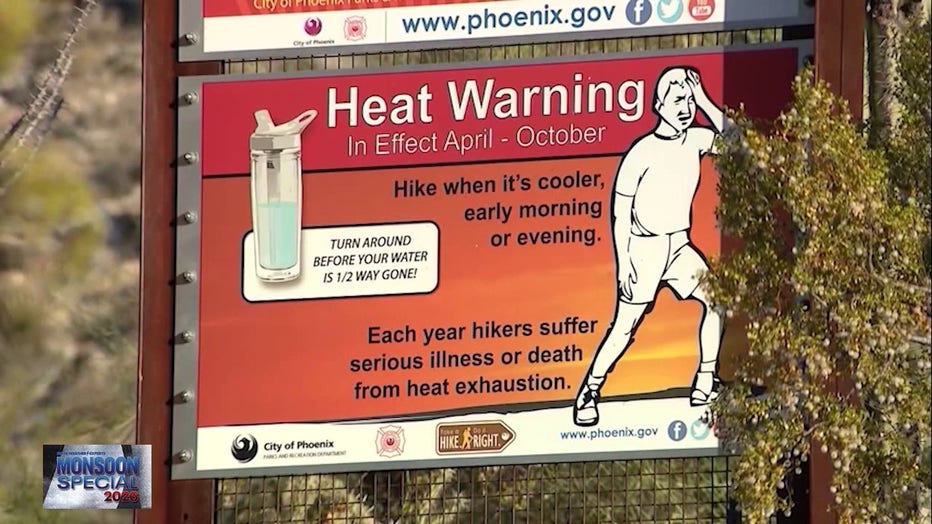
"Please, if you are going to hike, hydrate the night before," a Phoenix Fire official stated. "This is the exact same thing that we tell our firefighters."
The city of Phoenix has also teamed up with a number of nonprofits to help the unsheltered population this summer. Officials are putting a special focus on those battling addiction, since substance abuse is considered a major factor in heat-related fatalities in Phoenix. Each summer, local resource campuses serve around 1,200 people every day. The campuses feature multiple indoor spaces that act as heat relief over the summertime.
>>Map: Maricopa County heat relief network locations
To help protect the elderly population, senior centers around Phoenix will act as hydration and heat relief stations. Financial assistance is also available for seniors or low-income residents struggling with their utility bills. Arizona's attorney general is reminding landlords that AC units must remain in working condition. As part of a new deal with APS, the utility company will stop all disconnections when temperatures reach 95° degrees or hotter, regardless of the time of year.
APS settles with Arizona AG, make reforms after Sun City heath-related death
"No utility operating in this state should be allowed to cut off someone's power on a 99-degree day because of an unpaid bill" said Arizona AG Kris Mayes, as she announced a $7m settlement with APS.
"No utility operating in this state should be allowed to cut off someone's power on a 99-degree day because of an unpaid bill," Arizona Attorney General Kris Mayes emphasized.
The heat island effect
Living in the desert is hot, but living in Phoenix can be even hotter due to the urban heat island effect. The causes of an urban heat island are all around the metropolitan area. In rural areas, there is often more green space, such as trees and grass. Vegetation plays an important role in controlling temperatures for a few reasons. First, trees provide shade, which naturally keeps the surrounding area cooler. Plus, greenery leads to evapotranspiration, the process of plants and soil releasing water vapor into the air, which absorbs heat and naturally cools the surroundings.
In large cities, asphalt, concrete, metal, and glass work against cooling efforts. Vehicles and businesses emit heat. Asphalt and buildings absorb heat, keeping it at the ground level, and much of that heat is retained at night. While rural communities can effectively cool down after sunset, temperatures run considerably warmer in big cities. This is the urban heat island effect in Phoenix. It functions as a heat bubble that surrounds the city, making daytime and especially nighttime temperatures hotter than they would be without so many roads, vehicles, sidewalks, and buildings.
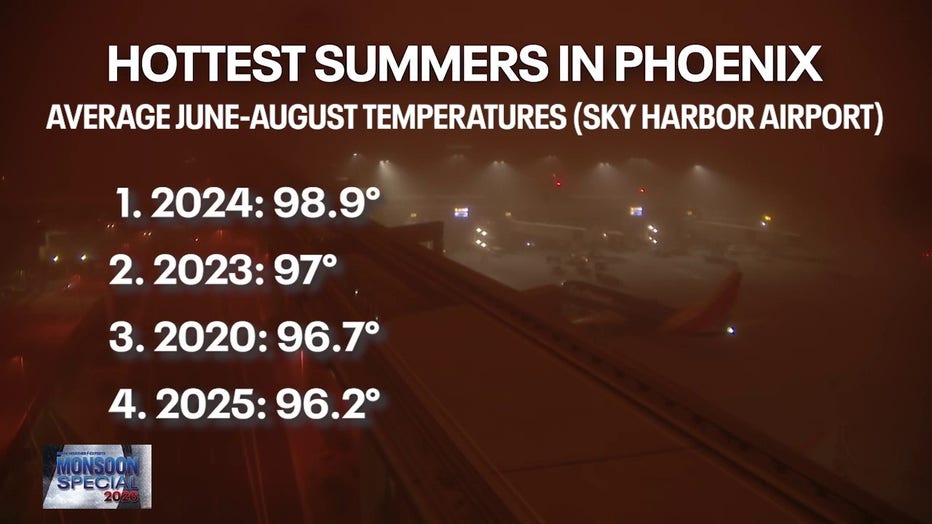
FOX 10 has crunched the data to figure out what to expect from Mother Nature this summer.
Local perspective:
Before presenting the official numbers, residents offered their own predictions.
"Uh, sure," one resident said. "I think it's going to be probably the one or the worst because it's getting hot so fast now, so I think this one that's upcoming is going to a pretty bad one. I hope we get a good one. I hope you get a good one, like I said, I love it when it's windy, storm, thunder, lightning, all kinds. I love it..it is the best, that's what I'm hoping for this year." Another person said, "I predict we will have a monsoon. It will be dusty, rainy, there will be lightning, and I predict that I will take some pictures."
What is an El Niño?
FOX 10 poured through data and tracked the latest models. There are a lot of factors at play when it comes to the monsoon forecast, beginning with El Niño. Currently, weather patterns are shifting into a neutral period, but a transition into an El Niño is forecast for this summer.
An El Niño is a global weather pattern defined by the warming of the ocean surface over the central and eastern tropical Pacific.
While El Niños more commonly impact winter precipitation trends, the team examined historical years that transitioned on roughly the same timing expected this year. The years 1976, 2006, 2009, 2018, and 2023 all met that criteria. The summer of 2015 also caught attention as the beginning of the strongest El Niño on recent record, and 2026 has the potential to become similarly strong or stronger.
Among those historical match years, three ran wetter than average, two ran below average, and one ran near average. As for temperatures, four out of the six analyzed years ran above average. This suggests there is not a clear connection between El Niños and monsoon rain, but it does point toward a hotter-than-normal summer.
Tropical moisture is the next factor. When Pacific systems approach the Southwest, the monsoon pattern is perfectly set up to push moisture over Arizona. In 2025, Hurricane Lorena assisted rain chances in early September, and Tropical Storm Mario's moisture gave the region active weather mid-month. During El Niños, there is an increased risk for Eastern Pacific tropical storm activity, meaning better chances for tropical moisture making its way to Arizona.
2026 Arizona monsoon forecast
The Climate Prediction Center's latest forecast leans toward a wetter-than-normal monsoon with hotter-than-normal temperatures. Global climate models also tend to point toward wetter weather.
Finally, regarding the timing of the season, soil moisture in the Southwest is running below normal following historically low snowpack across the West, including a disappointing showing in Arizona. Combine that with an already warm Pacific Ocean, and there is little stopping the monsoon pattern from taking shape on schedule around late June to early July.
The official FOX 10 forecast calls for warmer-than-average temperatures, which has become a summer staple in a warming climate. As for rain, a near-to-above-average season is forecast due to tropical influence. The second half of the season holds more potential for big storms, but it only takes one system to leave lasting impacts.
What's next:
Whenever the monsoon strikes, the FOX 10 Weather Center provides coverage on television, fox10phoenix.com, the FREE FOX Local app, YouTube, and TikTok.
The Source: Information in this report was gathered from interviews with Arizona residents, Dr. Ryan Heinzman of ASU's School of Geographical Sciences and Urban Planning, Dr. Frank Lavecchio of Valleywise Health, Phoenix Fire Department officials, local city council members, official climate statements from the Climate Prediction Center, and past FOX 10 storm tracking data.